CAS 14064-34-7
:Acide 4-amino-1-butanésulfonique
Description :
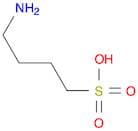
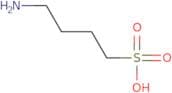
Acide 4-amino-1-butanésulfonique, communément connu sous le nom d'acide sulfonique de cystéamine, est un composé organique caractérisé par ses groupes fonctionnels amino et acide sulfonique. Il présente une structure de butane avec un groupe amino (-NH2) attaché au premier carbone et un groupe acide sulfonique (-SO3H) sur le quatrième carbone. Cette structure confère des propriétés à la fois hydrophiles et hydrophobes, le rendant soluble dans l'eau et adapté à diverses applications biochimiques. Le composé est souvent utilisé dans la synthèse de produits pharmaceutiques et comme réactif biochimique en raison de sa capacité à agir comme agent réducteur et de son rôle dans le métabolisme cellulaire. Il est également connu pour ses potentielles propriétés antioxydantes. En termes de sécurité, comme de nombreux acides sulfonés, il doit être manipulé avec précaution, car il peut provoquer des irritations de la peau et des yeux. Dans l'ensemble, Acide 4-amino-1-butanésulfonique est un composé polyvalent d'une grande pertinence tant dans la recherche que dans les applications industrielles.
Formule :C4H11NO3S
InChI :InChI=1S/C4H11NO3S/c5-3-1-2-4-9(6,7)8/h1-5H2,(H,6,7,8)
Code InChI :InChIKey=KNILZINKISHVIQ-UHFFFAOYSA-N
SMILES :C(S(=O)(=O)O)CCCN
Synonymes :- 1-Butanesulfonic acid, 4-amino-
- 4-Amino-1-butanesulfonic acid
- δ-Aminobutylsulfonic acid
- 1-Amino-4-sulfobutane
- 4-Aminobutanesulfonic acid
Trier par
Degré de pureté (%)
0
100
|
0
|
50
|
90
|
95
|
100
2 produits concernés.
4-Aminobutane-1-sulfonic acid
CAS :4-Aminobutane-1-sulfonic acid is a drug that has been shown to inhibit the growth of cancer cells in vitro. It binds to sulfonic acid groups, which are found on the surface of many cancer cells, and inhibits cell growth by preventing the formation of hydrogen bonds between water and proteins. The affinity of 4-aminobutane-1-sulfonic acid for different tissues has been quantified using human lung tissue. This drug may be a promising therapeutic agent for cancer because it can be used at low concentrations. It has been shown to have an anticancer effect on A549 cells in vitro. Nuclear magnetic resonance spectroscopy was used to investigate the binding mode of 4-aminobutane-1-sulfonic acid with respect to its parameters such as activation energies and distances.Formule :C4H11NO3SDegré de pureté :Min. 95%Masse moléculaire :153.2 g/mol