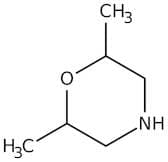
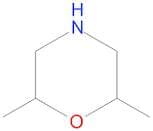
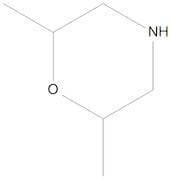
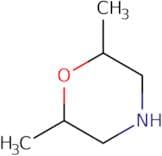
CAS 141-91-3
:2,6-Diméthylmorpholine
- (2R,6S)-2,6-dimethylmorpholine
- (2S,6S)-2,6-dimethylmorpholine
- 2,6-2-Methyl Morpholine
- Dimethylmorpholine
- Morpholine, 2,6-dimethyl-
- NSC 60704
- 2,6-Dimethylmorpholine
2,6-Dimethylmorpholine, cis + trans, 97%
CAS :This Thermo Scientific Chemicals brand product was originally part of the Alfa Aesar product portfolio. Some documentation and label information may refer to the legacy brand. The original Alfa Aesar product / item code or SKU reference has not changed as a part of the brand transition to Thermo Sci
Formule :C6H13NODegré de pureté :97%Couleur et forme :Clear colorless, LiquidMasse moléculaire :115.182,6-Dimethylmorpholine
CAS :2,6-DimethylmorpholineDegré de pureté :≥95%Masse moléculaire :115.17g/mol2,6-Dimethylmorpholine
CAS :Produit contrôléApplications 2,6-Dimethylmorpholine is used as a reagent in the synthesis of novel 3-(difluoromethyl)-1-methyl-1H-pyrazole-4-carboxylic acid amides which can exhibit antifungal activity. 2,6-Dimethylmorpholine is also used towards the synthesis of tetrahydrothiazolopyridine derivatives as potent smoothened antagonists.
Not a dangerous good if item is equal to or less than 1g/ml and there is less than 100g/ml in the package
References Du, S., et al.: Molecules, 20, 8395 (2015); Du, S., et al.: Molecules, 20, 4071 (2015); Ma, H., et al.: Eur. J. Med. Chem., 89, 721 (2015)Formule :C6H13NOCouleur et forme :NeatMasse moléculaire :115.1742,6-Dimethylmorpholine
CAS :2,6-Dimethylmorpholine is an organic compound that has two isomers: 2,6-dimethylaniline and 2,6-diethylaniline. The higher melting point of the 2,6-dimethylaniline isomer makes it more likely to crystallize out. It also has a lower inhibition activity than the 2,6-diethylaniline isomer. This compound has been used as corrosion inhibitor in petroleum products and as a surfactant in detergents. This chemical can be used to produce enantiomers of chiral drugs such as thalidomide and erythromycin by using an acid catalyst. 2,6-Dimethylmorpholine reacts with sodium hydroxide solution to form sodium salt of 2,6-dimethylaniline. The reaction time for this reaction can be optimized by changing the concentration of sodium hydroxide solution or using a different catalyst such as zinc chloride or copper
Formule :C6H13NODegré de pureté :Min. 95%Masse moléculaire :115.17 g/mol