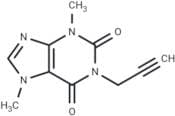
CAS 14114-46-6
:3,7-Diméthyl-1-propargylxanthine
Description :
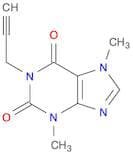
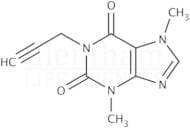
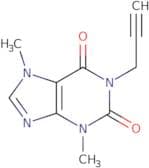
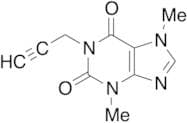
3,7-Diméthyl-1-propargylxanthine, avec le numéro CAS 14114-46-6, est un dérivé de xanthine qui présente des modifications structurelles typiques de cette classe de composés. Il possède un squelette de xanthine, caractérisé par une structure bicyclique fusionnée contenant des atomes d'azote. La présence de deux groupes méthyle aux positions 3 et 7, ainsi qu'un groupe propargylique à la position 1, contribue à ses propriétés chimiques uniques et à son activité biologique. Ce composé est connu pour son potentiel en tant qu'inhibiteur de la phosphodiestérase, ce qui peut influencer les voies de signalisation cellulaire en augmentant les niveaux de nucléotides cycliques. En conséquence, il peut avoir des implications dans divers domaines thérapeutiques, y compris les troubles cardiovasculaires et neurologiques. La solubilité et la stabilité de 3,7-Diméthyl-1-propargylxanthine peuvent varier en fonction du solvant et des conditions, ce qui est important pour son application dans la recherche et son utilisation médicinale potentielle. Dans l'ensemble, ses caractéristiques structurelles et son activité biologique en font un composé d'intérêt dans les études pharmacologiques.
Formule :C10H10N4O2
InChI :InChI=1S/C10H10N4O2/c1-4-5-14-9(15)7-8(11-6-12(7)2)13(3)10(14)16/h1,6H,5H2,2-3H3
Code InChI :InChIKey=IORPOFJLSIHJOG-UHFFFAOYSA-N
SMILES :O=C1C2=C(N(C)C(=O)N1CC#C)N=CN2C
Synonymes :- 1H-Purine-2,6-dione, 3,7-dihydro-3,7-dimethyl-1-(2-propynyl)-
- 3,7-Dihydro-3,7-dimethyl-1-(2-propyn-1-yl)-1H-purine-2,6-dione
- 3,7-Dimethyl-1-propargylxanthine
- 1H-Purine-2,6-dione, 3,7-dihydro-3,7-dimethyl-1-(2-propyn-1-yl)-
- Theobromine, 1-(2-propynyl)-
Trier par
Degré de pureté (%)
0
100
|
0
|
50
|
90
|
95
|
100
6 produits concernés.
3,7-Dimethyl-1-Propargylxanthine
CAS :Formule :C10H10N4O2Degré de pureté :98%Couleur et forme :SolidMasse moléculaire :218.21203,7-Dimethyl-1-propargylxanthine
CAS :Produit contrôlé3,7-Dimethyl-1-propargylxanthine is a cyclase inhibitor that has been shown to have pharmacological effects. It has been shown to be effective in vivo models of Parkinson's disease and has reduced locomotor activity. This drug also inhibits the production of adenosine and dopamine, leading to neuronal death. The 3,7-dimethyl-1-propargylxanthine shows high selectivity for adenosine A3 receptors and is an antagonist at these receptors. It prevents mitochondrial membrane potential from decreasing, which may be due to inhibition of the production of reactive oxygen species by mitochondria. 3,7-Dimethyl-1-propargylxanthine also inhibits platelet aggregation by blocking the activation of phospholipase C and enhances platelet aggregation by inhibiting phosphodiesterase activity.Formule :C10H10N4O2Degré de pureté :Min. 95%Couleur et forme :PowderMasse moléculaire :218.21 g/mol3,7-Dimethyl-1-propargylxanthine
CAS :Produit contrôléApplications A selective A2 adenosine receptor antagonist. Pharmacology: Ki vs [3H]NECA at A2 receptors in rat striatal membranes: 11± 3 uM; Ki vs [3H]CHA at A1 receptors in rat cerebral cortical membranes: 45 ± 4 uM.
References Alfinito, P., et al.: J. Neurosci., 23, 10982 (2003), Golembiowska, K., et al.: Neuropharmacol., 47, 414 (2004), Solinas, M., et al.: Psychopharmacol., 179, 576 (2005), Panjehpour, M., et al.: Oncol. Res., 16, 575 (2007),Formule :C10H10N4O2Couleur et forme :NeatMasse moléculaire :218.21DMPX
CAS :DMPX (3,7-Dimethyl-1-propargylxanthine) is a caffeine-like compound capable of crossing the blood-brain barrier. It serves as an A2-selective adenosine receptor (AR) antagonist, effectively and selectively blocking the hypothermia and behavioral inhibition induced by A2 adenosine receptor agonists, such as NECA. DMPX is utilized in research on diseases like Parkinson's disease.Formule :C10H10N4O2Couleur et forme :SolidMasse moléculaire :218.212