CAS 14133-90-5
:Chlorhydrate de 4-hydroxypropranolol
Description :
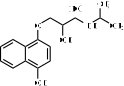
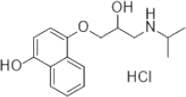
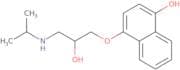
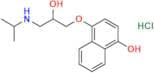
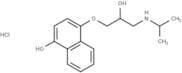
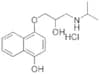
Chlorhydrate de 4-hydroxypropranolol est un composé pharmaceutique qui agit comme un bêta-bloquant, principalement utilisé dans le traitement des affections cardiovasculaires telles que l'hypertension et l'anxiété. C'est un dérivé du propranolol, caractérisé par la présence d'un groupe hydroxyle en position quatre de l'anneau aromatique. Cette modification améliore ses propriétés pharmacologiques. Le composé est généralement présenté sous forme de poudre cristalline blanche à blanc cassé, soluble dans l'eau et l'alcool, ce qui facilite son administration dans diverses formulations. Sa structure moléculaire comprend un anneau de naphtalène, une chaîne latérale d'isopropanol et une forme de sel chlorhydrate, ce qui aide à sa stabilité et à sa biodisponibilité. Le composé présente une gamme d'activités biologiques, y compris l'inhibition des récepteurs bêta-adrénergiques, entraînant une diminution de la fréquence cardiaque et de la pression artérielle. De plus, il peut avoir des applications dans la gestion de la prophylaxie de la migraine et de certains types de tremblements. Comme pour de nombreux médicaments, il est essentiel de prendre en compte les effets secondaires potentiels et les contre-indications lors de la prescription ou de l'utilisation de cette substance.
Formule :C16H21NO3·ClH
InChI :InChI=1S/C16H21NO3.ClH/c1-11(2)17-9-12(18)10-20-16-8-7-15(19)13-5-3-4-6-14(13)16;/h3-8,11-12,17-19H,9-10H2,1-2H3;1H
Code InChI :InChIKey=ROUJENUXWIFONU-UHFFFAOYSA-N
SMILES :O(CC(CNC(C)C)O)C=1C2=C(C(O)=CC1)C=CC=C2.Cl
Synonymes :- (R)-4-Hydroxy Propranolol Hydrochloride
- (S)-4-Hydroxy Propranolol Hydrochloride
- 1-Naphthalenol, 4-[2-hydroxy-3-[(1-methylethyl)amino]propoxy]-, hydrochloride
- 1-Naphthalenol, 4-[2-hydroxy-3-[(1-methylethyl)amino]propoxy]-, hydrochloride (1:1)
- 2-Propanol, 1-[(4-hydroxy-1-naphthyl)oxy]-3-(isopropylamino)-, hydrochloride
- 4-Hydroxypropranolol Hydrochloride
- 4-[(2R)-2-Hydroxy-3-[(1-methylethyl)amino]propoxy]-1-naphthalenol Hydrochloride
- 4-[(2S)-2-Hydroxy-3-[(1-methylethyl)amino]propoxy]-1-naphthalenol Hydrochloride
Trier par
Degré de pureté (%)
0
100
|
0
|
50
|
90
|
95
|
100
6 produits concernés.
4-Hydroxy Propranolol HCl
CAS :Formule :C16H21NO3·HClCouleur et forme :Off-White SolidMasse moléculaire :275.35 36.46(±)-4-Hydroxypropranolol HCl (unlabelled)
CAS :Couleur et forme :White SolidMasse moléculaire :311.81rac-4-Hydroxy Propranolol Hydrochloride
CAS :Stability Hygroscopic
Applications rac-4-Hydroxy Propranolol Hydrochloride is a metabolite of Propranolol.
References Walle, T., et al.: Drug Metab. Dispos., 13, 204 (1985), Mason, R., et al.: J. Med. Chem., 34, 869 (1991), Anderson, R., et al.: Biochem. Pharmacol., 52, 341 (1996), Hung, D., et al.: J. Pharmacol. Exp. Ther., 297, 780 (2001),Formule :C16H21NO3·ClHCouleur et forme :NeatMasse moléculaire :311.80(+/-)-4-Hydroxy propranolol hydrochloride
CAS :(+/-)-4-Hydroxy propranolol hydrochloride is a metabolite of the drug propranolol and was identified as an inhibitor of NADPH-cytochrome P450 reductase in rat liver microsomes. It inhibits the activity of this enzyme by binding to it, preventing the reduction of cytochrome P450 and thus inhibiting the metabolism of other drugs. (+/-)-4-Hydroxy propranolol hydrochloride has been shown to be effective against Aerobacter aerogenes, which belongs to a group of bacteria that are resistant to penicillin, ampicillin, and erythromycin. This compound is also glucuronidated in humans, but not in animals such as rats. This compound has been shown to be a useful experimental model for testing the effects of propranolol.Formule :C16H22ClNO3Degré de pureté :Min. 98 Area-%Couleur et forme :PowderMasse moléculaire :311.8 g/mol4-Hydroxypropranolol hydrochloride
CAS :4-Hydroxypropranolol hydrochloride is an active metabolite of Propranolol, with a potency comparable to Propranolol. It inhibits β1- and β2-adrenergic receptors (pA2s: 8.24 and 8.26).Formule :C16H22ClNO3Degré de pureté :98%Couleur et forme :SolidMasse moléculaire :311.8