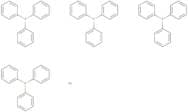
CAS 14221-02-4
:Tétrakis(triphénylphosphine)platine
Description :
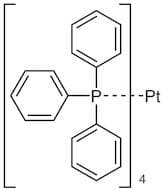
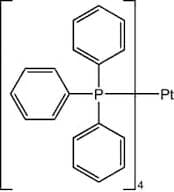
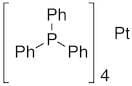
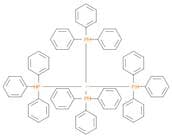
Tétrakis(triphénylphosphine)platine, avec le numéro CAS 14221-02-4, est un composé de coordination présentant du platine comme atome central métallique coordonné à quatre ligands de triphénylphosphine. Ce complexe est généralement caractérisé par sa géométrie carrée plane, qui est courante pour les complexes de platine(II). La présence des ligands volumineux de triphénylphosphine confère une hindrance stérique significative, influençant la réactivité et la stabilité du composé. Tétrakis(triphénylphosphine)platine est souvent utilisé dans diverses applications, y compris la catalyse, la synthèse organique et comme précurseur dans la préparation d'autres complexes de platine. Il présente une solubilité notable dans les solvants organiques, ce qui le rend adapté aux réactions dans des environnements non aqueux. De plus, le composé peut afficher des propriétés électroniques intéressantes en raison des interactions entre le centre de platine et les ligands de phosphine, ce qui peut affecter son comportement dans les processus catalytiques. Dans l'ensemble, Tétrakis(triphénylphosphine)platine est un composé important en chimie de coordination et en chimie organométallique, avec diverses applications dans la recherche et l'industrie.
Formule :C72H60P4Pt
InChI :InChI=1S/4C18H15P.Pt/c4*1-4-10-16(11-5-1)19(17-12-6-2-7-13-17)18-14-8-3-9-15-18;/h4*1-15H;
Code InChI :InChIKey=SYKXNRFLNZUGAJ-UHFFFAOYSA-N
SMILES :[Pt]([P](C1=CC=CC=C1)(C2=CC=CC=C2)C3=CC=CC=C3)([P](C4=CC=CC=C4)(C5=CC=CC=C5)C6=CC=CC=C6)([P](C7=CC=CC=C7)(C8=CC=CC=C8)C9=CC=CC=C9)[P](C%10=CC=CC=C%10)(C%11=CC=CC=C%11)C%12=CC=CC=C%12
Synonymes :- (T-4)-Tetrakis(triphenylphosphine)platinum
- Platinum tetra(triphenylphosphine)
- Platinum, tetrakis(triphenylphosphine)-
- Platinum, tetrakis(triphenylphosphine)-, (T-4)-
- Platinum-Triphenylphosphane (1:4)
- Tetrakis(triphenylphosphine)platinum
Trier par
Degré de pureté (%)
0
100
|
0
|
50
|
90
|
95
|
100
7 produits concernés.
Tetrakis(triphenylphosphine)platinum(0)
CAS :Formule :C72H60P4PtCouleur et forme :Light yellow to Brown powder to crystalMasse moléculaire :1,244.25Tetrakis(triphenylphosphine)platinum(0), Pt 15.2% min
CAS :Hydrosilation and oxidationFormule :C72H60P4PtMasse moléculaire :1244.25Tetrakis(triphenylphosphine)platinum(0), 98%
CAS :Tetrakis(triphenylphosphine)platinum(0), 98%
Formule :Pt(C6H5)3PDegré de pureté :98%Couleur et forme :yellow xtl.Masse moléculaire :1244.21Platinum, tetrakis(triphenylphosphine)-, (T-4)-
CAS :Formule :C72H60P4PtDegré de pureté :98%Couleur et forme :SolidMasse moléculaire :1244.2198Tetrakis(triphenylphosphine)platinum
CAS :Tetrakis(triphenylphosphine)platinum
Degré de pureté :98%Masse moléculaire :1244.22g/molTetrakis(triphenylphosphine)platinum(0)
CAS :Tetrakis(triphenylphosphine)platinum(0) is a compound that belongs to the group of organometallic complexes. It is a multinuclear compound, which means it contains more than one metal atom. Tetrakis(triphenylphosphine)platinum(0) has been used as an oxidizing agent in organic chemistry and as a catalyst for chemical reactions. Tetrakis(triphenylphosphine)platinum(0) is chemically stable and insoluble in water, making it useful for reactions that require protection from water or other protic solvents. Tetrakis(triphenylphosphine)platinum(0) has been shown to react with chloride to form chloroplatinates, with ester compounds to form platinum esters, and with carbon-carbon double bonds to form platinum carbonyls.Formule :C72H60P4PtCouleur et forme :PowderMasse moléculaire :1,244.23 g/molTetrakis(Triphenylphosphine)platinum(0)
CAS :Formule :C72H60P4PtDegré de pureté :95%Couleur et forme :Solid, PowderMasse moléculaire :1244.251