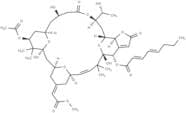
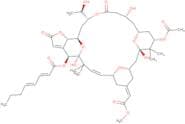
CAS 143370-84-7
:Acide 2,4-octadiénoïque, (4S,5S,7E,9R,11Z,13S,15S,17S,19R,21R,25R,27R,27aS)-17-(acétyloxy)-4,5,6,9,10,11,12,13,14,15,16,17,18,19,20,21,22,23,25,26,27,27a-docosahydro-5,15,21-trihydroxy-25-[(1R)-1-hydroxyéthyl]-11-(2-méthoxy-2-oxoéthylidène)-6,6,16,16-tétraméth
Description :
La substance chimique connue sous le nom d'acide 2,4-octadienoïque, avec le numéro CAS 143370-84-7, est un composé organique complexe caractérisé par ses groupes multifonctionnels et sa stéréochimie. Il présente une longue chaîne carbonée avec plusieurs doubles liaisons, spécifiquement aux positions 2 et 4, ce qui le classe comme un diène. La présence de groupes hydroxyles (-OH) indique qu'il s'agit d'un alcool, contribuant à sa réactivité potentielle et à sa solubilité dans des solvants polaires. Le composé contient également un groupe acétyloxy, suggérant qu'il pourrait participer à des réactions d'estérification. Sa stéréochimie est définie par plusieurs centres chiraux, qui peuvent influencer son activité biologique et son interaction avec des enzymes ou des récepteurs. La structure complexe implique qu'il pourrait présenter des propriétés uniques, telles que des points de fusion et d'ébullition spécifiques, ainsi que des applications potentielles en pharmacie ou en biochimie. Dans l'ensemble, la complexité du composé et ses groupes fonctionnels suggèrent qu'il pourrait jouer un rôle dans diverses réactions chimiques et processus biologiques.
Formule :C46H64O17
Synonymes :- Bryostatin1, 35-demethoxy-22,35-epoxy-, (22S)-
- 5,27:9,13:15,19-Triepoxy-2H-furo[2,3-e]oxacyclohexacosin,bryostatin 1 deriv.
- 2,4-Octadienoic acid,17-(acetyloxy)-4,5,6,9,10,11,12,13,14,15,16,17,18,19,20,21,22,23,25,26,27,27a-docosahydro-5,15,21-trihydroxy-25-(1-hydroxyethyl)-11-(2-methoxy-2-oxoethylidene)-6,6,16,16-tetramethyl-2,23-dioxo-5,27:9,13:15,19-triepoxy-2H-furo[2,3-e]oxacyclohexacosin-4-ylester,[4S-[4R*(2E,4E),5R*,7E,9S*,11Z,13R*,15R*,17R*,19S*,21S*,25S*(S*),27S*,27aR*]]-
- Bryostatin 3
- Bryostatin 3 >=95% (HPLC)
- (4S,5S,7E,9R,11Z,13S,15S,17S,19R,21R,25R,27R,27aS)-17-(Acetyloxy)-4,5,6,9,10,11,12,13,14,15,16,17,18,19, 20,21,22,23,25,26,27,27a-docosahydro-5,15,21-trihydroxy-25-[(1R)-1-hydroxyethyl]-11-(2-methoxy-2-oxoethylidene)-6,6,16,16-tetramethyl-2,23-dioxo-5,27:9,13:15,19-triepoxy-2H-furo[2,3-e]oxacyclohexacosin-4-yl-(2E,4E)-2,4-octadienoic acid ester
- 2,4-Octadienoic acid, (4S,5S,7E,9R,11Z,13S,15S,17S,19R,21R,25R,27R,27aS)-17-(acetyloxy)-4,5,6,9,10,11,12,13,14,15,16,17,18,19,20,21,22,23,25,26,27,27a-docosahydro-5,15,21-trihydroxy-25-[(1R)-1-hydroxyethyl]-11-(2-methoxy-2-oxoethylidene)-6,6,16,16-tetramethyl-2,23-dioxo-5,27:9,13:15,19-triepoxy-2H-f...
Trier par
Degré de pureté (%)
0
100
|
0
|
50
|
90
|
95
|
100
2 produits concernés.
Bryostatin 3
CAS :Bryostatin 3 is a protein kinase C activator.Formule :C46H64O17Degré de pureté :98%Couleur et forme :SolidMasse moléculaire :888.99Bryostatin 3
CAS :Bryostatin 3 is a polyunsaturated fatty acid that has been shown to be a potent anticancer agent. It inhibits the growth of cancer cells by activating protein kinase C and phospholipase C, which are enzymes that regulate membrane function. Bryostatin 3 also exhibits antimicrobial activity against Gram-positive bacteria and HIV. The molecule is synthesized by the asymmetric addition of a hydroxyl group to an organic quinoline derivative. The effective dose for bryostatin 3 is 10-30 ng/kg body weight per day, and it can be given intravenously or orally.Formule :C46H64O17Degré de pureté :Min. 95%Masse moléculaire :888.99 g/mol