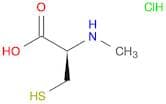
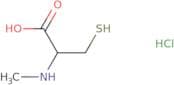
CAS 14344-46-8
:L-Cystéine, N-méthyl-, chlorhydrate (1:1)
- (1R)-1-carboxy-N-methyl-2-sulfanylethanaminium chloride
- <span class="text-smallcaps">L</span>-Cysteine, N-methyl-, hydrochloride
- <span class="text-smallcaps">L</span>-Cysteine, N-methyl-, hydrochloride (1:1)
- <span class="text-smallcaps">L</span>-N-Methylcysteine hydrochloride
- Cysteine, N-methyl-, hydrochloride, <span class="text-smallcaps">L</span>-
- Cysteine, N-methyl-, hydrochloride, L- (8CI)
- L-Cysteine, N-methyl-, hydrochloride (6CI, 9CI)
- L-N-Methylcysteine hydrochloride
- N-methylcysteine hydrochloride
- L-Cysteine, N-methyl-, hydrochloride (1:1)
- Cysteine, N-methyl-, hydrochloride, L-
- Voir plus de synonymes
3-Mercapto-2-(methylamino)propanoic acid hydrochloride
CAS :Formule :C4H10ClNO2SDegré de pureté :95%Couleur et forme :SolidMasse moléculaire :171.64573-Thio-2-(methylamino)propanoic acid hydrochloride
CAS :3-Thio-2-(methylamino)propanoic acid hydrochlorideDegré de pureté :95%Masse moléculaire :171.65g/mol3-Mercapto-2-(methylamino)propanoic acid hydrochloride
CAS :Formule :C4H10ClNO2SDegré de pureté :95.0%Masse moléculaire :171.64N-Methyl-L-cysteine Hydrochloride
CAS :Produit contrôléStability Air Sensitive
Applications N-Methyl-L-cysteine Hydrochloride is an intermediate used to prepare analogs of pyochelin (P840365), a siderophore of Pseudomonas aeruginosa.
References Rivault, F., et al.: Tetrahedron, 60, 12139 (2004); Noel, S., et al.: Bioorgan. Chem. Lett., 24, 132 (2014); Ankenbauer, R., et al.: J. Bacteriol., 170, 5344 (1988)Formule :C4H9NO2S·ClHCouleur et forme :NeatMasse moléculaire :171.653-Mercapto-2-(methylamino)propanoic acidHydrochloride
CAS :3-Mercapto-2-(methylamino)propanoic acidHydrochloride (3MA) is a synthetic antibiotic that binds to the phosphate groups of bacterial cell walls. It is a competitive inhibitor of siderophore production, which is an essential process for bacterial uptake of iron. 3MA has been shown to be effective against cultures of enterocolitica and Micacocidin-resistant strains of E. coli. 3MA has also been shown to have anti-inflammatory properties and may be useful in the treatment of colitis caused by Clostridium difficile or Salmonella enterica serovar Typhi infections.
Formule :C4H10ClNO2SDegré de pureté :Min. 95%Couleur et forme :PowderMasse moléculaire :171.65 g/mol