CAS 143537-62-6
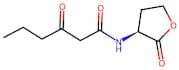
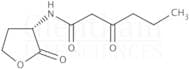
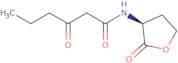
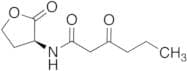
:N-(B-cétocaproyl)-L-homosérine lactone
- N-(Beta-Ketocaproyl)-Dl-Homoserine Lactone
- 3-oxo-N-[(3S)-2-oxotetrahydrofuran-3-yl]hexanamide
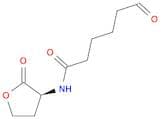
(S)-6-Oxo-N-(2-oxotetrahydrofuran-3-yl)hexanamide
CAS :Formule :C10H15NO4Degré de pureté :98%Couleur et forme :SolidMasse moléculaire :213.2304N-(β-Ketocaproyl)-L-hoMoserine lactone
CAS :N-(β-Ketocaproyl)-L-hoMoserine lactoneDegré de pureté :≥98%Masse moléculaire :213.23g/molN-(β-Ketocaproyl)-L-homoserine lactone
CAS :Formule :C10H15NO4Degré de pureté :≥ 98.0%Couleur et forme :White solidMasse moléculaire :213.23N-(β-Ketocaproyl)-L-hoMoserine lactone
CAS :N-(beta-Ketocaproyl)-L-hoMoserine lactone (N-(Ketocaproyl)-L-homoserine lactone) is a component of quorum regulatory sensing and an autoinducer of P.Formule :C10H15NO4Degré de pureté :99.76%Couleur et forme :SolidMasse moléculaire :213.23(S)-3-Oxo-N-(2-oxotetrahydrofuran-3-yl)hexanamide
CAS :Degré de pureté :98%Couleur et forme :SolidMasse moléculaire :213.2330017N-(Ketocaproyl)-L-homoserine lactone
CAS :N-(Ketocaproyl)-L-homoserine lactone is a fatty acid analog of the bacterial signaling molecule homoserine lactone and a potent inducer of cell lysis. The synthesis of this analog has been demonstrated in vitro with Escherichia coli, Bacillus subtilis, and Streptococcus pneumoniae. It is active against human pathogens including Helicobacter pylori and Staphylococcus aureus as well as mammalian tissue. N-(Ketocaproyl)-L-homoserine lactone induces cell lysis by binding to the DNA polymerase to inhibit its activity and terminate DNA synthesis. This inhibition leads to an accumulation of unprocessed RNA, which induces apoptosis in bacterial cells.
Formule :C10H15NO4Degré de pureté :Min. 98 Area-%Couleur et forme :White PowderMasse moléculaire :213.23 g/molN-(Ketocaproyl)-L-homoserine Lactone
CAS :Produit contrôléApplications An autoinducer of P. fischeri luciferase. A specific genetic regulator that is unrelated to at least one of the enzyme systems that it induces, and it acts after excretion and accumulation in the extracellular medium.
References Eberhard, A., et al.: Biochemistry, 20, 2444 (1981)Formule :C10H15NO4Couleur et forme :NeatMasse moléculaire :213.23