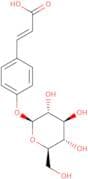
CAS 14364-05-7
:Glucoside d'acide p-coumarique
Description :
Glucoside d'acide p-coumarique, avec le numéro CAS 14364-05-7, est un composé phénolique qui se trouve naturellement et appartient à la classe des flavonoïdes. C'est un dérivé glycosidique de l'acide p-coumarique, ce qui signifie qu'il se compose d'un fragment d'acide p-coumarique lié à une molécule de glucose. Ce composé se trouve généralement dans diverses plantes, contribuant à leurs propriétés antioxydantes et à leurs potentiels bienfaits pour la santé. Glucoside d'acide p-coumarique présente une solubilité dans les solvants polaires en raison de la présence de l'unité de glucose, tandis que la structure phénolique lui confère la capacité de piéger les radicaux libres. Il est souvent étudié pour son rôle dans les mécanismes de défense des plantes et ses effets thérapeutiques potentiels, y compris des activités anti-inflammatoires et antimicrobiennes. De plus, ce composé peut jouer un rôle dans la biosynthèse d'autres phytocomposés importants. Sa présence dans les sources alimentaires, en particulier dans les fruits et légumes, souligne son importance dans la recherche sur la nutrition et la santé.
Formule :C15H18O8
InChI :InChI=1S/C15H18O8/c16-7-10-12(19)13(20)14(21)15(23-10)22-9-4-1-8(2-5-9)3-6-11(17)18/h1-6,10,12-16,19-21H,7H2,(H,17,18)/t10-,12-,13+,14-,15-/m1/s1
Code InChI :InChIKey=LJFYQZQUAULRDF-TVKJYDDYSA-N
SMILES :O([C@@H]1O[C@H](CO)[C@@H](O)[C@H](O)[C@H]1O)C2=CC=C(C=CC(O)=O)C=C2
Synonymes :- 2-Propenoic acid, 3-[4-(β-<span class="text-smallcaps">D</span>-glucopyranosyloxy)phenyl]-
- 3-[4-(β-<span class="text-smallcaps">D</span>-Glucopyranosyloxy)phenyl]-2-propenoic acid
- 4-(b-D-Glucopyranosyloxy)cinnamic acid
- 4-(β-<span class="text-smallcaps">D</span>-Glucopyranosyloxy)cinnamic acid
- 4-O-b-D-Glucopyranosyl-p-coumaricacid
- 4-O-β-<span class="text-smallcaps">D</span>-Glucopyranosyl cinnamate
- 4-O-β-<span class="text-smallcaps">D</span>-Glucopyranosyl-p-coumaric acid
- Cinnamic acid, p-(β-<span class="text-smallcaps">D</span>-glucopyranosyloxy)-
- Cinnamicacid, p-(b-D-glucopyranosyloxy)- (6CI,8CI)
- Glucopyranoside, p-(2-carboxyvinyl)phenyl, b-D- (8CI)
- Glucopyranoside, p-(2-carboxyvinyl)phenyl, β-<span class="text-smallcaps">D</span>-
- Glucosido-p-coumaric acid
- p-(Glucosyloxy)cinnamic acid
- p-Coumaric acid 4-O-β-<span class="text-smallcaps">D</span>-glucopyranoside
- p-Coumaric acid glucoside
- p-Coumaric acid β-glucoside
- p-Coumaric acid4-O-b-D-glucopyranoside
- p-Coumaricacid b-glucoside
- trans-p-Coumaricacid-4-O-b-D-glucopyranoside
- Cinnamic acid, p-(β-D-glucopyranosyloxy)-
- Glucopyranoside, p-(2-carboxyvinyl)phenyl, β-D-
- 3-[4-(β-D-Glucopyranosyloxy)phenyl]-2-propenoic acid
- Voir plus de synonymes
Trier par
Degré de pureté (%)
0
100
|
0
|
50
|
90
|
95
|
100
1 produits concernés.
Coumaric acid 4-O-glucoside
CAS :Coumaric acid 4-O-glucoside is a compound that is found in plants and can be extracted from flaxseed. It has been shown to have antioxidative activity, especially in the prevention of oxidation of fatty acids. Coumaric acid 4-O-glucoside has also been shown to inhibit the synthesis of n-3 fatty acids and secoisolariciresinol, as well as to regulate the biosynthesis of these lipids. The efficient method for preparing this compound is by hydrolysis of coumaroyl ester linkages using hydrochloric acid in methanol. Coumaric acid 4-O-glucoside was synthesized by reacting methyl acetoacetate with sodium hydroxide and hydrochloric acid in methanol at a temperature range of 0°C to 25°C. This reaction was followed by purification using phase liquid chromatography.Formule :C15H18O8Degré de pureté :Min. 95%Masse moléculaire :326.3 g/mol