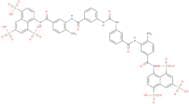
CAS 145-63-1
:Suramine
Description :
Suramine est un composé organique synthétique principalement connu pour son utilisation en tant qu'agent antiparasitaire, en particulier dans le traitement de la maladie du sommeil africain causée par Trypanosoma brucei. Il est classé comme une naphthylurée polysulfonée et présente une structure complexe comportant plusieurs groupes sulfonate, qui contribuent à sa solubilité dans l'eau. Suramine agit en inhibant diverses enzymes et en perturbant les processus cellulaires chez les parasites, empêchant ainsi leur prolifération. Le composé est administré par voie intraveineuse en raison de sa faible biodisponibilité orale. En plus de ses propriétés antiparasitaires, Suramine a été étudié pour des applications potentielles dans d'autres conditions médicales, y compris certains cancers et infections virales, bien que son utilisation dans ces domaines soit moins établie. La pharmacocinétique de Suramine implique une demi-vie relativement longue, permettant une posologie moins fréquente. Cependant, il peut provoquer des effets secondaires, y compris des réactions allergiques et une néphrotoxicité, nécessitant une surveillance attentive pendant le traitement. Dans l'ensemble, Suramine reste un composé important en médecine tropicale et en pharmacologie.
Formule :C51H40N6O23S6
InChI :InChI=1S/C51H40N6O23S6/c1-25-9-11-29(49(60)54-37-13-15-41(83(69,70)71)35-21-33(81(63,64)65)23-43(45(35)37)85(75,76)77)19-39(25)56-47(58)27-5-3-7-31(17-27)52-51(62)53-32-8-4-6-28(18-32)48(59)57-40-20-30(12-10-26(40)2)50(61)55-38-14-16-42(84(72,73)74)36-22-34(82(66,67)68)24-44(46(36)38)86(78,79)80/h3-24H,1-2H3,(H,54,60)(H,55,61)(H,56,58)(H,57,59)(H2,52,53,62)(H,63,64,65)(H,66,67,68)(H,69,70,71)(H,72,73,74)(H,75,76,77)(H,78,79,80)
Code InChI :InChIKey=FIAFUQMPZJWCLV-UHFFFAOYSA-N
SMILES :N(C(=O)C1=CC(NC(=O)C2=CC(NC(NC3=CC(C(NC4=CC(C(NC=5C6=C(C(S(=O)(=O)O)=CC5)C=C(S(=O)(=O)O)C=C6S(=O)(=O)O)=O)=CC=C4C)=O)=CC=C3)=O)=CC=C2)=C(C)C=C1)C=7C8=C(C(S(=O)(=O)O)=CC7)C=C(S(=O)(=O)O)C=C8S(=O)(=O)O
Synonymes :- Farma 939
- 1,3,5-Naphthalenetrisulfonic acid, 8,8′-[ureylenebis[m-phenylenecarbonylimino(4-methyl-m-phenylene)carbonylimino]]di-
- Farma
- 8,8′-[Carbonylbis[imino-3,1-phenylenecarbonylimino(4-methyl-3,1-phenylene)carbonylimino]]bis[1,3,5-naphthalenetrisulfonic acid]
- 1,3,5-Naphthalenetrisulfonic acid, 8,8′-[carbonylbis[imino-3,1-phenylenecarbonylimino(4-methyl-3,1-phenylene)carbonylimino]]bis-
Trier par
Degré de pureté (%)
0
100
|
0
|
50
|
90
|
95
|
100
4 produits concernés.
1,3,5-Naphthalenetrisulfonic acid, 8,8'-[carbonylbis[imino-3,1-phenylenecarbonylimino(4-methyl-3,1-phenylene)carbonylimino]]bis-
CAS :Formule :C51H40N6O23S6Degré de pureté :98%Couleur et forme :SolidMasse moléculaire :1297.2797Suramin
CAS :Suramin is an RdRp and PTPase inhibitor with anti-parasitic, anti-tumor, and anti-angiogenic activities, inhibiting sirtuins and DNA topoisomerase II.Formule :C51H40N6O23S6Degré de pureté :99.80%Couleur et forme :SolidMasse moléculaire :1297.28Suramin
CAS :Suramin is a nonsteroidal anti-inflammatory drug that binds to the ryanodine receptor, which is an intracellular calcium channel. It prevents the release of calcium from the sarcoplasmic reticulum, leading to decreased production of reactive oxygen species and preventing cell death. Suramin has been shown to inhibit the growth of murine sarcoma virus in cells by inhibiting the synthesis of a protein called growth factor-β1 (GF-β1). This drug also inhibits glycol ethers, which are known carcinogens that can cause DNA damage in cancerous cells. Suramin has been shown to have an apoptosis pathway, which is a biological process by which cells self-destruct when they are no longer needed or have become damaged. The binding of suramin to polymerase chain reaction (PCR) can be used as a diagnostic tool for detecting cancer tissues. Suramin has also been shown to bind to dextran sulfate and natural compounds with similarFormule :C51H40N6O23S6Degré de pureté :Min. 95%Masse moléculaire :1,297.3 g/mol