CAS 14523-22-9
:Rhodium, tétracarbonyle-di-μ-chlorodi-
Description :
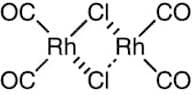
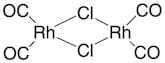
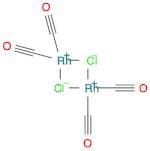
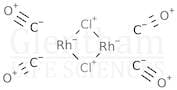
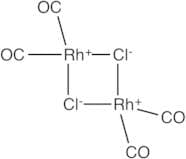
Rhodium, tétracarbonyle-di-μ-chlorodi- est un composé de coordination présentant le rhodium comme atome central de métal, coordonné par des ligands de monoxyde de carbone (CO) et des ions chlorure. Ce composé se caractérise par sa structure unique, où deux centres de rhodium sont reliés par deux ions chlorure, et chaque atome de rhodium est en outre coordonné à deux ligands de monoxyde de carbone. La présence de monoxyde de carbone contribue à la stabilité du composé et à sa capacité à participer à diverses réactions chimiques, y compris des processus catalytiques. Les complexes de rhodium sont connus pour leurs applications en catalyse, en particulier dans la synthèse organique et les processus industriels, en raison de leur capacité à faciliter des réactions telles que l'hydrogénation et la carbonylation. La désignation tétracarbonyl-di-μ-chlorure-di- indique l'arrangement spécifique des ligands autour des centres de rhodium, ce qui influence la réactivité et les propriétés du composé. Dans l'ensemble, ce composé illustre la riche chimie des complexes de métaux de transition, en particulier ceux impliquant le rhodium, qui est apprécié pour ses capacités catalytiques et ses propriétés électroniques uniques.
Formule :C4Cl2O4Rh2
InChI :InChI=1S/4CO.2ClH.2Rh/c4*1-2;;;;/h;;;;2*1H;;/q;;;;;;2*+1/p-2
Code InChI :InChIKey=FGKDXBICTVUSPK-UHFFFAOYSA-L
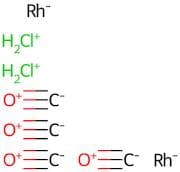
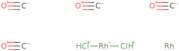
SMILES :C(#O)[Rh+]1(C#O)[Cl-][Rh+](C#O)(C#O)[Cl-]1
Synonymes :- Bis(chlororhodiumdicarbonyl)
- Bis(dicarbonyl(μ-chloro)rhodium)
- Bis(dicarbonylchlororhodium)
- Bis(dicarbonylrhodium chloride)
- Bis(μ-chloro)bis(dicarbonylrhodium)
- Carbon Monoxide
- Chlorodicarbonylrhodium dimer
- Chlorodicarbonylrhodium(I) dimer
- Chlororhodium dicarbonyl dimer
- Di-Mu-Chloro-Bis(Dicarbonylrhodium)
- Di-My-Chloro-Tetracarbonyldirhodium
- Di-mu-chloro-tetracarbonyldirhodium
- Di-Μ-Chloro-Bis(Dicarbonylrhodium)
- Di-Μ-Cloro-Bis(Dicarbonilrodio)
- Di-μ-Chlorotetracarbonyldirhodium(I)
- Di-μ-chlor-bis(dicarbonylrhodium)
- Dicarbonylchlororhodium dimer
- Dicarbonylrhodium chloride dimer
- Dichloride
- Dichlorodirhodiumtetracarbonyl
- Dichlorotetracarbonyldirhodium
- Dirhodium tetracarbonyl dichloride
- Nsc 120116
- Rhodium carbonyl chloride
- Rhodium carbonyl chloride (Rh2(CO)4Cl2)
- Rhodium carbonyl chloride (Rh<sub>2</sub>(CO)<sub>4</sub>Cl<sub>2</sub>)
- Rhodium carbonyl chloride dimer
- Rhodium dicarbonyl chloride dimer
- Rhodium(+1) Cation
- Rhodium, tetracarbonyldi-μ-chlorodi-
- Tetracarbonyl-μ,μ'-dichlorodirhodium
- Tetracarbonyl-μ,μ'-dichlorodirhodium(I)
- Tetracarbonylbis(μ-chloro)dirhodium
- Tetracarbonyldi-μ-chlorodirhodium
- Tetracarbonyldichlorodirhodium
- [Rh(CO)2Cl]2
- tetracarbonyldi-U-chlorodirhodium(I)
- Voir plus de synonymes
Trier par
Degré de pureté (%)
0
100
|
0
|
50
|
90
|
95
|
100
7 produits concernés.
Tetracarbonyldi-^m-chlorodirhodium(I), Rh 50.1-52.9%
CAS :It is used widely as a chemical for research purposes as well as it acts as a a biochemical for proteomics research. This Thermo Scientific Chemicals brand product was originally part of the Alfa Aesar product portfolio. Some documentation and label information may refer to the legacy brand. The ori
Formule :C4Cl2O4Rh2Masse moléculaire :388.75Chlorodicarbonylrhodium(I) dimer
CAS :Chlorodicarbonylrhodium(I) dimer
Formule :RhCl(CO)2Couleur et forme :red xtl.Masse moléculaire :388.76Tetracarbonyldi-mu-chlorodirhodium(i)
CAS :Formule :C4Cl2O4Rh2Degré de pureté :98%Couleur et forme :SolidMasse moléculaire :388.7574Tetracarbonyl dichlorodirhodium(I)
CAS :Formule :Rh(CO)2ClCouleur et forme :Dark red to red-brown powderMasse moléculaire :388.76Rhodium(I) dicarbonyl chloride dimer
CAS :Rhodium(I) dicarbonyl chloride dimerDegré de pureté :98%Couleur et forme :CrystalsMasse moléculaire :345.90g/molRhodium Carbonyl Chloride
CAS :Produit contrôléApplications Rhodium Carbonyl Chloride is a reagent for rhodium-catalyzed [4+2+1] cycloaddition of in situ generated ene/yne-ene-allenes and carbon monoxide to produce [4+2+1] cycloadducts
References Tian, Z.Y., et al.: Angewandte Chemie Int. Ed.’ 57, 15544 (2018)Formule :CO·2Cl·2RhCouleur et forme :NeatMasse moléculaire :388.757Di-¼-chloro-tetracarbonyldirhodium(I)
CAS :Di-¼-chloro-tetracarbonyldirhodium(I) is a compound that has been shown to catalyze the carbonylation of various organic substrates in the presence of oxygen. In the presence of a catalytic amount of di-¼-chloro-tetracarbonyldirhodium(I), aniline was converted to 4,4'-dichlorobenzophenone with a yield of 43%. The same reaction also produced 3,3'-dichlorobenzophenone and 2,2'-dichlorobenzophenone as side products. The compound was obtained by reacting hexanes with chlorodirhodium trichloride in the presence of air. The structural analysis was performed using x-ray diffraction technique on an orange powder. It was found that the compound crystallizes in a monoclinic space group with unit cell dimensions a=7.5 ÅFormule :C4Cl2O4Rh2Degré de pureté :Min. 95%Masse moléculaire :388.76 g/mol