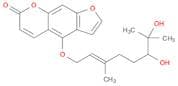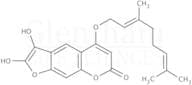
CAS 145414-76-2
:6′,7′-Dihydroxybergamottine
Description :
6′,7′-Dihydroxybergamottine est un composé naturellement présent classé comme un furanocoumarine, principalement trouvé dans le pamplemousse et d'autres agrumes. Il est connu pour son rôle potentiel dans l'influence du métabolisme des médicaments, en particulier à travers son interaction avec les enzymes du cytochrome P450, qui peuvent affecter la biodisponibilité de divers médicaments. Ce composé présente deux groupes hydroxyles aux positions 6′ et 7′ de la structure de la bergamottine, contribuant à sa réactivité chimique et à son activité biologique. 6′,7′-Dihydroxybergamottine a suscité de l'intérêt en pharmacologie en raison de sa capacité à inhiber certaines enzymes, ce qui peut entraîner des interactions médicamenteuses significatives lorsqu'il est consommé avec des médicaments métabolisés par ces voies. De plus, il présente des propriétés antioxydantes, suggérant des bénéfices potentiels pour la santé. Sa structure moléculaire et ses propriétés en font un sujet d'étude tant en chimie alimentaire qu'en pharmacologie, en particulier en ce qui concerne les influences diététiques sur l'efficacité et la sécurité des médicaments. Comme pour de nombreux furanocoumarines, il est conseillé de faire preuve de prudence lors de la consommation avec certains médicaments.
Formule :C21H24O6
InChI :InChI=1/C21H24O6/c1-13(4-6-18(22)21(2,3)24)8-10-26-20-14-5-7-19(23)27-17(14)12-16-15(20)9-11-25-16/h5,7-9,11-12,18,22,24H,4,6,10H2,1-3H3/b13-8+
Code InChI :InChIKey=IXZUPBUEKFXTSD-MDWZMJQENA-N
SMILES :O(C/C=C(/CCC(C(C)(C)O)O)\C)C=1C2=C(C=C3C1C=CO3)OC(=O)C=C2
Synonymes :- 4-[[(2E)-6,7-Dihydroxy-3,7-dimethyl-2-octen-1-yl]oxy]-7H-furo[3,2-g][1]benzopyran-7-one
- 4-{[(2E)-6,7-dihydroxy-3,7-dimethyloct-2-en-1-yl]oxy}-7H-furo[3,2-g]chromen-7-one
- 6,7-Dihydroxybergagamottin
- 6′,7′-Dihydroxybergamottin
- 7H-Furo[3,2-g][1]benzopyran-7-one, 4-[(6,7-dihydroxy-3,7-dimethyl-2-octenyl)oxy]-, (E)-
- 7H-Furo[3,2-g][1]benzopyran-7-one, 4-[[(2E)-6,7-dihydroxy-3,7-dimethyl-2-octen-1-yl]oxy]-
- 7H-Furo[3,2-g][1]benzopyran-7-one, 4-[[(2E)-6,7-dihydroxy-3,7-dimethyl-2-octenyl]oxy]-
- Dihydroxybergamottin
Trier par
Degré de pureté (%)
0
100
|
0
|
50
|
90
|
95
|
100
4 produits concernés.
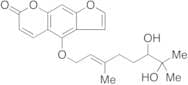
6',7'-Dihydroxy Bergamottin
CAS :Produit contrôléApplications A minor metabolite of Bergamottin (B318400). Metabolization of Bergamottin by cytochromes P 450 2B6 and 3A5.
References Lin, H., et al.: J. Pharmacol. Exp. Ther., 301, 160 (2002), Hesselink, D., et al.: Clin. Pharmacol. Ther., 74, 245 (2003), Evans, D., et al.: Chem. Res. Toxicol., 17, 3 (2004), Friesner, R., et al.: J. Med. Chem., 47, 1739 (2004), Bumpus, N., et al.: Drug Metab. Dispos., 33, 795 (2005),Formule :C21H24O6Couleur et forme :NeatMasse moléculaire :372.416',7'-Dihydroxy bergamottin
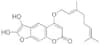
CAS :Bergamottin is a naturally occurring flavonoid that is found in grapefruit and other citrus fruit. It has been shown to inhibit the activity of the P-glycoprotein (P-gp) transporter in human cells, which may lead to drug interactions. A number of analytical methods have been developed for the determination of bergamottin in biological samples such as humans, rat liver microsomes, and natural compounds. Bergamottin has been shown to be a potent inhibitor of cytochrome P450 enzymes and can inhibit skin cancer development in mice by inhibiting the growth of human keratinocytes (HK-2 cells). Bergamottin also inhibits tumorigenesis in mice by decreasing cell proliferation and inducing apoptosis in hk-2 cells.Formule :C21H24O6Degré de pureté :Min. 95%Couleur et forme :PowderMasse moléculaire :372.41 g/mol