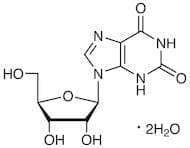
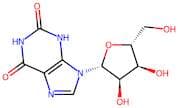
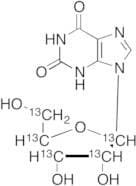
CAS 146-80-5
:Xanthosine
- (S)-1-(Azetidin-3-yl)pyrrolidin-3-ol hydrochloride
- 1H-Purine-2,6-dione, 3,9-dihydro-9-β-<span class="text-smallcaps">D</span>-ribofuranosyl-
- 2,3-Dihydro-2-oxoinosine
- 3,9-Dihydro-9-β-<span class="text-smallcaps">D</span>-ribofuranosyl-1H-purine-2,6-dione
- 9-pentofuranosyl-3,9-dihydro-1H-purine-2,6-dione
- 9-β-<span class="text-smallcaps">D</span>-Ribofuranosylxanthine
- Inosine, 2,3-dihydro-2-oxo-
- NSC 18930
- β-<span class="text-smallcaps">D</span>-Ribofuranoside, xanthine-9
- 3,9-Dihydro-9-β-D-ribofuranosyl-1H-purine-2,6-dione
- Xanthosine
- 9-β-D-Ribofuranosylxanthine
- 1H-Purine-2,6-dione, 3,9-dihydro-9-β-D-ribofuranosyl-
- Voir plus de synonymes
Xanthosine Dihydrate
CAS :Formule :C10H12N4O6·2H2ODegré de pureté :>98.0%(T)(HPLC)Couleur et forme :White to Almost white powder to crystalMasse moléculaire :320.26Xanthosine
CAS :Formule :C10H12N4O6Degré de pureté :98%Couleur et forme :SolidMasse moléculaire :284.2255Xanthosine
CAS :Xanthosine (9-Beta-D-Ribofuranosylxanthine) is a xanthine nucleoside that increases the number of mammary stem cells and milk production in goats and cattle.Formule :C10H12N4O6Degré de pureté :99.87% - >99.99%Couleur et forme :SolidMasse moléculaire :284.23Xanthosine
CAS :Produit contrôléXanthosine is a purine nucleoside that is formed from the metabolism of adenosine. Xanthosine can be phosphorylated to form xanthosine 5'-monophosphate (XMP), which has been shown to have biochemical properties and metabolic responses in vitro. The p-hydroxybenzoic acid moiety of xanthosine has been shown to have therapeutic potential for the treatment of inflammatory diseases, such as rheumatoid arthritis. It also has a role in the regulation of disease activity, as it is found at high concentrations in human serum, and regulates the proliferation of cells through its binding to nuclear proteins. Xanthosine is an important component of dinucleotide phosphate (NDP) pools that are essential for cell nuclei function. NDPs are also important for DNA synthesis and repair, as well as protein synthesis. Xanthosine 5'-monophosphate can act as a metal chelate and is used in
Formule :C10H12N4O6Degré de pureté :Min. 98 Area-%Couleur et forme :White Off-White PowderMasse moléculaire :284.23 g/molXanthosine-13C5
CAS :Produit contrôléApplications Xanthosine-13C5, is the labeled analogue of Xanthosine (X742100), the deamination product of Guanosine. It is also a potential biomarker for detecting radiation exposure.
References Magasanik, B, et al.: J. Bio. Chem., 206, 83 (1954);Formule :C10H12N4O6Couleur et forme :White SolidMasse moléculaire :284.23