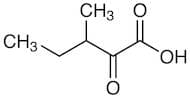
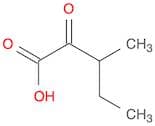
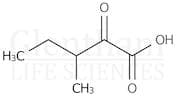
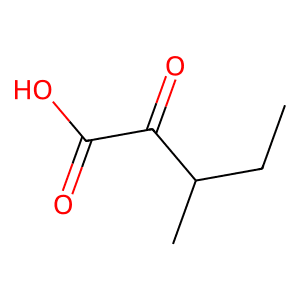
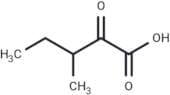
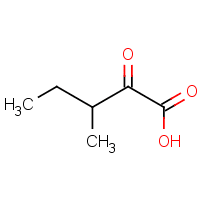
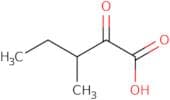
CAS 1460-34-0
:Acide (±)-3-méthyl-2-oxovalérique
- 2-Oxo-3(RS)-methylvaleric acid
- 2-Oxo-3-methyl-n-valeric acid
- 2-Oxo-3-methylpentanoic acid
- 2-Oxo-3-methylvaleric acid
- 2-Oxoisoleucine
- 3-Ethyl-3-methylpyruvic acid
- 3-Methyl-2-ketovaleric acid
- 3-Methyl-2-oxopentanoic acid
- 3-Methyl-2-oxovaleric acid
- <span class="text-smallcaps">DL</span>-3-Ethyl-3-methylpyruvic acid
- <span class="text-smallcaps">DL</span>-3-Methyl-2-oxopentanoate
- <span class="text-smallcaps">DL</span>-3-Methyl-2-oxopentanoic acid
- Pentanoic acid, 3-methyl-2-oxo-
- Sodium 3-Methyl-2-Oxopentanoate
- Valeric acid, 3-methyl-2-oxo-
- alpha-Keto-beta-methylvaleric acid
- α-Keto-β-methylvaleric acid
- α-Oxo-β-methyl-n-valeric acid
- α-Oxo-β-methylvaleric acid
- Voir plus de synonymes
3-Methyl-2-oxovaleric Acid
CAS :Formule :C6H10O3Degré de pureté :>95.0%(GC)(T)Couleur et forme :White to Light yellow powder to lumpMasse moléculaire :130.142-Oxo-3-methylvaleric acid
CAS :Formule :C6H10O3Degré de pureté :95%Couleur et forme :SolidMasse moléculaire :130.14183-Methyl-2-oxovaleric acid
CAS :Formule :C6H10O3Degré de pureté :≥ 98.0%Couleur et forme :Colourless to light yellow liquidMasse moléculaire :130.143-Methyl-2-oxovaleric acid
CAS :3-Methyl-2-oxovaleric acidDegré de pureté :≥95%Masse moléculaire :130.14g/mol3-Methyl-2-oxovaleric acid
CAS :3-Methyl-2-oxovaleric acid: byproduct of amino acid metabolism, neurotoxin, acidogen, metabotoxin, damages nerves.Formule :C6H10O3Degré de pureté :99.67%Couleur et forme :SolidMasse moléculaire :130.143-Methyl-2-oxovaleric acid
CAS :3-Methyl-2-oxovaleric acidFormule :C6H10O3Degré de pureté :95%Couleur et forme : white powderMasse moléculaire :130.14179g/mol(±)-3-Methyl-2-oxovaleric acid
CAS :(±)-3-Methyl-2-oxovaleric acid is a fatty acid that is found in the mitochondria of liver cells and other tissues. It is an intermediate in the citric acid cycle and can be converted into acetyl-CoA, which is used for energy production. (±)-3-Methyl-2-oxovaleric acid has been shown to cause necrotic cell death when it binds to the mitochondrial membrane potential and causes a loss of ATP production. This results in a lack of energy for the cell, leading to cell death. (±)-3-Methyl-2-oxovaleric acid has also been shown to inhibit protein synthesis by decreasing uptake and increasing creatine kinase activity. This inhibition leads to decreased body formation and tissue culture growth in vitro. In vivo, (±)-3-Methyl-2-oxovaleric acid causes primary sclerosing cholangitis, a disease characterized by inflammation of bile ducts that
Formule :C6H10O3Degré de pureté :Min. 95%Couleur et forme :White PowderMasse moléculaire :130.14 g/mol