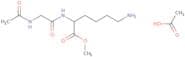
CAS 14752-92-2
:L-Lysine, N-acétylglycyl-, ester méthylique, acétate (1:1)
Description :
L-Lysine, N-acétylglycyl-, ester méthylique, acétate (1:1) est un composé chimique qui présente une combinaison d'acides aminés et de groupes fonctionnels. Il est dérivé de la lysine, un acide aminé essentiel, qui joue un rôle crucial dans la synthèse des protéines et divers processus métaboliques. La présence du groupe N-acétylglycyle indique que la lysine a été modifiée, ce qui pourrait améliorer sa solubilité et sa biodisponibilité. La fonctionnalité de l'ester méthylique suggère que le composé peut présenter des propriétés différentes par rapport à sa forme acide libre, telles qu'une réactivité et une stabilité altérées. Le composant acétate implique que le composé est sous forme de sel, ce qui peut influencer sa solubilité dans des solutions aqueuses. Ce composé pourrait être d'un intérêt dans la recherche biochimique, la pharmacie et les applications nutritionnelles en raison de ses rôles potentiels dans les fonctions cellulaires et comme élément de base pour les peptides. Cependant, les applications spécifiques et les activités biologiques dépendraient d'études supplémentaires et du contexte concernant son utilisation.
Formule :C11H21N3O4·C2H4O2
InChI :InChI=1S/C11H21N3O4.C2H4O2/c1-8(15)13-7-10(16)14-9(11(17)18-2)5-3-4-6-12;1-2(3)4/h9H,3-7,12H2,1-2H3,(H,13,15)(H,14,16);1H3,(H,3,4)/t9-;/m0./s1
Code InChI :InChIKey=UNWQLIOZIACTGA-FVGYRXGTSA-N
SMILES :[C@H](NC(CNC(C)=O)=O)(CCCCN)C(OC)=O.C(C)(O)=O
Synonymes :- <span class="text-smallcaps">L</span>-Lysine, N-acetylglycyl-, methyl ester, acetate (1:1)
- <span class="text-smallcaps">L</span>-Lysine, N-acetylglycyl-, methyl ester, monoacetate
- <span class="text-smallcaps">L</span>-Lysine, N<sup>2</sup>-(N-acetylglycyl)-, methyl ester, monoacetate
- Ac-Gly-Lys-OMe
- Lysine, N<sup>2</sup>-(N-acetylglycyl)-, methyl ester, monoacetate, <span class="text-smallcaps">L</span>-
- Methyl 6-[(2-Acetamidoacetyl)Amino]-2-Amino-Hexanoate
- N-?-Acetylglycyl-L-lysine methyl ester acetate
- N-Acetyl-Gly-Lys Methyl Ester Acetate Salt
- N-Acetylglycyl-<span class="text-smallcaps">L</span>-lysine methyl ester acetate
- L-Lysine, N2-(N-acetylglycyl)-, methyl ester, monoacetate
- Lysine, N2-(N-acetylglycyl)-, methyl ester, monoacetate, L-
- L-Lysine, N-acetylglycyl-, methyl ester, acetate (1:1)
- Voir plus de synonymes
Trier par
Degré de pureté (%)
0
100
|
0
|
50
|
90
|
95
|
100
3 produits concernés.
Ac-Gly-Lys-OMe acetate
CAS :Produit contrôléAc-Gly-Lys-OMe acetate salt is a reactive chemical compound that is used in the synthesis of peptides. This salt is synthesized by reacting glycine with lysine and formaldehyde. Ac-Gly-Lys-OMe acetate salt has been shown to have hemolytic activity and can be used as a synthetic substrate for kinetic studies. It has also been found to activate complement, which may be due to its disulfide bond formation. Ac-Gly-Lys-OMe acetate salt has been shown to inhibit fibrinogen and nitrosylation, which may result in thrombotic disorders.Formule :C11H21N3O4•C2H4O2Degré de pureté :Min. 95%Couleur et forme :PowderMasse moléculaire :319.35 g/molAc-Gly-Lys-OMe • AcOH [AGLME]
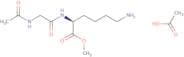
CAS :Ac-Gly-Lys-OMe • AcOH is a synthetic substrate that is used in enzymatic reactions. This product is a peptide that contains an amide bond and a disulfide bond. It has been shown to be inactive when exposed to human serum for up to 30 minutes. Ac-Gly-Lys-OMe • AcOH has been shown to have inhibitory effects on the activity of monoclonal antibodies as well as dodecyl, which belongs to the group of lipids found in blood plasma. The rate of this reaction increases with increasing temperature and pH, but decreases with increasing concentrations of AGLME or dodecanol.Formule :C11H21N3O4•CH3COOHDegré de pureté :Min. 95%Masse moléculaire :319.35 g/molAc-Val-Asp-Val-Ala-Asp-AMC
CAS :Produit contrôléAc-Val-Asp-Val-Ala-Asp-AMC is a research tool used to study the function of ion channels. It is an activator that binds to the receptor site on ATP sensitive potassium channels. Ac-Val-Asp-Val-Ala-Asp-AMC has been shown to inhibit calcium and sodium ion flux through ion channels, as well as high purity and good solubility. This peptide is useful for studying protein interactions, pharmacology, and life science research.
Formule :C33H44N6O12Degré de pureté :Min. 95%Masse moléculaire :716.74 g/mol

![Ac-Gly-Lys-OMe • AcOH [AGLME]](/_next/image/?url=https%3A%2Fstatic.cymitquimica.com%2Fproducts%2F3D%2Fthumb%2FSGK-3058.jpg&w=3840&q=75)