CymitQuimica logo

CAS 147664-63-9

:

Pexiganan

Description :
Pexiganan est un peptide antimicrobien synthétique qui est principalement utilisé pour ses propriétés antibactériennes, en particulier contre les bactéries Gram-négatives. Il est dérivé de la famille des peptides magainine, qui se trouvent naturellement dans la peau de certains amphibiens. Pexiganan présente un large spectre d'activité, ce qui le rend efficace dans le traitement des infections, en particulier dans les formulations topiques pour les plaies. Le mécanisme d'action implique la perturbation des membranes cellulaires bactériennes, entraînant la lyse cellulaire. Ce peptide se caractérise par sa taille relativement petite, consistant généralement en environ 22 acides aminés, et sa nature cationique, qui améliore son interaction avec les membranes bactériennes chargées négativement. Pexiganan est également remarquable pour sa stabilité et sa résistance à la dégradation protéolytique, ce qui contribue à son efficacité dans les applications cliniques. Son développement s'est particulièrement concentré sur la préoccupation croissante concernant la résistance aux antibiotiques, fournissant une approche alternative aux thérapies antibiotiques traditionnelles. Dans l'ensemble, Pexiganan représente un candidat prometteur dans le domaine des agents antimicrobiens, en particulier pour un usage topique.
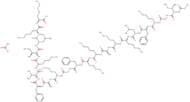
Formule :C122H210N32O22
InChI :InChI=1/C122H210N32O22/c1-13-77(9)102(152-98(155)71-132)120(174)135-73-100(157)139-86(50-26-35-59-125)110(164)150-96(69-82-44-20-16-21-45-82)118(172)148-93(66-74(3)4)116(170)145-90(54-30-39-63-129)113(167)142-87(51-27-36-60-126)109(163)137-79(11)105(159)141-88(52-28-37-61-127)112(166)143-91(55-31-40-64-130)114(168)149-95(68-81-42-18-15-19-43-81)107(161)134-72-99(156)138-85(49-25-34-58-124)108(162)136-80(12)106(160)147-97(70-83-46-22-17-23-47-83)119(173)153-101(76(7)8)121(175)146-92(56-32-41-65-131)115(169)154-103(78(10)14-2)122(176)151-94(67-75(5)6)117(171)144-89(53-29-38-62-128)111(165)140-84(104(133)158)48-24-33-57-123/h15-23,42-47,74-80,84-97,101-103H,13-14,24-41,48-73,123-132H2,1-12H3,(H2,133,158)(H,134,161)(H,135,174)(H,136,162)(H,137,163)(H,138,156)(H,139,157)(H,140,165)(H,141,159)(H,142,167)(H,143,166)(H,144,171)(H,145,170)(H,146,175)(H,147,160)(H,148,172)(H,149,168)(H,150,164)(H,151,176)(H,152,155)(H,153,173)(H,154,169)/t77-,78-,79-,80-,84-,85-,86-,87-,88-,89-,90-,91-,92-,93-,94-,95-,96-,97-,101-,102-,103-/m0/s1
SMILES :CC[C@H](C)[C@@H](C(=NCC(=N[C@@H](CCCCN)C(=N[C@@H](Cc1ccccc1)C(=N[C@@H](CC(C)C)C(=N[C@@H](CCCCN)C(=N[C@@H](CCCCN)C(=N[C@@H](C)C(=N[C@@H](CCCCN)C(=N[C@@H](CCCCN)C(=N[C@@H](Cc1ccccc1)C(=NCC(=N[C@@H](CCCCN)C(=N[C@@H](C)C(=N[C@@H](Cc1ccccc1)C(=N[C@@H](C(C)C)C(=N[C@@H](CCCCN)C(=N[C@@H]([C@@H](C)CC)C(=N[C@@H](CC(C)C)C(=N[C@@H](CCCCN)C(=N[C@@H](CCCCN)C(=N)O)O)O)O)O)O)O)O)O)O)O)O)O)O)O)O)O)O)O)O)O)N=C(CN)O
Synonymes :
  • Pexiganan [INN]
  • Glycyl-L-isoleucylglycyl-L-lysyl-L-phenylalanyl-L-leucyl-L-lysyl-L-lysyl-L-alanyl-L-lysyl-L-lysyl-L-phenylalanylglycyl-L-lysyl-L-alanyl-L-phenylalanyl-L-valyl-L-lysyl-L-isoleucyl-L-leucyl-L-lysyl-L-lysinamide
  • Magainin I, 7-L-lysine-8-L-lysine-10-L-lysine-18-L-lysine-19-de-L-glutamic acid-21-L-leucine-23-L-lysinamide
  • L-Lysinamide, glycyl-L-isoleucylglycyl-L-lysyl-L-phenylalanyl-L-leucyl-L-lysyl-L-lysyl-L-alanyl-L-lysyl-L-lysyl-L-phenylalanylglycyl-L-lysyl-L-alanyl-L-phenylaalanyl-L-valyl-L-lysyl-L-isoleucyl-L-leucyl-L-lysyl-
Trier par

Degré de pureté (%)
0
100
|
0
|
50
|
90
|
95
|
100
4 produits concernés.
  • Pexiganan

    CAS :
    <p>Pexiganan, a synthetic magainin 2 analog, is a broad-spectrum antimicrobial peptide for researching infections like diabetic foot ulcers.</p>
    Formule :C122H210N32O22
    Couleur et forme :Solid
    Masse moléculaire :2477.17
  • Pexiganan

    CAS :
    Custom research peptide; min purity 95%. For different specs please use the Peptide Quote Tool
    Formule :C122H210N32O22
    Masse moléculaire :2,477.21 g/mol

    Ref: 3D-PP50033

    ne
    À demander
  • Pexiganan acetate

    Produit contrôlé
    CAS :
    <p>Pexiganan acetate is the acetate salt form of a polymyxin B derivative that has potent antimicrobial activity against both Gram-positive and Gram-negative bacteria. It has been shown to be effective in the treatment of tissue infections, especially those caused by human pathogens such as Staphylococcus aureus, Pseudomonas aeruginosa, and Escherichia coli. Pexiganan also has significant activity against Mycobacterium tuberculosis and other mycobacteria. The mechanism of action for pexiganan is not fully understood but it may involve the inhibition of bacterial cell wall synthesis, or the disruption of bacterial membranes. Pexiganan was originally isolated from a marine sponge off the coast of Australia in 1961. It had been classified as an antimicrobial peptide (AMP) because of its chemical structure, which includes a polymyxin B moiety. Pexiganan’s AMP classification was later challenged when researchers found that it did</p>
    Formule :C122H210N32O22•(C2H4O2)x
    Degré de pureté :Min. 95%
    Couleur et forme :Powder
    Masse moléculaire :2,477.18 g/mol

    Ref: 3D-FP182746

    25mg
    280,00€
    50mg
    375,00€
    100mg
    481,00€
    250mg
    824,00€
    500mg
    1.195,00€
  • Pexiganan

    CAS :
    <p>Pexiganan is a polymyxin B derivative that has potent antimicrobial activity against both Gram-positive and Gram-negative bacteria. It has been shown to be effective in the treatment of tissue infections, especially those caused by human pathogens such as Staphylococcus aureus, Pseudomonas aeruginosa, and Escherichia coli. Pexiganan also has significant activity against Mycobacterium tuberculosis and other mycobacteria. The mechanism of action for pexiganan is not fully understood but it may involve the inhibition of bacterial cell wall synthesis, or the disruption of bacterial membranes. Pexiganan was originally isolated from a marine sponge off the coast of Australia in 1961. It had been classified as an antimicrobial peptide (AMP) because of its chemical structure, which includes a polymyxin B moiety. Pexiganan’s AMP classification was later challenged when researchers found that it did</p>
    Formule :C122H210N32O22
    Degré de pureté :Min. 95%
    Masse moléculaire :2,477.18 g/mol

    Ref: 3D-FP138116

    10mg
    863,00€
    25mg
    1.013,00€