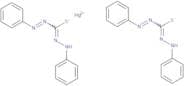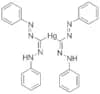
CAS 14783-59-6
:Dithizonate de mercure
- (T-4)-Bis[(2-phenyldiazenecarbothioic acid-κS) 2-phenylhydrazidato-κN<sup>2</sup>]mercury
- Diazenecarbothioic acid, phenyl-, 2-phenylhydrazide, mercury complex
- Mercuric bis(diphenylthiocarbazone)
- Mercuric dithizonate
- Mercury bis(diphenylthiocarbazonate)
- Mercury bis(diphenylthiocarbazone)
- Mercury bis(dithizonate)
- Mercury dithizonate
- Mercury(II) bis(dithizonate)
- Mercury, bis((2-phenyldiazenecarbothioic acid-kappaS) 2-phenylhydrazidato-kappaN2)-, (T-4)-
- Mercury, bis((phenyldiazenecarbothioic acid-kappaS) 2-phenylhydrazidato-kappaN2)-, (T-4)-
- Mercury, bis(dithizonato)-
- Mercury, bis(phenyldiazenecarbothioic acid 2-phenylhydrazidato-N<sup>2</sup>,S)-, (T-4)-
- Mercury, bis[(2-phenyldiazenecarbothioic acid-κS) 2-phenylhydrazidato-κN<sup>2</sup>]-, (T-4)-
- Mercury, bis[(phenylazo)thioformic acid 2-phenylhydrazidato]-
- mercury bis[(E)-N,2-diphenyldiazenecarbohydrazonothioate]
- Mercury, bis[(2-phenyldiazenecarbothioic acid-κS) 2-phenylhydrazidato-κN2]-, (T-4)-
- Voir plus de synonymes
Mercury(II) bis(dithizonate)
CAS :Produit contrôléMercury(II) bis(dithizonate) is an isomeric form of mercury that exhibits photochromism. It has a yellow color in the solid state and can reversibly change to a red color when exposed to light. Mercury(II) bis(dithizonate) is soluble in organic solvents and forms bright yellow crystals with a melting point of 81-82 °C. It has been used as an optical dye for microscopy, where it absorbs ultraviolet radiation and emits visible light. This property makes it useful for detection of bacteria or other microorganisms by optical microscopy or fluorescence microscopy. The solvents acetonitrile, diethylether, or acetone can be used to dissolve this compound. Mercury(II) bis(dithizonate) is metastable which means that it will decompose spontaneously into mercury(I) oxide and hydrogen gas if heated to 180 °C.
Formule :C26H22HgN8S2Degré de pureté :Min. 95%Couleur et forme :Dark Red SolidMasse moléculaire :711.23 g/mol