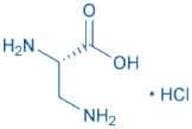
CAS 1482-97-9
:Chlorhydrate de 3-amino-L-alanine
Description :
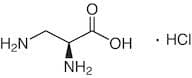
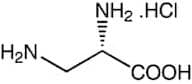
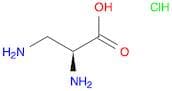
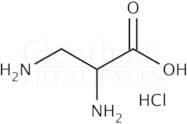
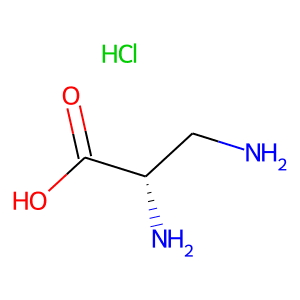
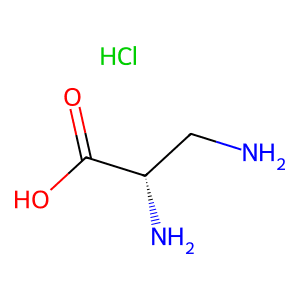
Chlorhydrate de 3-amino-L-alanine, avec le numéro CAS 1482-97-9, est un dérivé de l'acide aminé L-alanine, présentant un groupe amino en position 3 de la chaîne carbonée. Ce composé se rencontre généralement sous forme de poudre cristalline blanche à blanc cassé et est soluble dans l'eau, ce qui est caractéristique de nombreux acides aminés et de leurs dérivés. Il présente des propriétés basiques en raison de la présence du groupe amino, ce qui lui permet de participer à diverses réactions biochimiques. En tant que sel de chlorhydrate, il est stabilisé par la présence d'acide chlorhydrique, améliorant sa solubilité et sa stabilité dans les solutions aqueuses. La 3-amino-L-alanine suscite un intérêt dans la recherche biochimique et pourrait avoir des applications potentielles dans l'étude des voies métaboliques, la synthèse des protéines et comme élément de base dans la synthèse des peptides. Son rôle dans les systèmes biologiques et ses potentielles applications thérapeutiques sont des domaines de recherche en cours, notamment en ce qui concerne ses propriétés structurelles et fonctionnelles dans les protéines et les enzymes.
Formule :C3H9ClN2O2
InChI :InChI=1/C3H8N2O2.ClH/c4-1-2(5)3(6)7;/h2H,1,4-5H2,(H,6,7);1H/t2-;/m0./s1
SMILES :C([C@@H](C(=O)O)N)N.Cl
Synonymes :- alpha,beta-Diaminopropionic acid HCL
- 3-Amino-L-alanine monohydrochloride
- L-3-Aminoalanine hydrochloride
- L(+)-2,3-Diaminopropionic acid HCL
- L(+)-2,3-Diaminopropionic acid hydrochloride
- L-2,3-Diaminopropionic acid monohydrochloride
- 3-Aminoalanine Hydrochloride (1:1)
- 3-amino-D-alanine hydrochloride
- (S)-(+)-2,3-Diaminopropionic Acid HCL
- H-Dap-OH.HCl
- H-Dap-OH・HCl
Trier par
Degré de pureté (%)
0
100
|
0
|
50
|
90
|
95
|
100
10 produits concernés.
(S)-(+)-2,3-Diaminopropionic Acid Hydrochloride
CAS :Formule :C3H8N2O2·HClDegré de pureté :>98.0%(T)(N)Couleur et forme :White to Light yellow powder to crystalMasse moléculaire :140.57(S)-2,3-Diaminopropionic acid monohydrochloride, 95%
CAS :This Thermo Scientific Chemicals brand product was originally part of the Alfa Aesar product portfolio. Some documentation and label information may refer to the legacy brand. The original Alfa Aesar product / item code or SKU reference has not changed as a part of the brand transition to Thermo SciFormule :C3H9ClN2O2Degré de pureté :95%Masse moléculaire :140.573-Amino-L-alanine, HCl
CAS :Formule :C3H9ClN2O2Degré de pureté :98%Couleur et forme :SolidMasse moléculaire :140.5688L-2,3-Diaminopropanoic acid hydrochloride
CAS :L-2,3-Diaminopropanoic acid hydrochlorideFormule :C3H8N2O2·ClHDegré de pureté :98%Couleur et forme : white to off-white solidMasse moléculaire :140.57g/mol2,3-Diaminopropionic acid hydrochloride
CAS :2,3-Diaminopropionic acid hydrochlorideDegré de pureté :≥98%Masse moléculaire :140.57g/mol2,3-Diaminopropionic acid hydrochloride
CAS :2,3-Diaminopropionic acid hydrochloride (3-Amino-L-alanine hydrochloride) is a competitive cystathionase(CTH) inhibitor.Formule :C3H9ClN2O2Degré de pureté :98.77% - 99.77%Couleur et forme :White Crystalline PowderMasse moléculaire :140.57(S)-2,3-Diaminopropanoic acid hydrochloride
CAS :Formule :C3H9ClN2O2Degré de pureté :97%Couleur et forme :SolidMasse moléculaire :140.57L(+)-2,3-Diaminopropionic acid HCl
CAS :L(+)-2,3-Diaminopropionic acid HCl is a chiral modifier that is used in the separation of organic compounds. It has been shown to selectively interact with borate, sulfate, and hydroxyapatite. This interaction changes the physical properties of these substances by modifying their surface charge or adsorption capacity. L(+)-2,3-Diaminopropionic acid HCl has also been shown to be useful in diastereoselective reactions. The technique of elution can be used to isolate specific compounds from mixtures using this compound as a modifier. Hydrogen bonding groups and moieties on the functional group are important factors in the specificity of this interaction.END>>Formule :C3H8N2O2·HClDegré de pureté :Min. 95%Couleur et forme :White PowderMasse moléculaire :140.57 g/molH-Dap-OH · HCl
CAS :Dap salts are used as growth inhibitors for microorganisms. Dap derivatives occur in plants. The Nβ-oxalyl derivative of Dap (β-ODAP, BOAA) which is found in the seeds of the grass pea (Lathyrus sativus), is a strong neurotoxin, whereas the α-isomer is far less toxic.Formule :C3H8N2O2·HClDegré de pureté :> 99%Couleur et forme :White PowderMasse moléculaire :140.57