CAS 149-74-6
:Dichlorométhylphénylsilane
Description :
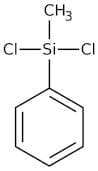
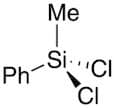
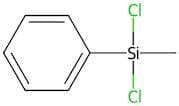
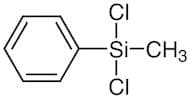
Dichlorométhylphénylsilane, avec le numéro CAS 149-74-6, est un composé organosiliconé caractérisé par la présence d'un atome de silicium lié à un groupe phényle, un groupe méthyle et deux atomes de chlore. Ce composé apparaît généralement sous forme de liquide incolore à jaune pâle et est connu pour sa réactivité, en particulier dans les réactions de substitution nucléophile en raison de la présence des groupes fonctionnels chlorés. Il est souvent utilisé comme agent de couplage silane, améliorant l'adhésion entre les matériaux inorganiques et les polymères organiques. De plus, Dichlorométhylphénylsilane peut servir d'intermédiaire dans la synthèse de divers composés contenant du silicium. Ses propriétés chimiques incluent un point d'ébullition relativement bas et une solubilité modérée dans les solvants organiques, ce qui le rend adapté à diverses applications en science des matériaux et en synthèse organique. Cependant, il doit être manipulé avec précaution en raison de sa toxicité potentielle et de sa réactivité, en particulier en présence d'humidité, ce qui peut entraîner une hydrolyse et la libération d'acide chlorhydrique. Des mesures et des protocoles de sécurité appropriés sont essentiels lors de la manipulation de ce composé.
Formule :C7H8Cl2Si
InChI :InChI=1S/C7H8Cl2Si/c1-10(8,9)7-5-3-2-4-6-7/h2-6H,1H3
Code InChI :InChIKey=GNEPOXWQWFSSOU-UHFFFAOYSA-N
SMILES :[Si](C)(Cl)(Cl)C1=CC=CC=C1
Synonymes :- (Dichloromethylsilyl)benzene
- Benzene, (dichloromethylsilyl)-
- Benzyl(Dichloro)Silane
- Dichlor(methyl)(phenyl)silan
- Dichloro(methyl)(phenyl)silane
- Dichlorophenylmethylsilane
- Dicloro(Fenil)(Metil)Silano
- Ls 1490
- Methylphenyldichlorosilane
- Nsc 96621
- Phenyldichloro(methyl)silane
- Phenylmethyldichlorosilane
- Silane, Methylphenyldichloro-
- Silane, dichloromethylphenyl-
- Tsl 8067
- [(Dichloro)methylsilyl]benzene
- Voir plus de synonymes
Trier par
Degré de pureté (%)
0
100
|
0
|
50
|
90
|
95
|
100
4 produits trouvés.
Dichloromethylphenylsilane, 98%
CAS :Dichloromethylphenylsilane is used as a monomer (‘building block’) in the production of silicone polymers or silicone resins. Silicone polymers may be oils, greases and rubbers. It is also used as an intermediate (starting material) in the production of other organosilicon substances. It is a bifuncFormule :C7H8Cl2SiDegré de pureté :98%Couleur et forme :Liquid, Clear colorless to pale pinkMasse moléculaire :191.13Methylphenyldichlorosilane, min. 97%
CAS :Methylphenyldichlorosilane, min. 97%
Formule :(CH3)(C6H5)SiCl2Degré de pureté :min. 97%Couleur et forme :colorless liq.Masse moléculaire :191.11Methyldichlorophenylsilane
CAS :MethyldichlorophenylsilaneDegré de pureté :95%Masse moléculaire :191.13g/molDichloro(methyl)phenylsilane
CAS :Formule :C7H8Cl2SiDegré de pureté :>98.0%(GC)Couleur et forme :Colorless to Almost colorless clear liquidMasse moléculaire :191.13