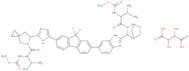
CAS 1499193-68-8
:Acide carbamique, N-[(1S)-1-[[(6S)-6-[5-[9,9-difluoro-7-[2-[(1R,3S,4S)-2-[(2S)-2-[(méthoxycarbonyl)amino]-3-méthyl-1-oxobutyl]-2-azabicyclo[2.2.1]hept-3-yl]-1H-benzimidazol-6-yl]-9H-fluorène-2-yl]-1H-imidazol-2-yl]-5-azaspiro[2.4]hept-5-yl]carbonyl]-2-méthylpropyl]-, ester méthylique, (2S,3S)-2,3-dihydroxybutanedioate (1:1)
Description :
L'acide carbamique, N-[(1S)-1-[[[6S)-6-[5-[9,9-difluoro-7-[2-[(1R,3S,4S)-2-[(2S)-2-[(méthoxycarbonyle)amino]-3-méthyl-1-oxobutyle]-2-azabicyclo[2.2.1]hept-3-yle]-1H-benzimidazol-6-yle]-9H-fluorène-2-yle]-1H-imidazol-2-yle]-5-azaspiro[2.4]hept-5-yle]carbonyle]-2-méthylpropyle]-, ester méthylique, (2S,3S)-2,3-dihydroxybutanedioate est un composé organique complexe caractérisé par sa structure moléculaire complexe, qui comprend plusieurs groupes fonctionnels tels que l'acide carbamique, l'ester et les groupes hydroxyles. Ce composé présente un centre chiral, indiquant un potentiel stéréoisomérisme, et contient plusieurs cycles hétérocycliques, contribuant à son activité biologique potentielle. La présence de moieties difluoro et azabicycliques suggère qu'il pourrait présenter des propriétés chimiques et une réactivité uniques. Son poids moléculaire et ses caractéristiques de solubilité dépendraient de l'arrangement spécifique de ses substituants. Étant donné sa complexité, ce composé pourrait être d'un intérêt en chimie médicinale, en particulier dans le développement de médicaments, en raison de ses interactions potentielles avec des cibles biologiques. D'autres études seraient nécessaires pour élucider ses propriétés et applications spécifiques.
Formule :C49H54F2N8O6·C4H6O6
InChI :InChI=1S/C49H54F2N8O6.C4H6O6/c1-24(2)39(56-46(62)64-5)44(60)58-23-48(15-16-48)21-38(58)42-52-22-37(55-42)28-9-13-32-31-12-8-26(18-33(31)49(50,51)34(32)19-28)27-10-14-35-36(20-27)54-43(53-35)41-29-7-11-30(17-29)59(41)45(61)40(25(3)4)57-47(63)65-6;5-1(3(7)8)2(6)4(9)10/h8-10,12-14,18-20,22,24-25,29-30,38-41H,7,11,15-17,21,23H2,1-6H3,(H,52,55)(H,53,54)(H,56,62)(H,57,63);1-2,5-6H,(H,7,8)(H,9,10)/t29-,30+,38-,39-,40-,41-;1-,2-/m00/s1
Code InChI :InChIKey=ZQVLPYMRXLPMDX-KEAIDYLOSA-N
SMILES :C([C@@H](NC(OC)=O)[C@@H](C)C)(=O)N1CC2(C[C@H]1C=3NC(=CN3)C=4C=C5C(=CC4)C=6C(C5(F)F)=CC(=CC6)C=7C=C8C(=CC7)N=C(N8)[C@H]9N(C([C@@H](NC(OC)=O)C(C)C)=O)[C@]%10(C[C@@]9(CC%10)[H])[H])CC2.[C@H]([C@@H](C(O)=O)O)(C(O)=O)O
Synonymes :- Carbamic acid, N-[(1S)-1-[[(6S)-6-[5-[9,9-difluoro-7-[2-[(1R,3S,4S)-2-[(2S)-2-[(methoxycarbonyl)amino]-3-methyl-1-oxobutyl]-2-azabicyclo[2.2.1]hept-3-yl]-1H-benzimidazol-6-yl]-9H-fluoren-2-yl]-1H-imidazol-2-yl]-5-azaspiro[2.4]hept-5-yl]carbonyl]-2-methylpropyl]-, methyl ester, (2S,3S)-2,3-dihydroxybutanedioate (1:1)
Trier par
Degré de pureté (%)
0
100
|
0
|
50
|
90
|
95
|
100
1 produits concernés.
Ledipasvir D-tartrate
CAS :Ledipasvir D-tartrate is an antiviral compound, which is a direct-acting antiviral agent used in the treatment of hepatitis C virus (HCV) infection. It originates from synthetic sources designed to inhibit the replication of specific viral proteins. Ledipasvir functions by targeting the NS5A protein of the hepatitis C virus, a key component necessary for viral replication. By binding to this protein, Ledipasvir disrupts and inhibits the HCV replication complex, effectively suppressing the viral load in patients.
Formule :C53H60F2N8O12Degré de pureté :Min. 95%Masse moléculaire :1,039.1 g/mol