CAS 151823-14-2
:Sapacitabine
Description :
Sapacitabine est un analogue de nucléoside synthétique avec la formule chimique C11H14N4O4S. Il est principalement caractérisé par son mécanisme d'action en tant qu'agent antinéoplasique, ciblant les cellules cancéreuses en interférant avec la synthèse et la réparation de l'ADN. Sapacitabine est conçu pour être activé dans le corps, conduisant à la formation d'une forme trifosphate qui peut être incorporée dans l'ADN, entraînant des effets cytotoxiques. Ce composé a été étudié pour son utilisation potentielle dans le traitement de diverses malignités hématologiques et tumeurs solides. Sa structure unique comprend un atome de soufre, qui contribue à son activité biologique. Sapacitabine est généralement administré par voie orale et a été étudié dans des essais cliniques pour évaluer son efficacité et son profil de sécurité. Comme de nombreux agents chimiothérapeutiques, les effets secondaires potentiels peuvent inclure une myélosuppression, des troubles gastro-intestinaux et d'autres effets systémiques, nécessitant une surveillance attentive pendant le traitement. Dans l'ensemble, Sapacitabine représente une approche prometteuse dans la thérapie du cancer, en particulier pour les patients atteints de types spécifiques de malignités.
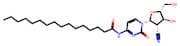
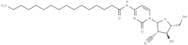
Formule :C26H42N4O5
InChI :InChI=1S/C26H42N4O5/c1-2-3-4-5-6-7-8-9-10-11-12-13-14-15-23(32)28-22-16-17-30(26(34)29-22)25-20(18-27)24(33)21(19-31)35-25/h16-17,20-21,24-25,31,33H,2-15,19H2,1H3,(H,28,29,32,34)/t20-,21+,24-,25+/m0/s1
Code InChI :InChIKey=LBGFKUUHOPIEMA-PEARBKPGSA-N
SMILES :C(#N)[C@@H]1[C@@H](O[C@H](CO)[C@H]1O)N2C(=O)N=C(NC(CCCCCCCCCCCCCCC)=O)C=C2
Synonymes :- 1-(2-cyano-2-deoxy-beta-D-arabinofuranosyl)-4-(hexadecanoylamino)pyrimidin-2(1H)-one
- Cs-682
- Cyc 682
- Hexadecanamide, N-[1-(2-cyano-2-deoxy-β-<span class="text-smallcaps">D</span>-arabinofuranosyl)-1,2-dihydro-2-oxo-4-pyrimidinyl]-
- N-[1-(2-Cyano-2-deoxy-β-<span class="text-smallcaps">D</span>-arabinofuranosyl)-1,2-dihydro-2-oxo-4-pyrimidinyl]hexadecanamide
- N-[1-[(2R,3S,4S,5R)-3-cyano-4-hydroxy-5-(hydroxymethyl)oxolan-2-yl]-2- oxo-pyrimidin-4-yl]hexadecanamide
- N-[1-(2-Cyano-2-deoxy-β-D-arabinofuranosyl)-1,2-dihydro-2-oxo-4-pyrimidinyl]hexadecanamide
- Hexadecanamide, N-[1-(2-cyano-2-deoxy-β-D-arabinofuranosyl)-1,2-dihydro-2-oxo-4-pyrimidinyl]-
- Sapacitabine
Trier par
Degré de pureté (%)
0
100
|
0
|
50
|
90
|
95
|
100
4 produits concernés.
Sapacitabine
CAS :Sapacitabine is an oral prodrug that is converted to its active form, the cytotoxic agent 9-β-D-arabinofuranosyladenine (araA), by cellular enzymes. It has potent antitumor activity against solid tumours and has been shown to be effective in a variety of human cancer cell lines. Sapacitabine targets intracellular targets, including DNA methyltransferases and other enzymes involved in the synthesis of RNA and DNA. The drug has been shown to have synergistic effects when used with other cytotoxic agents such as 5-fluorouracil and gemcitabine, which are also inhibitors of DNA methyltransferase.
Formule :C26H42N4O5Degré de pureté :Min. 95%Masse moléculaire :490.64 g/molSapacitabine
CAS :Sapacitabine (CS682) is a nucleoside analog precursor with anticancer activity used in the study of leukemia.Formule :C26H42N4O5Degré de pureté :98.82%Couleur et forme :SolidMasse moléculaire :490.64