CAS 152504-10-4
:Trier par
Degré de pureté (%)
0
100
|
0
|
50
|
90
|
95
|
100
10 produits concernés.
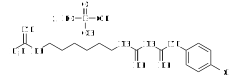
Chlorhexidine EP Impurity N Diphosphate
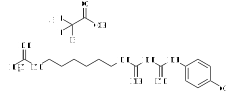
CAS :Formule :C15H25ClN8·2H3O4PMasse moléculaire :352.87 2*97.99Chlorhexidine EP Impurity N Tritrifluoroacetate
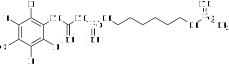
CAS :Formule :C15H25ClN8·3C2HF3O2Masse moléculaire :352.87 3*114.02Chlorhexidine Digluconate Impurity N Hydrochloride
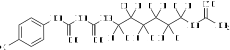
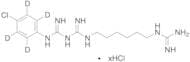
CAS :Formule :C15H25ClN8•x(HCl)Couleur et forme :White To Light YellowMasse moléculaire :352.873646Chlorhexidine Digluconate Impurity N-d4 Hydrochloride
CAS :Produit contrôléApplications Chlorhexidine Digluconate Impurity N-d4 Hydrochloride, is labelled Chlorhexidine Digluconate Impurity N (C377660), which is a degradation product found in chlorhexidine digluconate solution.
Not a dangerous good if item is equal to or less than 1g/ml and there is less than 100g/ml in the package
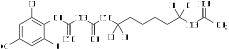
References Revelle, L., et. al.: Pharmaceut. Res., 10, 1777 (1993)Formule :C15H21D4ClN8•xHClCouleur et forme :NeatMasse moléculaire :356.893646Chlorhexidine EP Impurity N hydrochloride
CAS :Chlorhexidine is an antimicrobial agent that has been shown to be effective against escherichia and chlorobenzene. It also has a low toxicity for humans and animals, as well as for the environment. Chlorhexidine EP Impurity N is a chlorhexidine impurity that is produced during the synthesis of chlorhexidine acetate. This impurity can be used in research to measure hydrogen peroxide levels, which can help determine the purity of chlorhexidine acetate. Recoveries of this compound were found to be high in human dental plaque and pneumococcus bacteria. Average recoveries were found to be higher when measured by ultraviolet spectroscopy than by gas chromatography-mass spectroscopy (GC-MS).Formule :C15H25ClN8•(HCl)xDegré de pureté :Min. 95%Masse moléculaire :352.87 g/mol