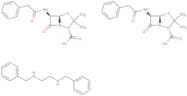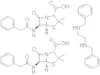
CAS 1538-09-6
:Benzathine pénicilline
Description :
Benzathine pénicilline est une forme de pénicilline à action prolongée, principalement utilisée comme antibiotique pour traiter diverses infections bactériennes, en particulier la fièvre rhumatismale et la syphilis. C'est un sel de pénicilline G, caractérisé par sa durée d'action prolongée en raison de sa libération lente du site d'injection. Le composé est généralement administré par injection intramusculaire et est connu pour son efficacité contre une gamme de bactéries gram-positives. Benzathine pénicilline est relativement stable en solution et a une faible solubilité dans l'eau, ce qui contribue à ses effets thérapeutiques prolongés. Son mécanisme d'action implique l'inhibition de la synthèse de la paroi cellulaire bactérienne, entraînant la lyse cellulaire et la mort. Les effets secondaires courants peuvent inclure des réactions allergiques, des douleurs au site d'injection et des troubles gastro-intestinaux. En raison de ses propriétés pharmacocinétiques, Benzathine pénicilline est souvent utilisé dans des traitements prophylactiques pour prévenir les infections chez les populations à haut risque. Dans l'ensemble, il reste un élément vital dans la gestion de certaines maladies infectieuses, en particulier dans des contextes où l'adhésion aux régimes de médication quotidienne peut être difficile.
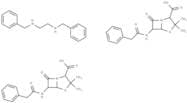
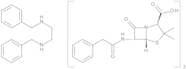
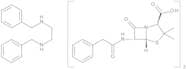
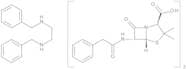
Formule :C16H20N2·2C16H18N2O4S
InChI :InChI=1S/C16H18N2O4S.C16H20N2/c1-16(2)12(15(21)22)18-13(20)11(14(18)23-16)17-10(19)8-9-6-4-3-5-7-9;1-3-7-15(8-4-1)13-17-11-12-18-14-16-9-5-2-6-10-16/h3-7,11-12,14H,8H2,1-2H3,(H,17,19)(H,21,22);1-10,17-18H,11-14H2/t11-,12+,14-;/m1./s1
Code InChI :InChIKey=JTFXYBGKLCCFSP-LQDWTQKMSA-N
SMILES :C(NCCNCC1=CC=CC=C1)C2=CC=CC=C2.C(O)(=O)[C@@H]1N2[C@@]([C@H](NC(CC3=CC=CC=C3)=O)C2=O)(SC1(C)C)[H]
Synonymes :- (2S,5R,6R)-3,3-dimethyl-7-oxo-6-[(phenylacetyl)amino]-4-thia-1-azabicyclo[3.2.0]heptane-2-carboxylic acid - N,N'-dibenzylethane-1,2-diamine (2:1)
- 1,2-Ethanediamine, N,N′-bis(phenylmethyl)-, bis[(2S,5R,6R)-3,3-dimethyl-7-oxo-6-[(phenylacetyl)amino]-4-thia-1-azabicyclo[3.2.0]heptane-2-carboxylate]
- 1,2-Ethanediamine, N,N′-bis(phenylmethyl)-, bis[[2S-(2α,5α,6β)]-3,3-dimethyl-7-oxo-6-[(phenylacetyl)amino]-4-thia-1-azabicyclo[3.2.0]heptane-2-carboxylate]
- 4-Thia-1-azabicyclo[3.2.0]heptane-2-carboxylic acid, 3,3-dimethyl-7-oxo-6-(2-phenylacetamido)-, compd. with N,N′-dibenzylethylenediamine (2:1)
- 4-Thia-1-azabicyclo[3.2.0]heptane-2-carboxylic acid, 3,3-dimethyl-7-oxo-6-[(2-phenylacetyl)amino]- (2S,5R,6R)-, compd. with N<sup>1</sup>,N<sup>2</sup>-bis(phenylmethyl)-1,2-ethanediamine (2:1)
- 4-Thia-1-azabicyclo[3.2.0]heptane-2-carboxylic acid, 3,3-dimethyl-7-oxo-6-[(phenylacetyl)amino]- (2S,5R,6R)-, compd. with N,N′-bis(phenylmethyl)-1,2-ethanediamine (2:1)
- 4-Thia-1-azabicyclo[3.2.0]heptane-2-carboxylic acid, 3,3-dimethyl-7-oxo-6-[(phenylacetyl)amino]- [2S-(2α,5α,6β)]-, compd. with N,N′-bis(phenylmethyl)-1,2-ethanediamine (2:1)
- Beacillin
- Benepen
- Benzacillin
- Benzapen
- Benzathine Benzylpenicillin
- Benzathine Penicillin
- Benzathine penicillin G
- Benzethacil
- Benzylpenicillin N,N′-dibenzylethylenediamine salt
- Benzylpenicillin benzathine
- Benzylpenicillin dibenzylethylenediamine salt
- Bica-penicillin
- Bicillin
- Bicillin 1
- Bicillin G
- Bicillin I
- Bicillin L-A
- Cepacilina
- Cillenta
- Debecillin
- Debecylina
- Diamine penicillin
- Dibencil
- Dibencillin
- Dibenzylethylenediamine dipenicillin G
- Duropenin
- Ethylenediamine, N,N′-dibenzyl-, bis[3,3-dimethyl-7-oxo-6-(2-phenylacetamido)-4-thia-1-azabicyclo[3.2.0]heptane-2-carboxylate]
- Ethylenediamine, N,N′-dibenzyl-, compd. with penicillin G (1:2)
- Extencilline
- Extenicilline
- Lentopenil
- Longacilina
- Longicil
- Megacillin suspension
- Moldamin
- N,N-dibenzylethylenediammonium bis(6-benzylpenicillanate)
- N,N′-Dibenzylethylenediamine bis[benzyl penicillin]
- N,N′-Dibenzylethylenediamine salt of benzylpenicillin
- Neolin
- Pen-Di-Ben
- Penadur
- Pendepon
- Penditan
- Penduran
- Penicillin G Benzathin
- Penicillin G, N,N′-dibenzylethylenediamine salt
- Penicillin G, compd. with N,N′-dibenzylethylenediamine (2:1)
- Penicom 12
- Penidural
- Penidure
- Permapen
- Strepdipen-Suspension
- Tardocillin
- Vicin
- Voir plus de synonymes
Trier par
Degré de pureté (%)
0
100
|
0
|
50
|
90
|
95
|
100
8 produits concernés.
BENZATHINE BENZYLPENICILLIN CRS
CAS :BENZATHINE BENZYLPENICILLIN CRSFormule :C48H56N6O8S2Couleur et forme :White. Powder.Masse moléculaire :909.1236Penicillin G benzathine
CAS :Penicillin G benzathine has anti-bacterial infectious activity and can be used to study early syphilis.Formule :C48H56N6O8S2Degré de pureté :97.99%Couleur et forme :CoaMasse moléculaire :909.13Penicillin G benzathine
CAS :Formule :C48H56N6O8S2Degré de pureté :≥ 98.0%Couleur et forme :White to faint yellow or faint beige powder or crystalsMasse moléculaire :909.12Benzylpenicillin Benzathine
CAS :Produit contrôléFormule :C16H20N2C16H18N2O4SCouleur et forme :NeatMasse moléculaire :909.12Benzathine penicilline G
CAS :Produit contrôléFormule :C16H20N2C16H18N2O4SCouleur et forme :NeatMasse moléculaire :909.12Penicillin G benzathine anhydrous
CAS :Penicillin G benzathine anhydrous is a penicillin antibiotic. It is used to treat bacterial infections, including syphilis, streptococcal pharyngitis, and other infectious diseases. Penicillin G benzathine anhydrous is administered intramuscularly or intravenously. The drug can be detected in the blood after administration, which makes it useful for diagnosis of infectious diseases. Penicillin G benzathine anhydrous has shown statistically significant efficacy in treatment trials that were conducted on patients with infectious diseases. However, there have been increasing reports of high resistance to this drug in recent years. Interferon alfa-2b may be used as adjunctive therapy for resistant cases.
Formule :C16H20N2•(C16H18N2O4S)2Degré de pureté :Min. 95%Couleur et forme :White PowderMasse moléculaire :909.13 g/mol