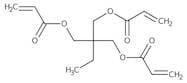
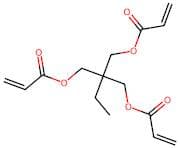
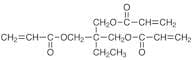
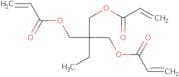
![2-Propenoic acid, 2-ethyl-2-[[(1-oxo-2-propenyl)oxy]methyl]-1,3-propanediyl ester](/_next/image/?url=https%3A%2Fstatic.cymitquimica.com%2Fcas-image%2Fthumb-webp%2F403763-trimethylolpropane-triacrylate.webp&w=3840&q=75)
CAS 15625-89-5
:Acide 2-propénoïque, 2-éthyl-2-[[(1-oxo-2-propényl)oxy]méthyl]-1,3-propanediyl ester
Description :
Acide 2-propénoïque, 2-éthyl-2-[[(1-oxo-2-propényl)oxy]méthyl]-1,3-propanediyl ester, communément connu comme un type d'ester acrylique, est un composé chimique caractérisé par sa structure qui comprend à la fois un acrylate et un groupe fonctionnel ester. Ce composé apparaît généralement sous forme de liquide incolore à jaune pâle et est connu pour sa réactivité, en particulier dans les processus de polymérisation. Il a une viscosité relativement basse et est soluble dans des solvants organiques, ce qui le rend utile dans diverses applications, y compris les revêtements, les adhésifs et les scellants. La présence du groupe acrylate permet une polymérisation rapide sous lumière UV ou chaleur, ce qui est avantageux dans les processus de fabrication. De plus, ce composé peut présenter une toxicité modérée et doit être manipulé avec précaution, en suivant les directives de sécurité appropriées. Sa structure unique contribue à son utilité dans la création de polymères avec des propriétés spécifiques, telles que la flexibilité et la durabilité, qui sont essentielles dans de nombreuses applications industrielles.
Formule :C15H20O6
InChI :InChI=1/C15H20O9/c16-8-15(9-17,10-18)7-14(4-1-11(19)20,5-2-12(21)22)6-3-13(23)24/h1-6,16-18H,7-10H2,(H,19,20)(H,21,22)(H,23,24)/p-3/b4-1+,5-2+,6-3+
Code InChI :InChIKey=DAKWPKUUDNSNPN-UHFFFAOYSA-N
SMILES :C(COC(C=C)=O)(COC(C=C)=O)(COC(C=C)=O)CC
Synonymes :- 1,1,1-Tri(acryloyloxymethyl)propane
- 1,1,1-Trimethylolpropane triacrylate
- 1,3-Propanediol, 2-ethyl-2-(hydroxymethyl)-, triacrylate
- 2,2-Bis(prop-2-enoyloxymethyl)butyl prop-2-enoate
- 2,2-Bis[(acryloyloxy)methyl]butyl acrylate
- 2-Ethyl-2-(hydroxymethyl)-1,3-propanediol triacrylate
- 2-Ethyl-2-[[(1-Oxoallyl)Oxy]Methyl]-1,3-Propanediyl Diacrylate
- 2-Ethyl-2-[[(1-oxoallyl)oxy]methyl]-1,3-propandiyldiacrylat
- 2-Propenoic acid, 1,1'-[2-ethyl-2-[[(1-oxo-2-propen-1-yl)oxy]methyl]-1,3-propanediyl] ester
- A-Tmpt
- Acrylic acid, triester with 2-ethyl-2-(hydroxymethyl)-1,3-propanediol
- Ageflex TMPTA
- AgiSyn 2811
- Aronix M 308
- Aronix M 309
- Aronix M 709
- Blemmer ATT
- Clm 400
- Cognis 4006
- Diacrilato De 2-Etil-2-[[(1-Oxoalil)Oxi]Metil]-1,3-Propanodiilo
- Diacrylate De 2-Ethyl-2-[[(1-Oxoallyl)Oxy]Methyl]-1,3-Propanediyle
- Diacrylate de 2-ethyl-2-[[(1-oxoallyl)oxy]methyl]propane-1,3-diyle
- Ebecryl TMPTA
- Em 231
- Em 231Tf
- Em 232
- Etermer 231
- Etermer EM 231
- Genomer 1330
- Kayarad KS-TMPTA
- Kayarad M 309
- Kayarad TMPTA
- Ks-Tmpta
- Laromer PR 9119
- Laromer TMPTA
- Light Acrylate TMP-A
- Lm 353
- M 300
- M 308
- M 309
- M 380
- Miramer 300
- Miramer M 300
- Miramer M 3130
- Monocizer TD 1500A
- NK Ester A-TMPT
- Neomer TA 300
- Newfrontier TMPT
- Photomer 4006
- Photomer 4006F
- Pl 400
- Saret 351
- Saret SR 519HP
- Sartomer 351
- Sartomer 351HP
- Sartomer 357
- Sartomer SR 351
- Setalux UV 2241
- Sm 631
- Sr 305
- Sr 315S
- Sr 351
- Sr 351H
- Sr 351Hp
- Sr 351Lv
- Sr 351Ns
- Sr 351S
- Sr 354
- Sr 454D-Ns
- Sr 519Hp
- T 30
- Td 1500A
- Tmp 3A
- Tmp 3A3
- Tmp-A
- Tmpta
- Tmpta-N
- Triacrylate, Trimethylolpropane
- Trimethylol Propane Triacrylate
- Trimethylolpropane triacrylate
- Trimethylolpropane tripropenoate
- V 295
- Viscoat 295
- Viscoat PET-S
- Viscoat TMP 3A
- Viscoat V 295
- 2-Propenoic acid, 2-ethyl-2-[[(1-oxo-2-propenyl)oxy]methyl]-1,3-propanediyl ester
- HEXAGLYCERINE TRIACRYLATE
- setaluxuv2241
- 1,1,1-TRIMETHYLOL PROPANE TRIACRYLATE
- acrylicacid,triesterwith2-ethyl-2-(hydroxymethyl)-1,3-propanediol
- ogumontt200
- m309
- 2-propenoicacid,2-ethyl-2-(((1-oxo-2-propenyl)oxy)methyl)-1,3-propanediyle
- sartomersr351
- acrylicacid,1,1,1-(trihydroxymethyl)propanetriester
- nkesteratmpt
- sr351
- saret351
- 3-propanediol,2-ethyl-2-(hydroxymethyl)-triacrylate
- 1,1,1-(TRIHYDROXYMETHYL)PROPANE TRIACRYLATE
- Voir plus de synonymes
Trier par
Degré de pureté (%)
0
100
|
0
|
50
|
90
|
95
|
100
5 produits concernés.
Trimethylolpropane triacrylate, stabilized
CAS :This Thermo Scientific Chemicals brand product was originally part of the Alfa Aesar product portfolio. Some documentation and label information may refer to the legacy brand. The original Alfa Aesar product / item code or SKU reference has not changed as a part of the brand transition to Thermo Sci
Formule :(CH2CHCO2CH2)3CCH2CH3Couleur et forme :Liquid, Clear colorless to pale yellowMasse moléculaire :296.31Trimethylolpropane Triacrylate
CAS :Formule :C15H20O6Degré de pureté :90%Couleur et forme :LiquidMasse moléculaire :296.31571,1,1-Tris(Acryloyloxymethyl)Propane
CAS :1,1,1-Tris(Acryloyloxymethyl)PropaneDegré de pureté :95%Masse moléculaire :296.32g/molTrimethylolpropane Triacrylate (stabilized with MEHQ)
CAS :Formule :C15H20O6Degré de pureté :>75.0%(GC)Couleur et forme :Colorless to Light yellow to Light orange clear liquidMasse moléculaire :296.32Trimethylolpropane triacrylate - stabilized with MEHQ
CAS :Trimethylolpropane triacrylate (TMPTA) is a glycol ester that reacts with acrylates and other monomers to form polymers. It has been used in coating materials as well as in the production of polymers for adhesives, paint, and varnishes. TMPTA has been shown to be carcinogenic in animal studies. In humans, exposure to TMPTA may lead to allergic skin reactions, but no long-term health effects have been observed. TMPTA is produced by reacting methyl ethyl alcohol with phosphorus pentoxide at temperatures above 140°C and then adding a catalyst such as MEHQ or MTOA. The reaction mechanism of this process is similar to that of an esterification reaction and the product is an acrylate. The reaction solution contains residual alcohols which can react with moisture in the air, forming water vapor and lower molecular weight molecules. This polymerization process is also known as "freeFormule :C15H20O6Degré de pureté :Min. 95%Masse moléculaire :296.32 g/mol