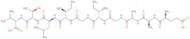
CAS 156251-01-3
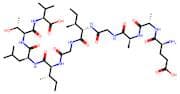
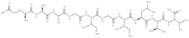
:H-GLU-ALA-ALA-GLY-ILE-GLY-ILE-LEU-THR-VAL-OH
Description :
La substance chimique portant le nom "H-GLU-ALA-ALA-GLY-ILE-GLY-ILE-LEU-THR-VAL-OH" et le numéro CAS "156251-01-3" est un peptide composé d'une séquence d'acides aminés. Ce peptide présente une combinaison de résidus hydrophiles et hydrophobes, ce qui peut influencer sa solubilité et son interaction avec les membranes biologiques. La présence d'acide glutamique (GLU) introduit une chaîne latérale chargée négativement, tandis que les acides aminés à chaîne ramifiée comme l'isoleucine (ILE) et la leucine (LEU) contribuent à son caractère hydrophobe. Le groupe hydroxyle terminal (OH) suggère qu'il peut avoir certaines caractéristiques polaires, ce qui pourrait améliorer sa solubilité dans des environnements aqueux. Des peptides comme celui-ci peuvent jouer des rôles significatifs dans les processus biologiques, y compris la signalisation, l'activité enzymatique et les fonctions structurelles dans les protéines. La séquence et la composition spécifiques peuvent également affecter son activité biologique, sa stabilité et ses applications potentielles en pharmacie ou en biotechnologie. Comprendre les propriétés de tels peptides est crucial pour leur utilisation dans des contextes de recherche et thérapeutiques.
Formule :C42H74N10O14
Synonymes :- Glu-Ala-Ala-Gly-Ile-Gly-Ile-Leu-Thr-Val
- Eaagigiltv
- Antigen Sk29-Aa (26-35) (Human)
- Antigen Lb39-Aa (26-35) (Human)
- Mart 1 (26-35)
- Mart-1 (26-35) (Human)
- Melanoma Antigen Recognized By T-Cells 1 (26-35) (Human)
Trier par
Degré de pureté (%)
0
100
|
0
|
50
|
90
|
95
|
100
6 produits concernés.
MART-1 (26-35) (human)
CAS :MART-1 (26-35) has been shown to be better recognized by a number of polyclonal and monoclonal populations of tumor-reactive HLA-A*0201-restricted cytotoxic T lymphocytes (CTL) than MART-1 (27-35) (human).Formule :C42H74N10O14Degré de pureté :96.7%Couleur et forme :WhiteMasse moléculaire :943.11MART-1 (26-35) (human)
CAS :MART-1 (26-35) (human) (MART-1 (26-35) human) is a peptide fragment of MART-1 protein.Formule :C42H74N10O14Degré de pureté :>99.99%Couleur et forme :SolidMasse moléculaire :943.1MART-1 (26-35)
CAS :Native Melan-A (26-35) decapeptide derives from the melanocyte lineage-specific protein Melan-A/MART-1, which is expressed in almost 75-100% of primary and metastatic melanomas. The region 26-35 of Melan-A protein acts as an antigenic peptide that is recognized by CD8+ tumor-reactive cytolytic T lymphocytes (CTLs) for designing antigen-specific cancer vaccines1. It has been shown that CD8+ Melan-A-specific CTLs isolated from melanoma patients efficiently lyse the Melan-A-expressing HLA-A*0201+ melanoma cell line. However, CTLs preferentially recognize the Melan-A (26-35) peptide as compared with the Melan-A (27-35) peptide. Moreover, the Melan-A (26-35) A27L analog (ELAGIGILTV) has a higher binding affinity to HLA-A*0201 than the native Melan-A (26-35) peptide (EAAGIGILTV), and consequently displays more potent antigenicity and immunogenicity. It has been reported that the concentration of Melan-A (26-35) A27L analog required to obtain 50% of maximal antigenic activity (EC50) is 0.01nM, whereas that of the native Melan-A (26-35) peptide is 0.25nM1. Therefore, the relative activity of Melan-A (26-35) A27L analog is 25 fold higher than that of the native Melan-A (26-35) peptide. Furthermore, functional competition assay has shown that the concentration of Melan-A (26-35) A27L analog required to achieve 50% inhibition (IC50) of tumor lysis is 2nM, which is 10 fold lower than that of the native Melan-A (26-35) peptide. Regarding peptide stability in human serum, the half-lifes (t1/2) of the native Melan-A (26-35) peptide and the A27L analog are quite similar (45 and 40min, respectively) as measured by HPLC-ESI-MS, but much higher than that of the Melan-A (27-35) nonapeptide (5min).Formule :C42H74N10O14Couleur et forme :PowderMasse moléculaire :943.1 g/molMART-1 (26-35) (human)
CAS :Native Melan-A (26-35) decapeptide derives from the melanocyte lineage-specific protein Melan-A/MART-1, which is expressed in almost 75-100% of primary and metastatic melanomas. The region 26-35 of Melan-A protein acts as an antigenic peptide that is recognized by CD8+ tumor-reactive cytolytic T lymphocytes (CTLs) for designing antigen-specific cancer vaccines1. It has been shown that CD8+ Melan-A-specific CTLs isolated from melanoma patients efficiently lyse the Melan-A-expressing HLA-A*0201+ melanoma cell line. However, CTLs preferentially recognize the Melan-A (26-35) peptide as compared with the Melan-A (27-35) peptide. Moreover, the Melan-A (26-35) A27L analog (ELAGIGILTV) has a higher binding affinity to HLA-A*0201 than the native Melan-A (26-35) peptide (EAAGIGILTV), and consequently displays more potent antigenicity and immunogenicity. It has been reported that the concentration of Melan-A (26-35) A27L analog required to obtain 50% of maximal antigenic activity (EC50) is 0.01nM, whereas that of the native Melan-A (26-35) peptide is 0.25nM1. Therefore, the relative activity of Melan-A (26-35) A27L analog is 25 fold higher than that of the native Melan-A (26-35) peptide. Furthermore, functional competition assay has shown that the concentration of Melan-A (26-35) A27L analog required to achieve 50% inhibition (IC50) of tumor lysis is 2nM, which is 10 fold lower than that of the native Melan-A (26-35) peptide. Regarding peptide stability in human serum, the half-lifes (t1/2) of the native Melan-A (26-35) peptide and the A27L analog are quite similar (45 and 40min, respectively) as measured by HPLC-ESI-MS, but much higher than that of the Melan-A (27-35) nonapeptide (5min).Formule :C42H74N10O14Masse moléculaire :943.11 g/molMART-1 (26-35) (human) trifluoroacetate salt
CAS :Native Melan-A (26-35) decapeptide derives from the melanocyte lineage-specific protein Melan-A/MART-1, which is expressed in almost 75-100% of primary and metastatic melanomas. The region 26-35 of Melan-A protein acts as an antigenic peptide that is recognized by CD8+ tumor-reactive cytolytic T lymphocytes (CTLs) for designing antigen-specific cancer vaccines1. It has been shown that CD8+ Melan-A-specific CTLs isolated from melanoma patients efficiently lyse the Melan-A-expressing HLA-A*0201+ melanoma cell line. However, CTLs preferentially recognize the Melan-A (26-35) peptide as compared with the Melan-A (27-35) peptide. Moreover, the Melan-A (26-35) A27L analog (ELAGIGILTV) has a higher binding affinity to HLA-A*0201 than the native Melan-A (26-35) peptide (EAAGIGILTV), and consequently displays more potent antigenicity and immunogenicity. It has been reported that the concentration of Melan-A (26-35) A27L analog required to obtain 50% of maximal antigenic activity (EC50) is 0.01nM, whereas that of the native Melan-A (26-35) peptide is 0.25nM1. Therefore, the relative activity of Melan-A (26-35) A27L analog is 25 fold higher than that of the native Melan-A (26-35) peptide. Furthermore, functional competition assay has shown that the concentration of Melan-A (26-35) A27L analog required to achieve 50% inhibition (IC50) of tumor lysis is 2nM, which is 10 fold lower than that of the native Melan-A (26-35) peptide. Regarding peptide stability in human serum, the half-lifes (t1/2) of the native Melan-A (26-35) peptide and the A27L analog are quite similar (45 and 40min, respectively) as measured by HPLC-ESI-MS, but much higher than that of the Melan-A (27-35) nonapeptide (5min).Formule :C42H74N10O14Degré de pureté :Min. 95%Masse moléculaire :943.1 g/mol