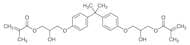
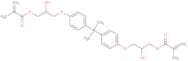
CAS 1565-94-2
:Éther diglycidylique de bisphénol A diméthacrylate
Description :
Éther diglycidylique de bisphénol A diméthacrylate (communément appelé BADGE-DMA) est un composé organique synthétique caractérisé par sa structure multifonctionnelle, qui comprend des groupes époxy et méthacrylate. Ce composé est généralement un liquide visqueux ou solide à température ambiante et est connu pour ses excellentes propriétés adhésives, ce qui le rend précieux dans diverses applications, en particulier dans les domaines des revêtements, des adhésifs et des matériaux dentaires. BADGE-DMA présente une bonne stabilité thermique et une résistance chimique, ce qui améliore ses performances dans des environnements exigeants. De plus, il peut subir une polymérisation par des mécanismes de radicaux libres, lui permettant de former des réseaux réticulés qui contribuent à sa durabilité et à sa résistance mécanique. Cependant, il est important de noter que le Bisphénol A et ses dérivés ont soulevé des préoccupations en matière de santé et d'environnement, entraînant un examen et une réglementation accrus. Des mesures de sécurité doivent être observées lors de la manipulation de ce composé, car il peut provoquer des irritations cutanées et oculaires. Dans l'ensemble, BADGE-DMA est un matériau polyvalent avec une utilité significative dans les applications industrielles et biomédicales.
Formule :C29H36O8
InChI :InChI=1S/C29H36O8/c1-19(2)27(32)36-17-23(30)15-34-25-11-7-21(8-12-25)29(5,6)22-9-13-26(14-10-22)35-16-24(31)18-37-28(33)20(3)4/h7-14,23-24,30-31H,1,3,15-18H2,2,4-6H3
Code InChI :InChIKey=AMFGWXWBFGVCKG-UHFFFAOYSA-N
SMILES :C(C)(C)(C1=CC=C(OCC(COC(C(C)=C)=O)O)C=C1)C2=CC=C(OCC(COC(C(C)=C)=O)O)C=C2
Synonymes :- (1-Methylethyliden)bis[4,1-phenylenoxy(2-hydroxy-3,1-propandiyl)]bismethacrylat
- (1-Methylethylidene)Bis[4,1-Phenyleneoxy(2-Hydroxy-3,1-Propanediyl)] Bismethacrylate
- 1,2-Propanediol, 3,3′-[isopropylidenebis(p-phenyleneoxy)]di-, 1,1′-dimethacrylate
- 2,2-Bis(4-(2-hydroxy-3-methacryloxypropoxy)phenyl)propane
- 2,2-Bis[4-(2-hydroxy-3-methacryloyloxy-1-propoxy)phenyl]propane
- 2,2-Bis[4-(2-hydroxy-3-methacryloyloxypropyloxy)phenyl]propane
- 2,2-Bis[4-(3-methacryloxy-2-hydroxypropoxy)phenyl]propane
- 2,2-Bis[4-(3-methacryloyloxy-2-hydroxypropoxy)phenyl]propane
- 2,2-Bis[4-[2-hydroxy-3-(methacryloyloxy)propoxy]phenyl]propane
- 2,2-Bis[methacryloyloxy(2′-hydroxypropyloxy)phenyl]propane
- 2,2-Bis[p-(3-methacryloxy-2-hydroxypropoxy)phenyl]propane
- 2,2-Bis[p-[2-hydroxy-3-(methacryloxy)propoxy]phenyl]propane
- 2-Methyl-2-propenoic acid (1-methylethylidene)bis[4,1-phenyleneoxy-(2-hyd roxy-3,1-propanediyl)] ester
- 2-Propenoic acid, 2-methyl-, (1-methylethylidene)bis[4,1-phenyleneoxy(2-hydroxy-3,1-propanediyl)] ester
- 2-Propenoic acid, 2-methyl-, 1,1'-[(1-methylethylidene)bis[4,1-phenyleneoxy(2-hydroxy-3,1-propanediyl)]] ester
- 3000Mk
- 4,4'-Isopropylidene-[1-(3-methacryloyloxy-2-hydroxypropyloxy) benzene]
- BADGE dimethacrylate
- Bgdma
- Bis-GMA
- Bismetacrilato De (1-Metiletiliden)Bis[4,1-Fenilenxi(2-Hidroxi-3,1-Propanodiilo)]
- Bismethacrylate De (1-Methylethylidene)Bis[4,1-Phenyleneoxy(2-Hydroxy-3,1-Propanediyle)]
- Bismethacrylate, 1-Methylethylidene-Bis-1,4- Phenylenoxy(2-Hydroxy-1,3-Propanediyl)
- Bisphenol A Diglycidyl Ether Dimethacrylate
- Bisphenol A bis(2-hydroxy-3-methacryloxypropyl) ether
- Bisphenol A bis(2-hydroxy-3-methacryloyloxypropyl ether)
- Bisphenol A diglycerolate dimethacrylate
- Bisphenol A diglycidyl methacrylate
- Bisphenol A glycerolate dimethacrylate
- Bisphenol A glycidylmethacrylate
- Bisphenylglycidyl methacrylate
- Charisma Opal
- Cn 151
- Craynor CN 151
- D-Gma
- Derakane 411-35
- Dimethacrylate de (1-methylethylidene)bis[4,1-phenylenoxy(2-hydroxy-3,1-propanediyle)]
- Dion 44070-00
- Dion VER 44070-00
- Dow 411-35
- Ebecryl 610
- Ecocryl 05345
- Epoxy Ester 3000M
- Epoxy Ester 3000MK
- Fw 484
- Glycidyl bisphenol A methacrylate
- Methacrylic acid, isopropylidenebis[p-phenyleneoxy(2-hydroxytrimethylene)] ester
- Nupol 1629
- Nupol 46-4005
- Rdx 26936
- Sarcryl CN 151
- Seal Rite I
- Voir plus de synonymes
Trier par
Degré de pureté (%)
0
100
|
0
|
50
|
90
|
95
|
100
5 produits concernés.
2-Propenoic acid, 2-methyl-, 1,1′-[(1-methylethylidene)bis[4,1-phenyleneoxy(2-hydroxy-3,1-propanediyl)]] ester
CAS :Formule :C29H36O8Masse moléculaire :512.59133999999982,2-Bis[4-(2-Hydroxy-3-Methacryloxypropoxy)Phenyl]Propane
CAS :2,2-Bis[4-(2-Hydroxy-3-Methacryloxypropoxy)Phenyl]PropaneDegré de pureté :glycerol/phenol:1Masse moléculaire :512.59g/molBisphenol A Glycerolate Dimethacrylate (mixture of isomers) (stabilized with MEHQ)
CAS :Formule :C29H36O8Degré de pureté :>85.0%(HPLC)Couleur et forme :Colorless to Light yellow clear liquidMasse moléculaire :512.60Bisphenol A glycerolate dimethacrylate
CAS :Bisphenol A glycerolate dimethacrylate is a synthetic polymer that has been used in various applications, including dental sealants and composites. It is a white or yellowish viscous liquid that is soluble in water and alcohol. Bisphenol A glycerolate dimethacrylate is used as a sealant due to its high viscosity. The molecular weight of this compound ranges from 2000 to 6000 Da. It also has an epoxy group that can form hydrogen bonds with other molecules. The major application for bisphenol A glycerolate dimethacrylate is in the dental industry as it provides an excellent sealant due to its high viscosity. This material is also used in composites due to its ability to form hydrogen bonding interactions with the polymer matrix. Bisphenol A glycerolate dimethacrylate is also known for its hemolytic activity and sugar transport properties, which are important for lactic acidFormule :C29H36O8Degré de pureté :Min. 95%Couleur et forme :Clear LiquidMasse moléculaire :512.59 g/mol


![2,2-Bis[4-(2-Hydroxy-3-Methacryloxypropoxy)Phenyl]Propane](/_next/image/?url=https%3A%2Fstatic.cymitquimica.com%2Fproducts%2F54%2Fthumb%2FOR1025224.jpg&w=3840&q=75)