CAS 157-06-2
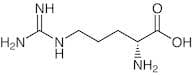
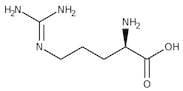
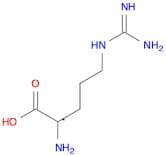
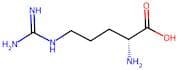
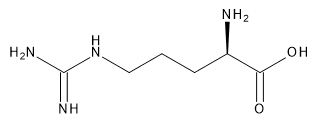
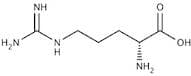
:D-(-)-Arginine
- (2R)-2-Amino-5-(diaminomethylideneamino)pentanoic acid
- (2R)-2-Amino-5-[(diaminomethylidene)amino]pentanoic acid
- (2R)-2-Amino-5-carbamimidamidopentanoic acid
- (R)-2-Amino-5-guanidinopentanoic acid
- (R)-Arginine
- <span class="text-smallcaps">D</span>-Arginine
- Arginine, <span class="text-smallcaps">D</span>-
- D-2-Amino-5-guanidinopentanoic acid
- H-D-Arg-OH
- H-D-Arginine
- Arginine, D-
- D-Arginine
- D-Arginine
- D(-)-arginine
- D-ARG
- RARECHEM AB PP 1748
- ARGININE, D-(RG)
- D-Arginine ,99%
- (-)-D-arginine hydrate
- D-ARGININE BASE
- D-2-AMINO-5-GUANIDINOVALERIC ACID
- (2R)-2-Amino-5-(diaminomethylideneamino)pentanoic acid hydrate
- D-ARG.FREE BASE
- Voir plus de synonymes
D-(-)-Arginine
CAS :Formule :C6H14N4O2Degré de pureté :>98.0%(T)Couleur et forme :White powder to crystalMasse moléculaire :174.20D-Arginine, 98%
CAS :1-Deamino-8-D-arginine vasopressin makes a new pharmacological approach to the management of haemophilia and von Willebrand's disease. A novel nonenzymatic pathway for the generation of nitric oxide is by the reaction of hydrogen peroxide and d- or l-arginine. This Thermo Scientific Chemicals brand
Formule :C6H14N4O2Degré de pureté :98%Couleur et forme :Crystals or powder or crystalline powder, WhiteMasse moléculaire :174.20D-Arginin
CAS :Formule :C6H14N4O2Degré de pureté :95%Couleur et forme :SolidMasse moléculaire :174.2010D-Arginine
CAS :D-Arginine is inactive form, inhibitor of EC 4.1.1.19 (arginine decarboxylase), toxicity to microorganisms, and acts as a regulator of microbial subpopulation.Formule :C6H14N4O2Degré de pureté :99.86%Couleur et forme :SolidMasse moléculaire :174.2D-Arginine
CAS :Formule :C6H14N4O2Degré de pureté :98.5 - 101.0 %Couleur et forme :White to off-white powderMasse moléculaire :174.20D-Arginine
CAS :D-ArginineFormule :C6H14N4O2Degré de pureté :98%Couleur et forme : white solidMasse moléculaire :174.20g/molD-Arginine
CAS :Produit contrôléApplications D-Arginine is an unnatural isomer of L-Arginine (A769505), and is used to inhibit glutamate-induced nitric oxide production in rats. Derivatives of D-Arginine are used for pharmaceutical purposes, one example is 1-Deamino-8-D-arginine vasopressin, which is used to treat various bleeding disorders.
References Castellano, M., et al.: Neurosci. Lett., 314, 127 (2001); Kobrinsky, N., et al.: Lancet, 323, 1145 (1984); Weyrich, A., et al.: Circulation, 86, 279 (1992)Formule :C6H14N4O2Couleur et forme :NeatMasse moléculaire :174.2D-Arginine
CAS :D-Arginine is an amino acid that plays an important role in the metabolism of nitrogen. D-Arginine is a substrate for nitric oxide synthase, which produces nitric oxide from L-arginine. It also binds to calcium receptors on the cytosolic surface of cells and increases intracellular calcium levels. D-Arginine is a competitive inhibitor of receptor binding by hydroxyl groups and can be used to study receptor binding. The X-ray crystal structures of D-arginine have been solved at 1.8Å resolution and show that the molecule adopts a β-turn conformation, with one N atom forming a hydrogen bond with the side chain carbonyl group. This interaction stabilizes the protein structure and prevents it from adopting its natural open conformation. D-Arginine has also been shown to have antimicrobial effects against bacteria by inhibiting peptide synthesis, while having no effect on mammalian cell growth or metabolicFormule :C6H14N4O2Couleur et forme :White PowderMasse moléculaire :174.2 g/molD-Arginine (free base) extrapure CHR, 99%
CAS :Formule :C6H14N4O2Degré de pureté :min. 99%Couleur et forme :White, Crystalline powderMasse moléculaire :174.20H-D-Arg-OH
CAS :M02984 - H-D-Arg-OH
Formule :C6H14N4O2Degré de pureté :98%Couleur et forme :SolidMasse moléculaire :174.204