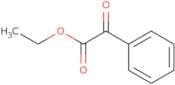
CAS 1603-79-8
:Éthyle benzoate de formyle
Description :
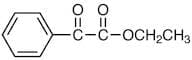
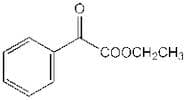
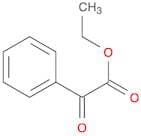
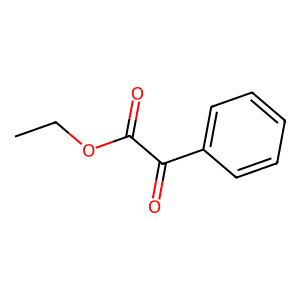
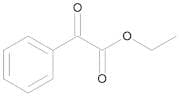
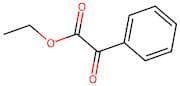
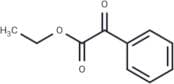
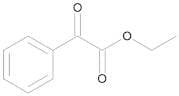
Éthyle benzoate de formyle, avec le numéro CAS 1603-79-8, est un composé organique qui appartient à la classe des esters. Il se caractérise par sa structure, qui comprend un groupe éthyle, un groupe benzoyle et un groupe formiate. Ce composé apparaît généralement sous la forme d'un liquide incolore à jaune pâle avec une agréable odeur aromatique. Éthyle benzoate de formyle est connu pour son rôle d'agent aromatisant et de parfum dans diverses applications, y compris les aliments et les cosmétiques. Il est soluble dans des solvants organiques et présente une stabilité modérée dans des conditions standard. Le composé peut subir une hydrolyse en présence d'eau, conduisant à la formation d'acide benzoylformique et d'éthanol. Éthyle benzoate de formyle est également d'un intérêt dans la chimie organique synthétique, où il peut servir d'intermédiaire dans la synthèse d'autres composés chimiques. Comme pour de nombreuses substances organiques, des précautions de sécurité doivent être prises lors de sa manipulation, car il peut provoquer des irritations de la peau et des yeux.
Formule :C10H10O3
InChI :InChI=1S/C10H10O3/c1-2-13-10(12)9(11)8-6-4-3-5-7-8/h3-7H,2H2,1H3
Code InChI :InChIKey=QKLCQKPAECHXCQ-UHFFFAOYSA-N
SMILES :C(C(OCC)=O)(=O)C1=CC=CC=C1
Synonymes :- 2-Oxo-2-phenylacetic acid ethyl ester
- 2-Phenyl-2-oxoacetic acid ethyl ester
- Benzeneacetic acid, α-oxo-, ethyl ester
- Benzoylformic acid ethyl ester
- Ethyl 2-oxo-2-phenylacetate
- Ethyl 2-phenyl-2-oxoacetate
- Ethyl Oxo(Phenyl)Acetate
- Ethyl benzoyl formate
- Ethyl oxophenylacetate
- Ethyl phenylglyoxylate
- Ethyl α-oxobenzeneacetate
- Ethylphenylglyoxylate
- Glyoxylic acid, phenyl-, ethyl ester
- NSC 6766
- Phenylglyoxylic acid ethyl ester
- α-Oxobenzeneacetic acid ethyl ester
- Voir plus de synonymes
Trier par
Degré de pureté (%)
0
100
|
0
|
50
|
90
|
95
|
100
11 produits concernés.
Ethyl Benzoylformate
CAS :Formule :C10H10O3Degré de pureté :>96.0%(GC)Couleur et forme :Colorless to Yellow clear liquidMasse moléculaire :178.19Ethyl phenylglyoxylate, 98%
CAS :Ethyl phenylglyoxylate has been used in preparation of 1,5-dihydro-5-deazaflavin derivatives possessing a chiral substituent at N(3) position. This Thermo Scientific Chemicals brand product was originally part of the Alfa Aesar product portfolio. Some documentation and label information may refer to
Formule :C10H10O3Degré de pureté :98%Couleur et forme :Clear colorless to yellow, LiquidMasse moléculaire :178.19Benzeneacetic acid, α-oxo-, ethyl ester
CAS :Formule :C10H10O3Degré de pureté :95%Couleur et forme :LiquidMasse moléculaire :178.1846Ethyl phenylglyoxylate
CAS :Ethyl phenylglyoxylateDegré de pureté :≥98%Masse moléculaire :178.18g/mol2-Phenyl-2-oxoacetic acid ethyl ester
CAS :Formule :C10H10O3Couleur et forme :NeatMasse moléculaire :178.18Ethyl oxo(phenyl)acetate
CAS :Ethyl oxo(phenyl)acetateFormule :C10H10O3Degré de pureté :98%Couleur et forme : pale yellow liquidMasse moléculaire :178.18g/molEthyl Benzoylformate
CAS :Formule :C10H10O3Degré de pureté :98%Couleur et forme :LiquidMasse moléculaire :178.187Ethyl phenylglyoxylate
CAS :Ethyl phenylglyoxylate (AI3 10033) is a simultaneous inhibitor and substrate of chicken liver carboxylesterase.Formule :C10H10O3Degré de pureté :98.46%Couleur et forme :Yellow LiquidMasse moléculaire :178.18Ethyl Benzoylformate
CAS :Produit contrôléApplications Ethyl Benzoylformate is a general chemical reagent used in the preparation of diaminoethanediyl bismethylpyridinium salts for designing recyclable organocatalysts.
References Lisnyak, V. et al.: J. Org. Chem., 80, 8570 (2015);Formule :C10H10O3Couleur et forme :NeatMasse moléculaire :178.18Ethyl benzoylformate
CAS :Ethyl benzoylformate is a chemical compound that belongs to the group of cinchona alkaloids. It is used as an analytical reagent for determining the concentration of cinchonidine, which assists in the diagnosis and treatment of inflammatory diseases. The biosynthesis of ethyl benzoylformate begins with the condensation reaction between fatty acid and dinucleotide phosphate. This reaction can be enhanced by adding a cationic surfactant to increase the rate at which it takes place. The redox potentials of this compound are important in understanding its reactivity because they indicate whether it will oxidize or reduce another molecule. Ethyl benzoylformate has been shown to act as an adrenergic receptor agonist in lutea l., a model system for studying adrenergic receptors. Its asymmetric synthesis is achieved through two different routes, one requiring ethyl formate and one not requiring it.Formule :C10H10O3Degré de pureté :Min. 95%Masse moléculaire :178.18 g/mol