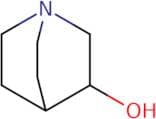
CAS 1619-34-7
:(±)-3-Quinuclidinol
- (3R)-3-hydroxy-1-azoniabicyclo[2.2.2]octane
- (3S)-3-hydroxy-1-azoniabicyclo[2.2.2]octane
- (RS)-3-Quinuclidinol
- 1-Azabicyclo[2.2.2]oct-3-yl alcohol
- 1-Azabicyclo[2.2.2]octan-3-ol
- 3-Hydroxy-1-azabicyclo[2.2.2]octane
- 3-Hydroxychinuclidin
- 3-Hydroxyquinuclidine
- 3-Hydroxyquinuelidine
- 3-Quinuclidinol
- 4-Azabicyclo[2.2.2]octan-2-ol
- NSC 93905
- Quinuclidine-3-ol
- Quinuclidinol
- Voir plus de synonymes
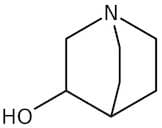
3-Quinuclidinol, 98+%
CAS :3-Quinuclidinol acts as a chiral building block for various antimuscarinic agents and other active pharmaceutical ingredients. It serves as a catalyst for condensation of methyl vinyl ketone with aldehydes. It is also used as a reagent for cleavage of beta-keto and vinylogous beta-keto esters. FurthFormule :C7H13NODegré de pureté :98+%Couleur et forme :Crystals or powder or crystalline powder or fused/lumpy solid, White to pale creamMasse moléculaire :127.19Penehyclidine Impurity 15
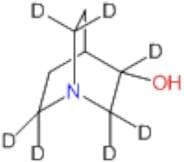
CAS :Formule :C7H13NOCouleur et forme :White To Off-White SolidMasse moléculaire :127.19(±)-3-Quinuclidinol-2,2,3,6,6,7,7-d7
CAS :Degré de pureté :99 atom % DCouleur et forme :White To Off-White SolidMasse moléculaire :134.233-Quinuclidinol
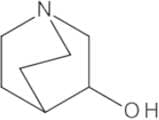
CAS :Produit contrôléApplications Hypotensive. Synthon for preparation of cholinergic receptor ligands and anesthetics.
Not a dangerous good if item is equal to or less than 1g/ml and there is less than 100g/ml in the package
References Rehavi, M., et al.: Life Sci., 21, 1293 (1977), Lockridge, O., et al.: NeuroToxicology, 21, 113 (2000), Kovarik, Z., et al.: Biochem. J., 373, 33 (2003),Formule :C7H13NOCouleur et forme :NeatMasse moléculaire :127.183-Quinuclidinol
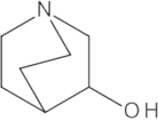
CAS :Produit contrôlé3-Quinuclidinol is an inorganic acid that has been shown to possess antimicrobial and pharmacological properties. 3-Quinuclidinol has been used as a biochemical reagent for the detection of l-tartaric acid, which is a key intermediate in the production of citric acid. It has also been used as an affinity ligand for the detection of diphosphate dinucleotides. This compound has asymmetric synthesis capability, which makes it suitable for use as a pharmaceutical agent. 3-Quinuclidinol binds to GABA receptors and can be used to treat epilepsy and other neurological disorders.
Formule :C7H13NODegré de pureté :Min. 95%Masse moléculaire :127.18 g/mol