CymitQuimica logo

CAS 163931-61-1

:

Triphenyldifluorosilicate de tétrabutylammonium (TBAT)

Description :
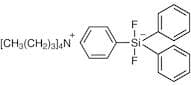
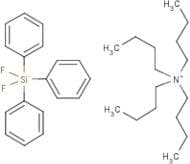
Triphenyldifluorosilicate de tétrabutylammonium (TBAT) est un composé organosiliconé caractérisé par sa structure unique, qui comprend un cation de tétrabutylammonium et un anion de difluorosilicate de triphényl. Ce composé est typiquement un solide blanc à jaune clair à température ambiante et est soluble dans des solvants organiques, ce qui le rend utile dans diverses applications, en particulier dans la synthèse organique et en tant que catalyseur de transfert de phase. TBAT présente une stabilité dans des conditions standard, bien qu'il puisse se décomposer lorsqu'il est exposé à l'humidité ou à des températures élevées. La présence d'atomes de fluor dans l'anion silicate contribue à ses propriétés chimiques uniques, y compris une réactivité améliorée et des applications potentielles en science des matériaux. De plus, TBAT peut faciliter le transfert d'espèces silicatées dans les réactions, ce qui le rend précieux dans la synthèse de matériaux à base de silicate. Des précautions de sécurité doivent être prises lors de la manipulation de TBAT, comme pour de nombreux composés organosiliconés, en raison de la toxicité potentielle et des préoccupations environnementales. Dans l'ensemble, TBAT est un composé polyvalent avec des implications significatives tant dans les milieux industriels que de recherche.
Formule :C34H51F2NSi
InChI :InChI=1/C18H15F2Si.C16H36N/c19-21(20,16-10-4-1-5-11-16,17-12-6-2-7-13-17)18-14-8-3-9-15-18;1-5-9-13-17(14-10-6-2,15-11-7-3)16-12-8-4/h1-15H;5-16H2,1-4H3/q-1;+1
SMILES :c1ccc(cc1)[Si-](c1ccccc1)(c1ccccc1)(F)F.CCCCN(CCCC)(CCCC)CCCC
Synonymes :
  • Tetrabutylammonium triphenyldifluorosilicate
  • Tbat
  • Tetrabutylammonium difluorotriphenylsilicate
  • N,N,N-tributylbutan-1-aminium difluoro(triphenyl)silicate(1-)
  • Tetrabutylamoniumdifluorotriphenylsilicate
Trier par

Degré de pureté (%)
0
100
|
0
|
50
|
90
|
95
|
100
5 produits concernés.
  • Tetrabutylammonium Difluorotriphenylsilicate

    CAS :
    Formule :C34H51F2NSi
    Degré de pureté :>97.0%(T)(qNMR)
    Couleur et forme :White to Almost white powder to crystal
    Masse moléculaire :539.87

    Ref: 3B-T1909

    5g
    95,00€
    25g
    297,00€
  • Tetrabutylammonium difluorotriphenylsilicate(IV)

    CAS :
    Degré de pureté :97%
    Masse moléculaire :539.38

    Ref: 10-F996236

    5g
    21,00€
    10g
    29,00€
    25g
    67,00€
  • Tetrabutylammonium difluorotriphenylsilicate

    CAS :
    Tetrabutylammonium difluorotriphenylsilicate
    Degré de pureté :98%
    Masse moléculaire :539.86g/mol

    Ref: 54-PC905582

    5g
    30,00€
    25g
    72,00€
    100g
    225,00€
    500g
    987,00€
  • Tetrabutylammonium Difluorotriphenylsilicate

    Produit contrôlé
    CAS :
    <p>Stability Moisture Sensitive<br>Applications Tetrabutylammonium Difluorotriphenylsilicate is used as a reagent in the synthesis of (S)-N-(3-(3,6-dibromo-9H-carbazol-9-yl)-2-fluoropropyl)-6-methoxypyridin-2-amine ((-)-P7C3-S243); a neuroprotective chemical with improved druglike properties.<br> Not a dangerous good if item is equal to or less than 1g/ml and there is less than 100g/ml in the package<br>References Naidoo, J., et al.: J. Med. Chem., 57, 3754 (2014)<br></p>
    Formule :C18H15F2Si·C16H36N
    Couleur et forme :Neat
    Masse moléculaire :539.858

    Ref: TR-T291240

    1g
    121,00€
    5g
    162,00€
    25g
    369,00€
  • Tetrabutylammonium difluorotriphenylsilicate

    CAS :
    <p>Tetrabutylammonium difluorotriphenylsilicate is a model system for studying the mechanism of nucleophilic substitution at an unsymmetrical carbon center. It is used in analytical chemistry to prepare samples for analysis. Tetrabutylammonium difluorotriphenylsilicate has been shown to be an effective and selective reagent for the synthesis of picolinic acid, which can be used as a precursor for the synthesis of nicotinamide riboside, a vitamin B3 derivative. The reaction proceeds via an SN2 mechanism, where hydrogen fluoride (HF) acts as a nucleophile that attacks the electrophilic carbon center of allyl chloride (CH2=CH-CH2Cl) to form an intermediate with two alkyl groups on opposite sides. The reaction product is then hydrolyzed to release tetrabutylammonium chloride (tBuNH4Cl).</p>
    Formule :C34H51F2NSi
    Degré de pureté :Min. 95%
    Couleur et forme :White Powder
    Masse moléculaire :539.86 g/mol

    Ref: 3D-FT60389

    50g
    341,00€
    100g
    486,00€
    250g
    729,00€
    500g
    923,00€