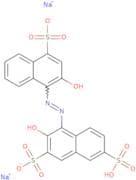
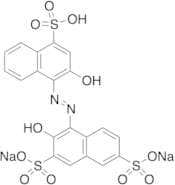
CAS 165660-27-5
:Bleu d'hydroxynaphtol
Description :
Bleu d'hydroxynaphtol, identifié par son numéro CAS 165660-27-5, est un composé organique synthétique couramment utilisé comme indicateur de pH et colorant dans diverses applications. Il présente un changement de couleur distinct en réponse aux variations de pH, ce qui le rend utile dans les titrations et d'autres processus de chimie analytique. Le composé se caractérise par sa solubilité dans l'eau et les solvants organiques, ce qui améliore sa polyvalence dans les environnements de laboratoire. Bleu d'hydroxynaphtol apparaît généralement comme une solution bleue ou violette dans des conditions alcalines et passe à une teinte différente dans des environnements acides. Sa stabilité dans une gamme de conditions permet un fonctionnement fiable tant dans les applications éducatives qu'industrielles. De plus, il est important de manipuler ce composé avec précaution, comme c'est le cas pour de nombreux colorants synthétiques, en raison de la toxicité potentielle et des préoccupations environnementales. Dans l'ensemble, Bleu d'hydroxynaphtol sert d'outil efficace pour visualiser les changements de pH et est précieux dans divers domaines, y compris la biochimie et le suivi environnemental.
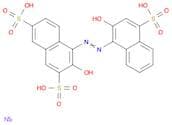
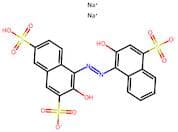
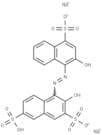
Formule :C20H14N2O11S3·2Na
InChI :InChI=1S/C20H14N2O11S3.2Na/c23-15-9-16(35(28,29)30)13-3-1-2-4-14(13)18(15)21-22-19-12-6-5-11(34(25,26)27)7-10(12)8-17(20(19)24)36(31,32)33;;/h1-9,23-24H,(H,25,26,27)(H,28,29,30)(H,31,32,33);;
Code InChI :InChIKey=PPLGBYKWDBFHQY-UHFFFAOYSA-N
SMILES :N(=NC=1C2=C(C(S(=O)(=O)O)=CC1O)C=CC=C2)C=3C4=C(C=C(S(=O)(=O)O)C3O)C=C(S(=O)(=O)O)C=C4.[Na]
Synonymes :- 2,2-Dihydroxy-1,1-azonaphthalene-3,4,6-trisulfonic acid disodium salt
- 2,7-Naphthalenedisulfonic acid, 3-hydroxy-4-[(2-hydroxy-4-sulfo-1-naphthalenyl)azo]-, disodium salt
- 2,7-Naphthalenedisulfonic acid, 3-hydroxy-4-[2-(2-hydroxy-4-sulfo-1-naphthalenyl)diazenyl]-, sodium salt (1:2)
- Disodium 3-hydroxy-4-(2-hydroxy-4-sulfonaphthalen-1-yl)diazenylnaphthalene-2,7-disulfonate
- Hydroxy naphthol blue
- Hydroxy naphthol blue disodium salt
Trier par
Le filtre de pureté n’est pas visible car les produits actuels ne disposent pas de données de pureté associées pour le filtrage.
6 produits concernés.
2,7-Naphthalenedisulfonic acid, 3-hydroxy-4-[2-(2-hydroxy-4-sulfo-1-naphthalenyl)diazenyl]-, sodium salt (1:2)
CAS :Formule :C20H12N2Na2O11S3Couleur et forme :SolidMasse moléculaire :598.4906Hydroxy Naphthol Blue Disodium Salt
CAS :Hydroxy Naphthol Blue Disodium SaltDegré de pureté :ACSMasse moléculaire :598.49g/molHydroxy naphthol blue disodium
CAS :Hydroxy naphthol blue disodium, an azo dye functioning as a metal indicator for calcium and a colorimetric reagent for alkaline earth metal ions (λmax = 650 nmFormule :C20H12N2Na2O11S3Couleur et forme :SolidMasse moléculaire :598.49Hydroxy naphthol blue disodium salt
CAS :Formule :C20H12N2O11S3Na2Couleur et forme :Dark blue powder or crystalsMasse moléculaire :598.49Hydroxy naphthol blue disodium
CAS :Hydroxy naphtol blue is a synthetic azo dye, characterised for containing the functional group R N=N R. The hydroxy naphtol blue disodium and trisodium salt are used as indicators to determine the content of alkaline earth and lanthanides spectrophotometrically, showing at maximum a wavelength of ~ 650 nm (λmax = 647.6 nm). The best example of the use of hydroxy naphtol blue sodium salt is to determine the hardness of water by measuring the concentration of calcium and magnesium. At alkaline or basic pH, the hydroxy naphtol blue forms a pink/red complex with the metal ions and, after titration with EDTA, hydroxy naphtol blue is liberated, turning the solution blue which indicates the endpoint.Formule :C20H14N2O11S3·2NaCouleur et forme :PowderMasse moléculaire :600.51 g/molHydroxy Naphthol Blue Disodium Salt (Technical Grade)
CAS :Produit contrôléApplications Hydroxy Naphthol Blue Disodium Salt is a synthetic dye that has been used as a calcium indicator, which has a λmax = 650 nm. Dyes and metabolites.
References Newfield, O.E. 1967. Med. J. Aust. 1: 1257; Goto, M., et al. 2009. BioTechniques. 46: 167-172Formule :C20H12N2O11S3·2NaCouleur et forme :NeatMasse moléculaire :598.49062