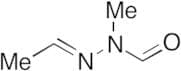
CAS 16568-02-8
:gyromitrine
- 2-Ethylidene-1-methylhydrazinecarboxaldehyde
- Acetaldehyde N-formyl-N-methylhydrazone
- Acetaldehyde methylformylhydrazone
- Acetaldehyde-N-Methyl-N-Formylhydrazone
- Acetaldehydemethylformylhydrazone
- Ethylenegyromitrin
- Ethylidene gyromitrin
- Formic acid, ethylidenemethylhydrazide
- Formicacid,Ethylidenemethylhydrazide
- Hydrazinecarboxaldehyde, 2-ethylidene-1-methyl-
- Hydrazinecarboxaldehyde, ethylidenemethyl-
- Methylformylhydrazone
- N'-[(1E)-ethylidene]-N-methylformic hydrazide
- N'-ethylidene-N-methylformic hydrazide
- gyromitrin
- Voir plus de synonymes
Gyromitrin
CAS :Produit contrôléStability Light Sensitive
Applications Gyromitrin is hepatotoxic and carcinogenic compound that is found in G. esculenta and few other mushrooms, which has resulted in severe poisonings and even deaths in human.
Not a dangerous good if item is equal to or less than 1g/ml and there is less than 100g/ml in the package
References Michelot, D., et al.: J. Appl. Toxicol., 11, 235 (1991)Formule :C4H8N2OCouleur et forme :NeatMasse moléculaire :100.12Gyromitrin
CAS :Gyromitrin is a potent inhibitor of tumor growth and apoptosis in human cancer cells. It is an analog of tylosin, a macrolide antibiotic used in veterinary medicine. Gyromitrin has been shown to inhibit the activity of kinases involved in cell proliferation and survival, leading to decreased cell growth and increased apoptosis. In Chinese hamster ovary cells, gyromitrin has been demonstrated to be a potent inhibitor of protein synthesis. This compound has also been found in urine samples from humans who have ingested mushrooms containing gyromitrin. Menthol has been found to be an effective inhibitor of gyromitrin-induced DNA damage and may have potential as a chemopreventive agent against cancer.
Formule :C4H8N2ODegré de pureté :Min. 95%Masse moléculaire :100.12 g/mol