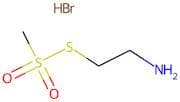
CAS 16599-33-0
:S-(2-aminoéthyl) méthanesulfonothioate
- methanesulfonothioic acid, S-(2-aminoethyl) ester
S-(2-Aminoethyl) methanethiosulphonate hydrobromide
CAS :S-(2-Aminoethyl) methanethiosulphonate hydrobromideFormule :C3H9NO2S2·BrHDegré de pureté :≥95%Couleur et forme : off-white solidMasse moléculaire :236.15g/mol2-Aminoethyl Methanethiosulfonate Hydrobromide
CAS :Produit contrôléStability Hygroscopic
Applications 2-Aminoethyl Methanethiosulfonate Hydrobromide reacts specifically and rapidly with thiols to form mixed disulfides. Used to probe the structures of the ACh receptor channel of the GABA receptor channel and of lactose permease. Useful for mapping the pore-lining regions of the ryanodine receptor.
References Yang, N. et al.: Neuron, 16, 113 (1996), Kuner, T. et al.: Neuron, 17, 343 (1996), Holmgren, M. et al: Neuropharmacology, 35, 797 (1996) Chahine, M. et al.: Biochemical & Biophysical Res. Commun., 233, 606 (1997), Ehrlich, B.E., et al.: J. Gen. Physiol., 109, 255 (1997), Rassendren, F., et al.: The EMBO Journal, 16, 3446 (1997), Egan, T.M., et al.: The Journal of Neuroscience, 18(7), 2350 (1998), Lin, C.-W. and Tsung-Yu, C.: J. Gen. Physiol., 116, 535 (2000)Formule :C3H9NO2S2·BrHCouleur et forme :NeatMasse moléculaire :236.152-Aminoethyl methanethiosulfonate hydrobromide
CAS :2-Aminoethyl methanethiosulfonate hydrobromide (2AMTSH) is an alkylating agent that inhibits the uptake of creatine in the brain. It has been shown to inhibit the transport of creatine across the apical membrane of granule neurons in Xenopus oocytes, which is mediated by a sodium-dependent, electroneutral transporter. 2AMTSH also binds to basic proteins and prevents their activation by blocking the binding of ATP. This inhibition leads to a decrease in cellular energy production and may be responsible for some of the effects observed in mice. The therapeutic potential for 2AMTSH is limited due to its toxicity, but it may be useful as a nutritional supplement for those with creatine deficiencies.Formule :C3H10BrNO2S2Degré de pureté :Min. 95%Couleur et forme :PowderMasse moléculaire :236.15 g/molMTSEA hydrobromide
CAS :MTSEA hydrobromide is a sulfhydryl-reactive compound that modifies free cysteine residues to produce a positively charged side chain similar in size to lysine.Formule :C3H10BrNO2S2Degré de pureté :98%Couleur et forme :SolidMasse moléculaire :236.15