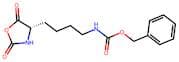
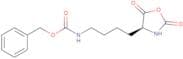
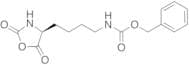
![Carbamic acid, [4-(2,5-dioxo-4-oxazolidinyl)butyl]-, phenylmethyl ester,(S)-](/_next/image/?url=https%3A%2Fstatic.cymitquimica.com%2Fcas-image%2Fthumb-webp%2F40544-n6-carbobenzoxy-l-lysine-n-carboxyanhydride.webp&w=3840&q=75)
CAS 1676-86-4
:Acide carbamique, [4-(2,5-dioxo-4-oxazolidinyl)butyl]-, phénylméthyl ester,(S)-
Description :
L'acide carbamique, [4-(2,5-dioxo-4-oxazolidinyle)butyle]-, ester de phénylméthyle, avec le numéro CAS 1676-86-4, est un composé organique caractérisé par son groupe fonctionnel carbamate. Cette substance présente un groupe ester de phénylméthyle, qui contribue à ses applications potentielles en chimie médicinale et en tant qu'intermédiaire synthétique. La présence de l'anneau oxazolidinone indique qu'il pourrait présenter des propriétés biologiques intéressantes, possiblement liées à sa similarité structurelle avec certains médicaments. Le composé est susceptible d'être un solide blanc à blanc cassé, soluble dans des solvants organiques, et pourrait avoir une stabilité modérée dans des conditions standard. Sa réactivité peut être influencée par les fonctionnalités ester et carbamate, ce qui en fait un candidat pour d'autres transformations chimiques. Les données de sécurité doivent être consultées pour la manipulation et le stockage, comme pour toute substance chimique, afin de garantir que les précautions appropriées soient prises. Dans l'ensemble, ce composé représente une structure unique qui pourrait être d'intérêt dans divers domaines, y compris le développement de médicaments et la synthèse organique.
Formule :C15H18N2O5
Synonymes :- Carbamic acid, N-[(4S)-4-(2,5-dioxo-4-oxazolidinyl)butyl]-, phenylmethyl ester
- Lys(Z)-NCA
- N-[(4S)-4-(2,5-Dioxo-4-oxazolidinyl)butyl]carbaMic Acid PhenylMethyl Ester
- L-Lys(Cbz)-NCA
- CarbaMic acid, [4-(2,5-dioxo-4-oxazolidinyl)butyl]-, phenylMethyl ester,(S)-
- (S)-[4-(2,5-Dioxo-4-oxazolidinyl)butyl]carbaMic Acid Phen
- L-[4-(2,5-Dioxo-4-oxazolidinyl)butyl]carbaMic Acid Benzyl Ester
- N-benzyloxycarbonyl-L-lysine N-carboxyanhydride
- (S)-Benzyl (4-(2,5-dioxooxazolidin-4-yl)butyl)carbamate
- Lys(Cbz)-NCA
- K(Z)-NCA
- N6-Carbobenzoxy-L-lysine N-Carboxyanhydride
- Voir plus de synonymes
Trier par
Degré de pureté (%)
0
100
|
0
|
50
|
90
|
95
|
100
5 produits concernés.
N6-Benzyloxycarbonyl-L-lysine N-carboxyanhydride
CAS :Formule :C15H18N2O5Degré de pureté :96%Couleur et forme :SolidMasse moléculaire :306.3138(S)-Benzyl (4-(2,5-Dioxooxazolidin-4-Yl)Butyl)Carbamate
CAS :(S)-Benzyl (4-(2,5-Dioxooxazolidin-4-Yl)Butyl)CarbamateDegré de pureté :97%Masse moléculaire :306.31g/molN6-Carbobenzoxy-L-lysine N-carboxyanhydride
CAS :N6-Carbobenzoxy-L-lysine N-carboxyanhydride is a protected form of amino acid L-lysine, where the side chain amine is Z-protected and the α-amine and carboxylic acid groups are linked via a carboxyl. N6-Carbobenzoxy-L-lysine N-carboxyanhydride can undergo a basic polycondensation reaction to afford polylysine, a polymer of α-linked lysine. Polylysine has a range of biological activities, such as, the inhibition of fungal infections (Trichophyton mentagrophytes, T. rubrum, and Candida albicans) in plants. Polylysine is used to coat tissue culture ware, where it enhances cell adherence.Formule :C15H18N2O5Degré de pureté :Min. 95%Couleur et forme :White Off-White PowderMasse moléculaire :306.31 g/mol(S)-Benzyl (4-(2,5-dioxooxazolidin-4-yl)butyl)carbamate
CAS :Formule :C15H18N2O5Degré de pureté :96%Masse moléculaire :306.318N6-Carbobenzoxy-L-lysine N-Carboxyanhydride
CAS :Produit contrôléApplications A L-lysine derivative used in the preparation of Polylysine, a synthetic, basic poly-α-amino acid. Polylysine inhibited fungal penetration and polyphenol formation in susceptible sweet potatoes infected with C. fimbriata and caused some inhibition of fungal growth, a lessening of the penetration by the fungus, and more callus formation in resistant sweet potatoes. The compound inhibited the infection of tomato cuttings by F. lycopersici but was also toxic to the plants. Polyglutamic acid had no effect on the fungi in vitro.
References Buchanan-Davidson, D.J., et al.: Science, 132, 1664 (1960),Formule :C15H18N2O5Couleur et forme :NeatMasse moléculaire :306.31