CAS 1709-71-3
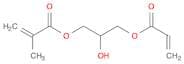
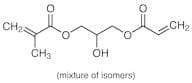
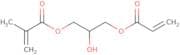
:3-Acryloyloxy-2-hydroxypropyl méthacrylate
Description :
3-Acryloyloxy-2-hydroxypropyl méthacrylate (CAS 1709-71-3) est un composé chimique qui appartient à la classe des esters de méthacrylate. Il présente à la fois des groupes fonctionnels acryloyle et méthacrylate, qui contribuent à sa réactivité et à son utilité en chimie des polymères. Ce composé se caractérise par sa capacité à subir une polymérisation par radicaux libres, ce qui le rend précieux dans la production de divers polymères et copolymères. Il possède un groupe hydroxyle, qui améliore son hydrophilie et peut améliorer les propriétés d'adhésion dans les formulations. La présence de fonctionnalités acryloyle et méthacrylate permet des applications polyvalentes dans les revêtements, les adhésifs et les matériaux dentaires. De plus, sa structure permet le réticulation, ce qui peut améliorer les propriétés mécaniques des polymères résultants. Dans l'ensemble, 3-Acryloyloxy-2-hydroxypropyl méthacrylate est reconnu pour son rôle dans la création de matériaux avec des propriétés sur mesure, adaptés à une gamme d'applications industrielles et biomédicales.
Formule :C10H14O5
InChI :InChI=1S/C10H14O5/c1-4-9(12)14-5-8(11)6-15-10(13)7(2)3/h4,8,11H,1-2,5-6H2,3H3
Code InChI :InChIKey=ZODNDDPVCIAZIQ-UHFFFAOYSA-N
SMILES :C(C(COC(C=C)=O)O)OC(C(C)=C)=O
Synonymes :- 1-(Acryloyloxy)-2-hydroxy-3-(methacryloyloxy)propane
- 1-Acryloyloxy-3-(methacryloyloxy)-2-propanol
- 1-Methacryloyloxy-3-acryloyloxy-2-propanol
- 2-Hydroxy-1-acryloxy-3-methacryloxypropane
- 2-Hydroxy-1-acryloyloxy-3-methacryloyloxypropane
- 2-Hydroxy-3-acryloyloxy-1-methacryloyloxypropane
- 2-Hydroxy-3-acryloyloxypropyl methacrylate
- 2-Hydroxy-3-methacryloyloxypropyl acrylate
- 2-Propenoic acid, 2-methyl-, 2-hydroxy-3-[(1-oxo-2-propen-1-yl)oxy]propyl ester
- 2-Propenoic acid, 2-methyl-, 2-hydroxy-3-[(1-oxo-2-propenyl)oxy]propyl ester
- 3-(Acryloxy)-2-hydroxypropyl methacrylate
- 3-(Acryloyloxy)-2-Hydroxypropyl 2-Methylprop-2-Enoate
- 3-(Acryloyloxy)-2-hydroxypropyl methacrylate
- 3-Acryloyloxy glycerol monomethacrylate
- Acrylic acid-glycidyl methacrylate 1:1 adduct
- Ahpma
- Blemmer GAM
- G 201P
- Light Ester G 201P
- Methacrylic acid, 2,3-dihydroxypropyl ester, 3-acrylate
- Voir plus de synonymes
Trier par
Degré de pureté (%)
0
100
|
0
|
50
|
90
|
95
|
100
5 produits concernés.
3-(Acryloyloxy)-2-hydroxypropyl methacrylate
CAS :Formule :C10H14O5Degré de pureté :80%Couleur et forme :LiquidMasse moléculaire :214.21523-(Acryloyloxy)-2-Hydroxypropyl Methacrylate
CAS :3-(Acryloyloxy)-2-Hydroxypropyl MethacrylateDegré de pureté :80%,stabilized with MEHQMasse moléculaire :214.22g/mol1-(Acryloyloxy)-3-(methacryloyloxy)-2-propanol (mixture of isomers) (stabilized with MEHQ)
CAS :Formule :C10H14O5Degré de pureté :>80.0%(GC)Couleur et forme :Colorless to Almost colorless clear liquidMasse moléculaire :214.221-(Acryloyloxy)-3-(methacryloyloxy)-2-propanol (stabilized with MEHQ)
CAS :1-(Acryloyloxy)-3-(methacryloyloxy)-2-propanol (stabilized with MEHQ) is a polymer that is used as an antimicrobial agent. It is synthesized by the reaction of acrylates and methacrylates with a crosslinker, such as MEHQ. This polymer has shown to have strong activity against bacteria and fungi, but it does not have any effect on viruses. The compound has the ability to bind to the surface of cells and cause cell death through the disruption of protein synthesis or by causing membrane leakage. FT-IR spectroscopy has shown that this polymer contains hydroxyl groups, which may account for its antimicrobial properties. The use of multi-walled carbon nanotubes in this polymer may also be responsible for its antimicrobial properties because they are able to bind to organic compounds like chloride ions and hydrogen bonds. 1-(Acryloyloxy)-3Formule :C10H14O5Degré de pureté :Min. 95%Couleur et forme :Clear LiquidMasse moléculaire :214.22 g/mol3-(Acryloyloxy)-2-hydroxypropyl methacrylate Stabilised with MEHQ
CAS :Formule :C10H14O5Degré de pureté :95.0%Couleur et forme :LiquidMasse moléculaire :214.217