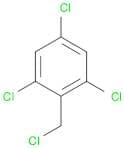
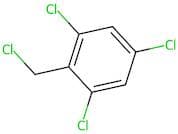
CAS 17293-03-7
:1,3,5-Trichloro-2-(chlorométhyl)benzène
- 2,4,6-Trichlorobenzyl chloride
- Benzene, 1,3,5-trichloro-2-(chloromethyl)-
- Benzene, 1,3,5-trichloro-2-(chloromethyl)- (9CI)
- Benzene, 2-(chloromethyl)-1,3,5-trichloro-
- Brn 2503430
- Toluene, alpha,2,4,6-tetrachloro-
- Toluene, α,2,4,6-tetrachloro-
- alpha,2,4,6-Tetrachlorotoluene
- 1,3,5-Trichloro-2-(chloromethyl)benzene
- 1,3,5-Trichloro-2-(chloromethyl)benzene
- 4-05-00-00822 (Beilstein Handbook Reference)
1,3,5-Trichloro-2-(chloromethyl)benzene
CAS :Formule :C7H4Cl4Degré de pureté :95%Couleur et forme :SolidMasse moléculaire :229.91871,3,5-Trichloro-2-(chloromethyl)benzene
CAS :1,3,5-Trichloro-2-(chloromethyl)benzeneDegré de pureté :95%Masse moléculaire :229.92g/mol1,3,5-Trichloro-2-(chloromethyl)benzene
CAS :1,3,5-Trichloro-2-(chloromethyl)benzene (TCMB) is a chemical compound that inhibits the synthesis of proteins and is used in cancer therapy. TCMB has been shown to inhibit protein synthesis by binding to the polymerase chain reaction enzyme transcriptase polymerase chain reaction. It also inhibits the activity of enzymes involved in lipid metabolism, such as lipases and cholesterol esterases. The serum bilirubin levels were found to be lower in mice treated with TCMB than in those not treated with TCMB. This may be due to the ability of this drug to inhibit the enzyme fatty acid synthase, which is responsible for synthesizing fatty acids. TCMB has been shown to induce apoptosis in bladder cells, which may be due to its inhibition of DNA synthesis and repair.
Formule :C7H4Cl4Degré de pureté :Min. 95%Masse moléculaire :229.9 g/molRef: 3D-SAA29303
Produit arrêté