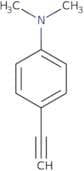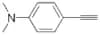
CAS 17573-94-3
:4-Éthynyl-N,N-diméthylaniline
Description :
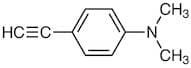
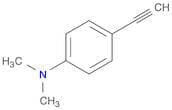
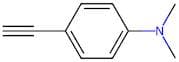
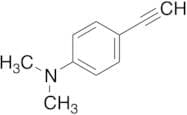
4-Éthynyl-N,N-diméthylaniline, avec le numéro CAS 17573-94-3, est un composé organique caractérisé par sa structure, qui comprend un groupe éthynyle attaché à une partie de diméthylaniline. Ce composé apparaît généralement sous forme liquide ou solide, selon les conditions spécifiques, et est connu pour ses propriétés aromatiques en raison de la présence de la structure de l'aniline. Il est souvent utilisé dans la synthèse organique et comme intermédiaire dans la production de colorants, de produits pharmaceutiques et d'autres produits chimiques. Le groupe éthynyle contribue à sa réactivité, permettant diverses transformations chimiques, y compris des réactions de couplage. De plus, 4-Éthynyl-N,N-diméthylaniline peut présenter une toxicité modérée, nécessitant des précautions de sécurité appropriées lors de la manipulation. Ses caractéristiques de solubilité peuvent varier, étant souvent soluble dans des solvants organiques tout en ayant une solubilité limitée dans l'eau. Dans l'ensemble, ce composé est significatif dans le domaine de la chimie organique pour son utilité dans la synthèse de molécules plus complexes.
Formule :C10H11N
InChI :InChI=1S/C10H11N/c1-4-9-5-7-10(8-6-9)11(2)3/h1,5-8H,2-3H3
Code InChI :InChIKey=ZWMAYLMVFSCMMS-UHFFFAOYSA-N
SMILES :N(C)(C)C1=CC=C(C#C)C=C1
Synonymes :- (4-Ethynyl-Phenyl)-Dimethyl-Amine
- (4-Ethynylphenyl)dimethylamine
- 1-(Dimethylamino)-4-ethynylbenzene
- 1-Ethynyl-4-(dimethylamino)benzene
- 1-Ethynyl-4-Dimethylaniline
- 4-(Dimethylamino)phenylethyne
- 4-Dimethylaminophenylacetylene
- 4-Ethynyl-N,N-Dimethylaniline
- 4-Ethynyl-N,N-Dimethylbenzenamine
- 4-Ethynyl-N,N-dimethylaminobenzene
- 4-Ethynylphenyl-N,N-dimethylamine
- 4-Phenylthiomorpholine 1,1-Dioxide
- Aniline, p-ethynyl-N,N-dimethyl-
- Benzenamine, 4-Ethynyl-N,N-Dimethyl-
- N,N-Dimethyl-4-Ethynylbenezeamine
- N,N-Dimethyl-4-ethynylaniline
- N,N-Methyl-4-ethynylaniline
- N-(4-Ethynylphenyl)-N,N-dimethylamine
- [4-(N,N-Dimethylamino)phenyl]acetylene
- [p-(Dimethylamino)phenyl]acetylene
- p-(N,N-Dimethylamino)phenylacetylene
- p-Ethynyl-N,N-dimethylaniline
- Voir plus de synonymes
Trier par
Degré de pureté (%)
0
100
|
0
|
50
|
90
|
95
|
100
7 produits concernés.
4-Ethynyl-N,N-dimethylaniline
CAS :Formule :C10H11NDegré de pureté :>98.0%(GC)(T)Couleur et forme :White to Light yellow to Light orange powder to crystalMasse moléculaire :145.214'-DIMETHYLAMINOPHENYL ACETYLENE
CAS :Formule :C10H11NDegré de pureté :98%Couleur et forme :SolidMasse moléculaire :145.20104'-Dimethylaminophenyl acetylene
CAS :4'-Dimethylaminophenyl acetyleneDegré de pureté :98%Couleur et forme :SolidMasse moléculaire :145.20g/mol4′-Dimethylaminophenyl acetylene
CAS :Formule :C10H11NDegré de pureté :98%Couleur et forme :SolidMasse moléculaire :145.2054'-Dimethylaminophenyl Acetylene
CAS :Produit contrôléApplications 4'-Dimethylaminophenyl acetylene
Formule :C10H11NCouleur et forme :WhiteMasse moléculaire :145.24-Ethynyl-N,N-dimethylaniline
CAS :4-Ethynyl-N,N-dimethylaniline (EDMA) is a potential drug candidate for the treatment of cancer. EDMA has been shown to have anti-cancer activity in vitro and in vivo. It inhibits the growth of cancer cells by binding to amines and other functional groups, which prevents their use by enzymes. This binding also prevents the production of reactive oxygen species, leading to cell death. The structure of EDMA has been determined using X-ray crystallography, which showed that it binds to chloride ions in a catalytic mechanism. The chloride ion was found to be an important component for the drug’s activity. EDMA also has anti-inflammatory properties due to its ability to inhibit hydroxamic acid synthesis in neutrophils and macrophages.Formule :C10H11NDegré de pureté :Min. 95%Masse moléculaire :145.2 g/mol