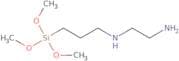
CAS 1760-24-3
:N-(2-aminoéthyl)-3-aminopropyltriméthoxysilane
- (2-Aminoethyl)(3-(trimethoxysilyl)propyl)amine
- (Ethylenediaminepropyl)trimethoxysilane
- (Ethylenediaminopropyl)trimethoxysilane
- (Trimethoxysilylpropyl)ethylenediamine
- (β-Aminoethyl)-γ-aminopropyltrimethoxysilane
- (γ-Ethylenediaminepropyl)trimethoxysilane
- 2-Aminoethylaminopropyltrimethoxysilane
- 3-(2-Aminoethyl)-Aminopropyltrimethoxysilane
- 3-(2-Aminoethylamino)propyltrimethoxysilane
- 3-(N-Aminoethyl)aminopropyltrimethoxysilane
- 3-(Trimethoxysilyl)propylethylenediamine
- 3-Ethylenediaminopropyltrimethoxysilane
- 3-[N-(2-Aminoethyl)amino]propyltrimethoxysilane
- 6-Amino-4-azahexyltrimethoxysilane
- A0700
- Aas-M
- Aminoethylaminopropyltrimethoxysilane
- Damo-P
- Damo-T
- N(beta-aminoethyl)gamma-aminopropyltrimethoxy-silane
- N-(2-Aminoethyl)(3-aminopropyl)trimethoxysilane
- N-(2-Aminoethyl)-3-(Trimethoxysilyl)Propylamine
- N-(2-Aminoethyl)-3-Aminopropyltrimethoxysilane
- N-(3-(Trimethoxysilyl)propyl)ethylendiamin
- N-(3-(trimetoxisilil)propil)etilenodiamina
- N-(3-Trimethoxysillylpropyl)ethylenediamine
- N-(Aminoethyl)aminopropyltrimethoxysilane
- N-(Trimethoxysilylpropyl)ethylenediamine
- N-(β-Aminoethyl)-3-aminopropyltrimethoxysilane
- N-(β-Aminoethyl)-g-aminopropylmethyldimethoxysilane
- N-(β-Aminoethyl)-γ-aminopropyltrimethoxysilane
- N-Aminoethyl-3-aminopropyltrimethoxysilane
- N-Aminoethyl-γ-aminopropyltrimethoxysilane
- N-Beta-(Aminoethyl)-Gamma-Aminopropyltrimethoxysilane
- N-[1-(trimethoxysilyl)propyl]ethane-1,1-diamine
- N-[1-(trimethoxysilyl)propyl]ethane-1,2-diamine
- N-[3-(Trimethoxysilyl)Propyl]Ethylenediamine
- N-[3-(Trimethoxysilyl)propyl]-1,2-ethanediamine
- N-[3-(Trimethoxysilyl)propyl]-1,2-ethylenediamine
- N-[3-(trimethoxysilyl)propyl]ethane-1,2-diamine
- N1-[3-(Trimethoxysilanyl)propyl]ethane-1,2-diamine
- N<sup>1</sup>-[3-(Trimethoxysilyl)propyl]-1,2-ethanediamine
- Trimethoxy[3-[(2-aminoethyl)amino]propyl]silane
- [3-(2-Aminoethylamino)propyl]trimethoxylsilane
- [3-[(2-Aminoethyl)amino]propyl]trimethoxysilane
- [N-(2-Aminoethyl)-γ-aminopropyl]trimethoxysilane
- [γ-(β-Aminoethylamino)propyl]trimethoxysilane
- en-APTAS
- γ-(2-Aminoethyl)aminopropyltrimethoxysilane
- γ-(Ethylenediamino)propyltrimethoxysilane
- γ-Aminoethylaminopropyltrimethoxysilane
- Ethylenediamine, N-[3-(trimethoxysilyl)propyl]-
- 1,2-Ethanediamine, N1-[3-(trimethoxysilyl)propyl]-
- N1-[3-(Trimethoxysilyl)propyl]-1,2-ethanediamine
- Voir plus de synonymes
3-(2-Aminoethylamino)propyltrimethoxysilane, tech. 90%
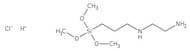
CAS :This Thermo Scientific Chemicals brand product was originally part of the Alfa Aesar product portfolio. Some documentation and label information may refer to the legacy brand. The original Alfa Aesar product / item code or SKU reference has not changed as a part of the brand transition to Thermo SciFormule :C8H23ClN2O3SiDegré de pureté :90%Couleur et forme :Clear, colorless, LiquidMasse moléculaire :258.823-(2-Aminoethylamino)propyltrimethoxysilane, 96%
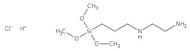
CAS :3-(2-Aminoethylamino) propyltrimethoxysilane acts as a silane coupling agent. It is useful for chemical research. It is also employed as an adhesives and sealant chemical. Further, it is used as a paint additive and coating additive. In addition to this, it plays an important role in the productionFormule :C8H23ClN2O3SiDegré de pureté :96%Couleur et forme :Clear colorless to yellow, LiquidMasse moléculaire :258.82[3-(2-Aminoethylamino)propyl]trimethoxysilane
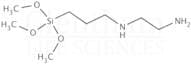
CAS :[3-(2-Aminoethylamino)propyl]trimethoxysilaneDegré de pureté :99%Masse moléculaire :222.36g/mol3-(2-Aminoethylamino)propyltrimethoxysilane
CAS :Formule :C8H22N2O3SiDegré de pureté :≥ 97.0%Couleur et forme :Clear, colourless liquidMasse moléculaire :222.363-(2-Aminoethylamino)propyltrimethoxysilane
CAS :Formule :C8H22N2O3SiDegré de pureté :>97.0%(GC)Couleur et forme :Colorless to Almost colorless clear liquidMasse moléculaire :222.363-(2-Aminoethyl)3-Aminopropyltrimethoxy silane
CAS :Formule :C8H22N2O3SiDegré de pureté :98%Couleur et forme :LiquidMasse moléculaire :222.36N-(2-AMINOETHYL)-3-AMINOPROPYLTRIMETHOXYSILANE, tech
CAS :Diamino Functional Trialkoxy Silane
Silane coupling agents have the ability to form a durable bond between organic and inorganic materials to generate desired heterogeneous environments or to incorporate the bulk properties of different phases into a uniform composite structure. The general formula has two classes of functionality. The hydrolyzable group forms stable condensation products with siliceous surfaces and other oxides such as those of aluminum, zirconium, tin, titanium, and nickel. The organofunctional group alters the wetting or adhesion characteristics of the substrate, utilizes the substrate to catalyze chemical transformations at the heterogeneous interface, orders the interfacial region, or modifies its partition characteristics, and significantly effects the covalent bond between organic and inorganic materials.
N-(2-Aminoethyl)-3-aminopropyltrimethoxysilane; N-[3-(Trimethoxysilyl)propyl]ethylenediamine; DAMO
For higher purity see SIA0591.1 Viscosity: 6.5 cStγc of treated surfaces: 36.5 mN/mSpecific wetting surface: 358 m2/gCoefficient of thermal expansion: 0.8x10⁻³Coupling agent for polyamides, polycarbonates (e.g. in CDs), polyesters and copper/brass adhesionFilm-forming coupling agent/primer, berglass size componentFor cyclic version: SID3543.0 For pre-hydrolyzed version: SIA0590.0 Used in the immobilization of copper (II) catalyst on silicaUsed together w/ SID3396.0 to anchor PdCl2 catalyst to silica for acceleration of the Tsuji-Trost reaction in the allylation of nucleophilesDetermined by TGA a 25% weight loss of dried hydrolysates at 390 °CAvailable as a cohydrolysate with n-propyltrimethoxysilane (SIP6918.0) ; see SIA0591.3Formule :C8H22N2O3SiDegré de pureté :techCouleur et forme :Straw LiquidMasse moléculaire :222.36N-(2-AMINOETHYL)-3-AMINOPROPYLTRIMETHOXYSILANE, 98%
CAS :N-(2-Aminoethyl)-3-aminopropyltrimethoxysilane, N-[3-(trimethoxysilyl)prpyl]ethylenediamine, DAMO
Diamino functional trialkoxy silaneViscosity: 6.5 cStγc of treated surfaces: 36.5 mN/mSpecific wetting surface: 358 m2/gCoefficient of thermal expansion: 0.8x10⁻³Coupling agent for polyamides, polycarbonates (e.g. in CDs), polyesters and copper/brass adhesionFilm-forming coupling agent/primer, berglass size componentFor cyclic version: SID3543.0 For pre-hydrolyzed version: SIA0590.0 Used in the immobilization of copper (II) catalyst on silicaUsed together w/ SID3396.0 to anchor PdCl2 catalyst to silica for acceleration of the Tsuji-Trost reaction in the allylation of nucleophilesDetermined by TGA a 25% weight loss of dried hydrolysates at 390 °C For technical grade see SIA0591.0 Shorter chain analog of SIA0595.0Available as a cohydrolysate with n-propyltrimethoxysilane (SIP6918.0) ; see SIA0591.3Formule :C8H22N2O3SiDegré de pureté :98%Couleur et forme :Straw LiquidMasse moléculaire :222.363-(2-Aminoethylamino)propyl]trimethoxysilane-15N2
CAS :Produit contrôléFormule :C8H2215N2O3SiCouleur et forme :NeatMasse moléculaire :224.3443-(2-Aminoethylamino)propyl]trimethoxysilane-15N
CAS :Produit contrôléFormule :C8H2215NNO3SiCouleur et forme :NeatMasse moléculaire :223.351N-(2-Aminoethyl)-3-(trimethoxysilyl)propylamine
CAS :N-(2-Aminoethyl)-3-(trimethoxysilyl)propylamine (NAP) is a cationic surfactant that is used as a fluorescent probe to study the binding of proteins to cell surface integrin receptors. The adsorption mechanism is based on the interaction between the hydrophobic parts of the protein and the hydrophobic parts of NAP. This interaction leads to an increase in the concentration of NAP at the interface and thus an increase in fluorescence. NAP has been shown to bind human serum albumin, fatty acids, and monoclonal antibodies with high affinity. It also has been shown to bind to plasma proteins through hydrogen bonding. The optimum concentration for NAP adsorption is 1mM.Formule :C8H22N2O3SiDegré de pureté :Min. 95%Masse moléculaire :222.36 g/mol

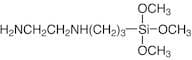
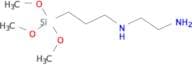
![[3-(2-Aminoethylamino)propyl]trimethoxysilane](/_next/image/?url=https%3A%2Fstatic.cymitquimica.com%2Fproducts%2F54%2Fthumb%2FOR1008869.jpg&w=3840&q=75)





![3-(2-Aminoethylamino)propyl]trimethoxysilane-15N2](/_next/image/?url=https%3A%2Fstatic.cymitquimica.com%2Fproducts%2FTR%2Fthumb%2FA609123.jpg&w=3840&q=75)

![3-(2-Aminoethylamino)propyl]trimethoxysilane-15N](/_next/image/?url=https%3A%2Fstatic.cymitquimica.com%2Fproducts%2FTR%2Fthumb%2FA609122.jpg&w=3840&q=75)