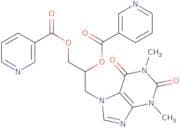
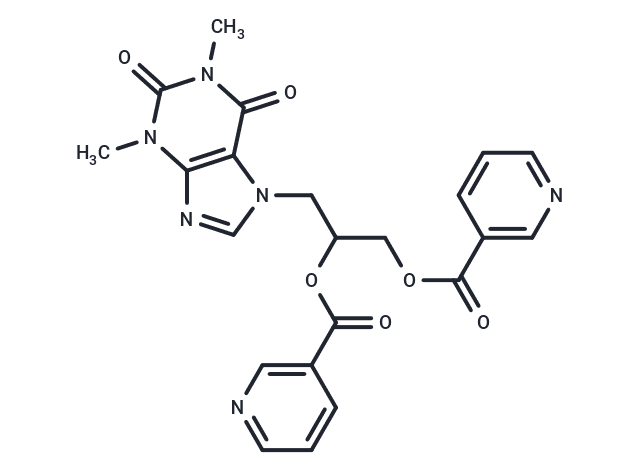
![1,1′-[1-[(1,2,3,6-Tetrahydro-1,3-dimethyl-2,6-dioxo-7H-purin-7-yl)methyl]-1,2-ethanediyl] di-3-pyr…](/_next/image/?url=https%3A%2Fstatic.cymitquimica.com%2Fcas-image%2Fthumb-webp%2F479126-11-1-1236-tetrahydro-13-dimethyl-26-dioxo-7h-purin-7-yl-methyl-12-ethanediyl-di-3-pyridinecarboxylate.webp&w=3840&q=75)
CAS 17692-30-7
:1,1′-[1-[(1,2,3,6-Tétrahydro-1,3-diméthyl-2,6-dioxo-7H-purine-7-yl)méthyl]-1,2-éthanediyl] di-3-pyridinecarboxylate
Description :
1,1′-[1-[(1,2,3,6-Tétrahydro-1,3-diméthyl-2,6-dioxo-7H-purine-7-yl)méthyl]-1,2-éthanediyl] di-3-pyridinecarboxylate, avec le numéro CAS 17692-30-7, est un composé organique complexe caractérisé par ses caractéristiques structurelles uniques, y compris un dérivé de purine et des moieties de pyridinecarboxylate. Cette substance présente des propriétés typiques des analogues de purine, telles qu'une activité biologique potentielle, qui peut inclure des interactions avec des structures d'acides nucléiques ou des enzymes. La présence de plusieurs groupes fonctionnels, y compris des groupes carboxylate et méthyle, suggère qu'elle peut participer à diverses réactions chimiques, y compris l'esterification et les substitutions nucléophiles. Sa solubilité et sa stabilité peuvent varier en fonction du solvant et des conditions environnementales, ce qui est crucial pour son application dans la recherche biochimique ou le développement pharmaceutique. De plus, la structure moléculaire du composé peut conférer des propriétés pharmacologiques spécifiques, ce qui le rend intéressant en chimie médicinale. Dans l'ensemble, ce composé représente un exemple significatif de l'interaction entre la chimie organique et l'activité biologique, justifiant une enquête plus approfondie sur ses utilisations potentielles.
Formule :C22H20N6O6
InChI :InChI=1S/C22H20N6O6/c1-26-18-17(19(29)27(2)22(26)32)28(13-25-18)11-16(34-21(31)15-6-4-8-24-10-15)12-33-20(30)14-5-3-7-23-9-14/h3-10,13,16H,11-12H2,1-2H3
Code InChI :InChIKey=ZMXGPGZXYJCCHZ-UHFFFAOYSA-N
SMILES :C(C(OC(=O)C=1C=CC=NC1)COC(=O)C=2C=CC=NC2)N3C4=C(N=C3)N(C)C(=O)N(C)C4=O
Synonymes :- (Dinicotinoyloxy-2,3-propyl)-7 theophylline
- (Dinicotinoyloxy-2,3-propyl)-7 theophylline [French]
- 1,1′-[1-[(1,2,3,6-Tetrahydro-1,3-dimethyl-2,6-dioxo-7H-purin-7-yl)methyl]-1,2-ethanediyl] di-3-pyridinecarboxylate
- 3-(1,3-dimethyl-2,6-dioxo-1,2,3,6-tetrahydro-7H-purin-7-yl)propane-1,2-diyl dipyridine-3-carboxylate
- 3-(7-Theophyllinyl)propylen dinicotinat
- 3-Pyridinecarboxylic acid, 1,1′-[1-[(1,2,3,6-tetrahydro-1,3-dimethyl-2,6-dioxo-7H-purin-7-yl)methyl]-1,2-ethanediyl] ester
- 3-Pyridinecarboxylic acid, 1-((1,2,3,6-tetrahydro-1,3-dimethyl-2,6-dioxo-7H-purin-7-yl)methyl)-1,2-ethanediyl ester
- 7-(2,3-Dihydroxypropyl)theophylline bis(nicotinate ester)
- 7-(2,3-Dinicotinoyloxypropyl)theophyllin
- A 17 Hf
- Corverum
- Diniprofilina
- Diniprofilina [INN-Spanish]
- Diniprofylline [INN:DCF]
- Diniprofyllinum
- Diniprofyllinum [INN-Latin]
- Nicotinic acid, diester with 7-(2,3-dihydroxypropyl)theophylline
- Nicotinic acid, diester with 7-(2,3-dihydroxypropyl)theophylline (8CI)
- Theophylline, 7-(2,3-dihydroxypropyl)-, dinicotinate (ester)
- Voir plus de synonymes
Trier par
Degré de pureté (%)
0
100
|
0
|
50
|
90
|
95
|
100
2 produits concernés.
Diniprofylline
CAS :Produit contrôléDiniprofylline is a drug that binds to adrenergic receptors and increases the levels of cAMP. It is used cosmetically to reduce the viscosity of oils and fatty acids, as well as in implanting because it can be reconstituted with distilled water. Diniprofylline has been shown to have positive effects on the heart by increasing heart rate, coronary blood flow, and myocardial contractility. It also reduces the chances of developing radiation-induced heart disease by suppressing radiation-induced constriction of coronary arteries. Diniprofylline has been shown to decrease inflammation by inhibiting the H2 receptor.Formule :C22H20N6O6Degré de pureté :Min. 95%Masse moléculaire :464.43 g/molDiniprofylline
CAS :Diniprofylline, a phosphodiesterase inhibitor, has been used as a peripheral nervous system agent, a bronchodilator agent, and an anti-asthamtic agent.Formule :C22H20N6O6Couleur et forme :SolidMasse moléculaire :464.43