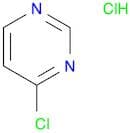
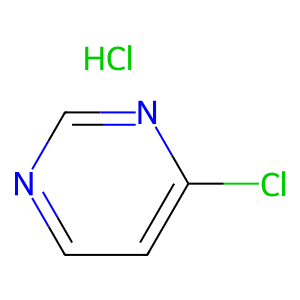
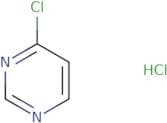
CAS 179051-78-6
:chlorhydrate de 4-chloropyrimidine
- 2-Chloropyrimidinehydrochloride
Pyrimidine, 4-chloro-, hydrochloride (1:1)
CAS :Formule :C4H4Cl2N2Degré de pureté :96%Couleur et forme :SolidMasse moléculaire :150.99404-Chloropyrimidine hydrochloride
CAS :4-Chloropyrimidine hydrochlorideFormule :C4H3ClN2·ClHDegré de pureté :95%Couleur et forme : yellow solidMasse moléculaire :150.99g/mol4-Chloropyrimidine hydrochloride
CAS :Formule :C4H4Cl2N2Degré de pureté :96%Couleur et forme :SolidMasse moléculaire :150.994-Chloropyrimidine HCl
CAS :4-Chloropyrimidine HCl is a covalent molecule that contains 4-chloropyridine and hydrogen chloride. It exists as two tautomers, the enol form and the keto form. The protonation of the proton on nitrogen will determine which tautomer it will exist in. When there is no proton present, the molecule will exist in its enol form. Resonance is also an important factor with this molecule because it can have a variety of resonance forms. Resonance spectrometry has been used to identify 4-chloropyrimidine HCl because it produces a specific resonance pattern when exposed to magnetic fields. 4-Chloropyridinium trifluoroacetate is another name for this compound that is formed when the chlorine atom bonds with trifluoroacetic acid. This chemical does not have any interactions with azide but can react with tetrazole to produce a stable compound, which can be easily
Formule :C4H3ClN2·HClDegré de pureté :Min. 95%Couleur et forme :PowderMasse moléculaire :150.99 g/mol