CAS 17912-87-7
:Myricitrine
Description :
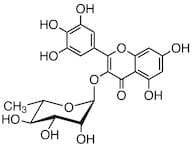
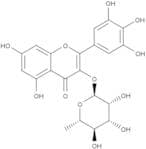
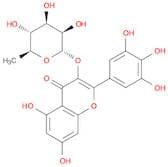
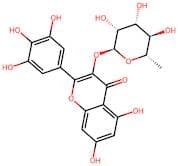
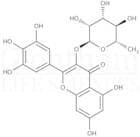
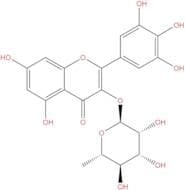
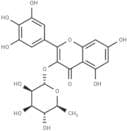
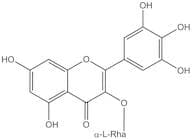
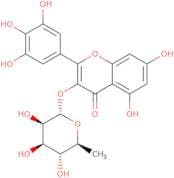
Myricitrine, avec le numéro CAS 17912-87-7, est un glycoside flavonoïde principalement trouvé dans diverses plantes, en particulier dans les espèces de Myrica. Il se caractérise par sa structure, qui consiste en un aglycone de myricétine lié à une portion de sucre rhamnose. Myricitrine présente plusieurs activités biologiques, y compris des propriétés antioxydantes, anti-inflammatoires et potentiellement antimicrobiennes, ce qui le rend intéressant pour la recherche pharmacologique. Le composé est généralement soluble dans des solvants polaires, reflétant sa nature glycosidique, et est souvent étudié pour ses bienfaits pour la santé, en particulier dans la médecine traditionnelle. De plus, Myricitrine a été étudié pour son rôle dans la protection des cellules contre le stress oxydatif et son potentiel à moduler diverses voies biochimiques. Sa présence dans les sources alimentaires suggère qu'il pourrait contribuer aux bienfaits pour la santé associés aux régimes à base de plantes. Dans l'ensemble, Myricitrine représente un composé significatif dans le domaine des produits naturels et de la phytochimie, avec des recherches en cours sur ses applications thérapeutiques.
Formule :C21H20O12
InChI :InChI=1/C21H20O12/c1-6-14(26)17(29)18(30)21(31-6)33-20-16(28)13-9(23)4-8(22)5-12(13)32-19(20)7-2-10(24)15(27)11(25)3-7/h2-6,14,17-18,21-27,29-30H,1H3
Code InChI :InChIKey=DCYOADKBABEMIQ-OWMUPTOHSA-N
SMILES :O(C1=C(OC=2C(C1=O)=C(O)C=C(O)C2)C3=CC(O)=C(O)C(O)=C3)[C@H]4[C@H](O)[C@H](O)[C@@H](O)[C@H](C)O4
Synonymes :- 17912-87-7
- 3,3′,4′,5,5′,7-Hexahydroxyflavone, 3-rhamnoside
- 3-O-Rhamnosylmyricetin
- 3-[(6-Deoxy-α-<span class="text-smallcaps">L</span>-mannopyranosyl)oxy]-5,7-dihydroxy-2-(3,4,5-trihydroxyphenyl)-4H-1-benzopyran-4-one
- 4H-1-Benzopyran-4-one, 3-[(6-deoxy-α-<span class="text-smallcaps">L</span>-mannopyranosyl)oxy]-5,7-dihydroxy-2-(3,4,5-trihydroxyphenyl)-
- 4H-1-benzopyran-4-one, 3-[(6-deoxy-alpha-L-mannopyranosyl)oxy]-5,7-dihydroxy-2-(3,4,5-trihydroxyphenyl)-
- 5,7-Dihydroxy-3-{[(2S,3R,4R,5R,6S)-3,4,5-trihydroxy-6-methyltetrahydro-2H-pyran-2-yl]oxy}-2-(3,4,5-trihydroxyphenyl)-4H-chromen-4-on
- 5,7-Dihydroxy-3-{[(2S,3R,4R,5R,6S)-3,4,5-trihydroxy-6-methyltetrahydro-2H-pyran-2-yl]oxy}-2-(3,4,5-trihydroxyphenyl)-4H-chromen-4-one
- 5,7-Dihydroxy-4-oxo-2-(3,4,5-trihydroxyphenyl)-4H-chromen-3-yl 6-deoxy-a-L-mannopyranoside
- 5,7-Dihydroxy-4-oxo-2-(3,4,5-trihydroxyphenyl)-4H-chromen-3-yl 6-deoxy-alpha-L-mannopyranoside
- 5,7-dihydroxy-4-oxo-2-(3,4,5-trihydroxyphenyl)-4H-chromen-3-yl 6-deoxyhexopyranoside
- 6-Désoxy-alpha-L-mannopyranoside de 5,7-dihydroxy-4-oxo-2-(3,4,5-trihydroxyphényl)-4H-chromén-3-yle
- Myricetin 3-O-rhamnopyranoside
- Myricetin 3-O-rhamnoside
- Myricetin 3-O-α-<span class="text-smallcaps">L</span>-rhamnopyranoside
- Myricetin 3-O-α-<span class="text-smallcaps">L</span>-rhamnoside
- Myricetin 3-O-α-<span class="text-smallcaps">L</span>-rhamnpyronoside
- Myricetin 3-O-α-rhamnopyranoside
- Myricetin 3-rhamnoside
- Myricetin-3-O-α-rhamnoside
- Myricetin-3-O-β-rhamnopyranoside
- Myricitrin
- Myricitrine
- Myricitroside
- NSC 19803
- 4H-1-Benzopyran-4-one, 3-[(6-deoxy-α-L-mannopyranosyl)oxy]-5,7-dihydroxy-2-(3,4,5-trihydroxyphenyl)-
- 3-[(6-Deoxy-α-L-mannopyranosyl)oxy]-5,7-dihydroxy-2-(3,4,5-trihydroxyphenyl)-4H-1-benzopyran-4-one
- MYRICITRIN WITH HPLC
- MIRICITRIN
- 3-[(6-Deoxy-alpha-L-Mannopyranosyloxy)]-5,7-dihydroxy-2-(3,4,5-trihydroxyphenyl)-4H-chroMen-4-one
- CANNABISCITRIN
- 3,3′,4′,5,5′,7-Hexahydroxyflavone 3-O-rhamnoside
- Myricetin 3-O-α-L-rhamnopyranoside
- mannopyranosyl)oxy]-5,7-dihydroxy-2-(3,4,5-trihydroxyphenyl)-
- MYRICITRIN HPLC 98+%
- YRICITRIN
- Myricitrin(Myricitrine)
- MYRICITRIN(MYRICETIN-3-O-RHAMNOSIDE)(SH)
- 5,7-dihydroxy-3-((2s,3r,4r,5r,6s)-3,4,5-trihydroxy-6-methyl-tetrahydro-pyran-2-yloxy)-2-(3,4,5-trihydroxy-phenyl)-1-benzopyran-4-one
- 3-[(6-deoxy-alpha-L-mannopyranosyl)oxy]-5,7-dihydroxy-2-(3,4,5-trihydroxyphenyl)-4H-benzopyran-4-one
- Myricitrin, froM Myrica rubra
- Myricetin 3-α-L-rhamnopyranoside
- MYRICETIN-3-O-RHAVINOSIDE
- 5,7-Dihydroxy-3-((2S,3R,4R,5R,6S)-3,4,5-trihydroxy-6-methyl-tetrahydro-pyran-2-yloxy)-2-(3,4,5-trihydroxy-phenyl)-1-benzopyran-4-one
- 3',4',5,5',7-Pentahydroxy-3-(α-L-rhamnopyranosyloxy)flavone
- 4H-1-Benzopyran-4-one,3-[(6-deoxy-α-L-
- 3-[(6-deoxy-α-L-mannopyranosyl)oxy]-5,7-dihydroxy-2-(3,4,5-trihydroxyphenyl)-4H-benzopyran-4-one
- Myricetrin
- Voir plus de synonymes
Trier par
Degré de pureté (%)
0
100
|
0
|
50
|
90
|
95
|
100
10 produits concernés.
Myricitrin
CAS :Formule :C21H20O12Degré de pureté :>98.0%(HPLC)Couleur et forme :Light yellow to Yellow to Orange powder to crystalMasse moléculaire :464.38Myricitrin
CAS :Myricitrin analytical standard provided with w/w absolute assay, to be used for quantitative titration.Formule :C21H20O12Degré de pureté :(HPLC) ≥99%Couleur et forme :PowderMasse moléculaire :464.38Myricitrin
CAS :Formule :C21H20O12Degré de pureté :95%Couleur et forme :SolidMasse moléculaire :464.3763Myricitrin
CAS :Formule :C21H20O12Degré de pureté :(HPLC) ≥ 98.0%Couleur et forme :White to light yellow powderMasse moléculaire :464.38Myricetrin
CAS :Myricitrin exhibits hepatoprotective, anti-inflammatory,antioxidant, anti-allergic, antinociception, anxiolytic-like, and antipsychotic-like effects. Myricitrin can be used as a drug candidate for the treatment of cardiovascular diseases, by effectively protecting cells from ox-LDL-induced endothelial cell apoptosis and reducing atherosclerotic plaque formation. Myricitrin is also a nitric oxide (NO) and protein kinase C (PKC) inhibitor that has central nervous system activity.Formule :C21H20O12Degré de pureté :95%~99%Masse moléculaire :464.379Myricitrin
CAS :Myricitrin (Myricitrine), a flavonoid compound isolated from the root bark of Myrica cerifera, exerts antinociceptive effects.Formule :C21H20O12Degré de pureté :99.72%Couleur et forme :Light Yellow To Off-White Crystalline PowderMasse moléculaire :464.38Myricitrin
CAS :Natural glycosideFormule :C21H20O12Degré de pureté :≥ 95.0 % (HPLC)Couleur et forme :PowderMasse moléculaire :464.38Myricitrin
CAS :Myricitrin is a natural compound that is found in the bark of the Myrica tree. It has been shown to have antioxidant effects and pro-apoptotic activities. Myricitrin has been shown to induce apoptosis in HL-60 cells through activation of the caspase-3 pathway, which includes cleavage of poly (ADP-ribose) polymerase and activation of caspases. In addition, myricitrin induces apoptosis by binding to DNA and inhibiting transcription. The physiological effects of myricetin are similar to those of myricitrin due to their structural similarity. However, there is no data available on the anti-inflammatory properties or hypoglycemic effect of myricetin.Formule :C21H20O12Degré de pureté :Min. 95%Couleur et forme :White PowderMasse moléculaire :464.38 g/mol