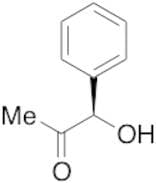
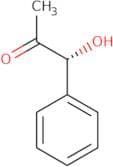
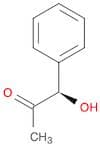
CAS 1798-60-3
:(R)-Phénylacétylcarbinol
Description :
(R)-Phénylacétylcarbinol, avec le numéro CAS 1798-60-3, est un composé organique caractérisé par sa structure chirale, qui présente un groupe phényle attaché à un carbone portant à la fois un groupe hydroxyle et un groupe acétyle. Ce composé est un liquide incolore à jaune pâle à température ambiante et est connu pour son agréable arôme floral, ce qui le rend utile dans l'industrie des parfums. Il est soluble dans des solvants organiques tels que l'éthanol et l'éther, mais a une solubilité limitée dans l'eau. Le composé est significatif dans la synthèse organique et est souvent utilisé comme intermédiaire dans la production de divers produits pharmaceutiques et produits chimiques fins. Sa chiralité permet la production de substances enantiomériquement pures, ce qui est crucial dans le développement de médicaments avec des activités biologiques spécifiques. De plus, (R)-Phénylacétylcarbinol peut subir diverses réactions chimiques, y compris l'oxydation et l'estérification, élargissant encore son utilité en chimie organique synthétique. Les données de sécurité indiquent qu'il doit être manipulé avec précaution, comme de nombreux composés organiques, en raison de ses propriétés irritantes potentielles.
Formule :C9H10O2
InChI :InChI=1S/C9H10O2/c1-7(10)9(11)8-5-3-2-4-6-8/h2-6,9,11H,1H3/t9-/m0/s1
Code InChI :InChIKey=ZBFFNPODXBJBPW-VIFPVBQESA-N
SMILES :[C@@H](C(C)=O)(O)C1=CC=CC=C1
Synonymes :- (-)-(1R)-1-Hydroxy-1-phenyl-2-propanone
- (1R)-1-Phenyl-1-hydroxypropan-2-one
- (1R)-1-hydroxy-1-phenylpropan-2-one
- (R)-1-Hydroxy-1-phenyl-2-propanone
- (R)-1-Hydroxy-1-phenylpropanone
- (R)-Hydroxy-1-Phenyl-2-propanedione
- (R)-Phenylacetylcarbinol
- 1-Hydroxy-1-Phenylpropan-2-One
- 2-Propanone, 1-hydroxy-1-phenyl-, (1R)-
- 2-Propanone, 1-hydroxy-1-phenyl-, (R)-
- <span class="text-smallcaps">D</span>-(-)-1-Hydroxy-1-phenylpropanone
- <span class="text-smallcaps">D</span>-(-)-1-Phenyl-1-hydroxy-2-propanone
- <span class="text-smallcaps">D</span>-(-)-Phenylacetylcarbinol
- l-Phenylacetylcarbinol
- D-(-)-1-Hydroxy-1-phenylpropanone
- Voir plus de synonymes
Trier par
Degré de pureté (%)
0
100
|
0
|
50
|
90
|
95
|
100
5 produits concernés.
Ephedrine Hydrochloride EP Impurity A
CAS :Produit contrôléFormule :C9H10O2Couleur et forme :Pale Yellow LiquidMasse moléculaire :150.18(R)-1-Hydroxy-1-phenylpropanone
CAS :Produit contrôléApplications (R)-1-Hydroxy-1-phenylpropanone is used as a reagent in the preparation of chiral (amino)alkanol derivatives and determination of their activity as antibacterial agents and antifungal agents. It is also an intermediate used in the synthesis of Pseudoephedrine and Ephedrine.
References Chennakesava, R. K., et al.: Bioorg. Med. Chem. Lett., 24, 3057 (2014); Baxter, E., et al.: Org. Reactions, 59 (2002); Astrova, M., et al.: Res. on Chem. Intermediates, 33, 663 (2007)Formule :C9H10O2Couleur et forme :Light YellowMasse moléculaire :150.17Ephedrine Hydrochloride EP Impurity A
CAS :Produit contrôléEphedrine Hydrochloride EP Impurity A is a product of the biotransformations of pseudoephedrine. It has been shown that this impurity can be formed in enzymatic reactions where pseudoephedrine is acted upon by β-unsaturated ketones or by filamentous fungi. Ephedrine Hydrochloride EP Impurity A is a chiral compound, which means that it has two different forms that are non-superimposable mirror images of each other. The enantiomers (left and right) are the individual molecules that make up the racemic mixture. In some cases, ephedrine hydrochloride ep impurity a may be present as a result of a reaction between pseudoephedrine and an enzyme preparation containing β-unsaturated ketones, such as acetone peroxide or benzoyl peroxide. This impurity has been shown to inhibit candida glabrata and to have kinetic properties similar to that of ephedFormule :C9H10O2Degré de pureté :Min. 96 Area-%Couleur et forme :Clear Viscous LiquidMasse moléculaire :150.17 g/mol2-Propanone, 1-hydroxy-1-phenyl-, (1R)-
CAS :Produit contrôléFormule :C9H10O2Couleur et forme :LiquidMasse moléculaire :150.1745