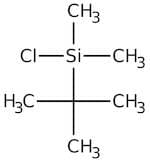
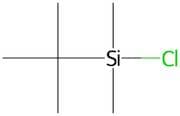
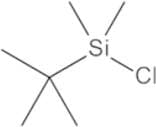
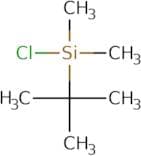
CAS 18162-48-6
:chlorure de tert-butyldiméthylsilyle
- (1,1-Dimethylethyl)dimethylsilyl chloride
- 2-(Chlorodimethylsilyl)-2-methylpropane
- 2-[4-(TertButyldimethylsilanyloxy)phenyl] chloride
- Chloro(1,1-dimethylethyl)dimethylsilane
- Chloro-tert-butyldimethylsilane
- Chlorodimethyl-tert-butylsilane
- Dimethyl(1,1-dimethylethyl)chlorosilane
- Dimethyl-tert-butylchlorosilane
- Dimethyl-tert-butylsilyl chloride
- Ls 1190
- Silane, T-Butyl-Dimethylchloro-
- Silane, chloro-tert-butyldimethyl-
- T-Butyldimethylchlorosilane
- TBDMS chloride
- TBDMS-Cl
- TBSCl
- Terc-Butilclorodimetilsilano
- Tert-Butyldimethylchlorosilane
- tert-Butyl(dimethyl)silane chloride
- tert-Butylchlordimethylsilan
- tert-Butylchlorodimethylsilane
- tert-Butyldimethylsilyl chloride
- (1-chloro-2-methylpropan-2-yl)(dimethyl)silane
- Silane, chloro(1,1-dimethylethyl)dimethyl-
- Tert-Butyl Dimethyl Silyl Chloride
- TBDMSCL
- Tertiary butyldimethylchlorosilane
- Tert-butyl-dimethyl chlorosilance
- Tert-Butyl Dimethylchlorosilane
- Voir plus de synonymes
tert-Butyldimethylchlorosilane [tert-Butyldimethylsilylating Agent]
CAS :Formule :C6H15ClSiDegré de pureté :>98.0%(GC)Couleur et forme :White to Almost white powder to crystalMasse moléculaire :150.72tert-Butyldimethylchlorosilane, 50% w/w in toluene
CAS :This Thermo Scientific Chemicals brand product was originally part of the Alfa Aesar product portfolio. Some documentation and label information may refer to the legacy brand. The original Alfa Aesar product / item code or SKU reference has not changed as a part of the brand transition to Thermo Sci
Formule :C6H15ClSiCouleur et forme :Clear colorless, LiquidMasse moléculaire :150.72tert-Butyldimethylchlorosilane, 97%
CAS :tert-Butyldimethylchlorosilane is used to protect hydroxyl group in organic synthesis. It finds application in the synthesis of prostaglandin. It is also used as an auxiliary material for hypolipaemics such as lovastatin and simvastatin. It plays an important role in the preparation of isoxazolinesFormule :C6H15ClSiDegré de pureté :97%Couleur et forme :Colorless to white, Crystals or powder or crystalline powder or lumps or fused solidMasse moléculaire :150.72tert-Butyldimethylsilyl chloride
CAS :tert-Butyldimethylsilyl chlorideFormule :C6H15ClSiDegré de pureté :≥95%Couleur et forme : white crystalsMasse moléculaire :150.72179g/moltert-Butyldimethylchlorosilane
CAS :Formule :C6H15ClSiDegré de pureté :≥ 99.0%Couleur et forme :White crystalsMasse moléculaire :150.73tert-Butyldimethylchlorosilane
CAS :S03300 - tert-Butyldimethylchlorosilane
Formule :C6H15ClSiDegré de pureté :98%Couleur et forme :SolidMasse moléculaire :150.72tert-Butyldimethylsilyl chloride, 50% solution in toluene
CAS :tert-Butyldimethylsilyl chloride, 50% solution in tolueneDegré de pureté :≥95%Couleur et forme :Colourless LiquidMasse moléculaire :150.72g/moltert-Butyldimethylsilyl Chloride
CAS :Applications Used to protect alcohols during organic synthesis.
References Shen, H., et al.: J. Med. Chem., 53, 2666 (2010), Qiang, L., et al.: Bioorg. Med. Chem. Lett., 20, 836 (2010),Formule :C6H15ClSiCouleur et forme :White SolidMasse moléculaire :150.72tert-Butyldimethylsilyl chloride
CAS :Tert-butyldimethylsilyl chloride is a silicon-containing compound that is used to prepare the tert-butyl group, which is an important part of many organic compounds. Tert-butyldimethylsilyl chloride reacts with trifluoroacetic acid to form hydrogen bonds. It can also react with hydrochloric acid to form a tert-butyl chloride, which is soluble in water and hydrolyzes in human serum. Tert-butyldimethylsilyl chloride has been used for the synthesis of carbohydrates and fatty acids. It has been used as a sample preparation agent for gas chromatography mass spectrometry and high performance liquid chromatography. The reaction solution can be prepared by reacting tert-butyldimethylsilyl chloride with an alcohol or carboxylic acid in the presence of base at low temperature. Tert-butyldimethylsilyl chloride can be synthesized by reactingFormule :C6H15ClSiDegré de pureté :Min. 95 Area-%Couleur et forme :Colorless PowderMasse moléculaire :150.73 g/molt-BUTYLDIMETHYLCHLOROSILANE
CAS :Trialkylsilyl Blocking Agent
Used as a protecting group for reactive hydrogens in alcohols, amines, thiols, and carboxylic acids. Organosilanes are hydrogen-like, can be introduced in high yield, and can be removed under selective conditions. They are stable over a wide range of reaction conditions and can be removed in the presence of other functional groups, including other protecting groups. The tolerance of silylated alcohols to chemical transformations summary is presented in Table 1 of the Silicon-Based Blocking Agents brochure.
Alkyl Silane - Conventional Surface Bonding
Aliphatic, fluorinated aliphatic or substituted aromatic hydrocarbon substituents are the hydrophobic entities which enable silanes to induce surface hydrophobicity. The organic substitution of the silane must be non-polar. The hydrophobic effect of the organic substitution can be related to the free energy of transfer of hydrocarbon molecules from an aqueous phase to a homogeneous hydrocarbon phase. A successful hydrophobic coating must eliminate or mitigate hydrogen bonding and shield polar surfaces from interaction with water by creating a non-polar interphase. Although silane and silicone derived coatings are in general the most hydrophobic, they maintain a high degree of permeability to water vapor. This allows coatings to breathe and reduce deterioration at the coating interface associated with entrapped water. Since ions are not transported through non-polar silane and silicone coatings, they offer protection to composite structures ranging from pigmented coatings to rebar reinforced concrete. A selection guide for hydrophobic silanes can be found on pages 22-31 of the Hydrophobicity, Hydrophilicity and Silane Surface Modification brochure.
tert-Butyldimethylchlorosilane; TBS-Cl; Chlorodimethyl-t-butylsilane; tert-Butylchlorodimethylsilane; Chloro(1,1-dimethylethyl)dimethylsilane
Excellent for 1° and 2° alcoholsSilylation catalyzed by imidazoleBlocking agent widely used in prostaglandin synthesisStable to many reagentsCan be selectively cleaved in presence of acetate, THP and benzyl ethers among othersUsed for the protection of alcohols, amines, thiols, lactams, and carboxylic acidsClean NMR characteristics of protecting groupSilylation reagent - derivatives resistant to Grignards, alkyl lithium compounds, etcFacile removal with flouride ion sourcesSummary of selective deprotection conditions is provided in Table 7 through Table 20 of the Silicon-Based Blocking Agents brochureFormule :C6H15ClSiDegré de pureté :97%Couleur et forme :Translucent SolidMasse moléculaire :150.72t-Butyldimethylchlorosilane, min. 97%
CAS :t-Butyldimethylchlorosilane, min. 97%
Formule :(CH3)3CSi(CH3)2ClDegré de pureté :min. 97%Couleur et forme :white pwdr.Masse moléculaire :150.70tert-Butyldimethylchlorosilane
CAS :Formule :C6H15ClSiDegré de pureté :95%Couleur et forme :SolidMasse moléculaire :150.7218Ref: IN-DA0035NH
Produit arrêtétert-Butyldimethylsilyl Chloride (TBDMS.Cl) extrapure, 98%
CAS :Formule :C6H15ClSiDegré de pureté :min. 98%Couleur et forme :White, Hygroscopic compound, Clear, ColourlessMasse moléculaire :150.73
![tert-Butyldimethylchlorosilane [tert-Butyldimethylsilylating Agent]](/_next/image/?url=https%3A%2Fstatic.cymitquimica.com%2Fproducts%2F3B%2Fthumb%2FB0995.jpg&w=3840&q=75)