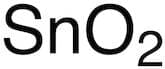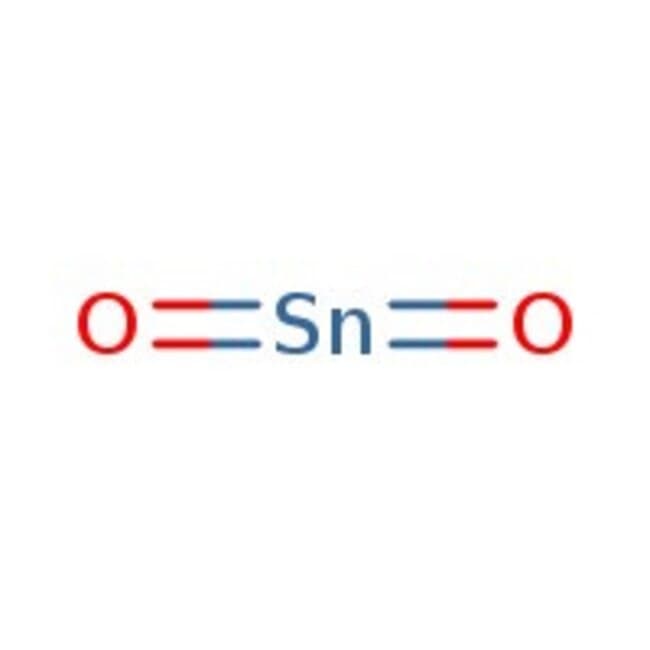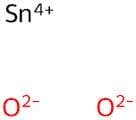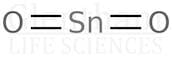
CAS 18282-10-5
:Oxyde d'étain (SnO2)
- At-Snno 200N
- Cp 004
- Cxf 303Ip
- Dioxido De Estano
- Dioxyde d'etain
- Eps 12
- Eps 12A
- Eps 8
- His 30Mh
- Hx 405Mh
- Nalco SN 20
- Nanotek SN
- Nanotek SnO2
- Nanotek SnO<sub>2</sub>
- Nanotek Tin Oxide
- Nyacol SN 15
- Nyacol SN 15CG
- Ov-Sn
- P 3001
- QF-Ti 1125P
- S 1
- S 1 (tin compound)
- S 1S
- S 2000
- S 2000 (oxide)
- S 3976
- S 8
- S 8 (oxide)
- SAM 05 (catalyst)
- SH (oxide)
- SH-S (oxide)
- SN 38 (oxide)
- Sam 05
- Sh-S
- Sn 38
- SnO<sub>2</sub>
- Stannic anhydride
- Stannic dioxide
- Stannic oxide
- Stannic oxide (SnO2)
- Stannic oxide (SnO<sub>2</sub>)
- Suncolloid HX 305M5
- Suncolloid HX 405MH
- T 10
- T 10 (oxide)
- T 1186
- Tego RL
- Tin (Iv) Oxide
- Tin Dioxide
- Tin dioxide (SnO2)
- Tin dioxide (SnO<sub>2</sub>)
- Tin oxide
- Tin oxide (SnO<sub>2</sub>)
- Zinn(Iv)-Oxid
- Zinndioxid
- Tin oxide (SnO2)
- C.I. 77861
- TinoxidePURATREMmeshoffwhitepowder
- Tinoxidewhitepowder
- Voir plus de synonymes
Tin(IV) Oxide
CAS :Formule :SnO2Degré de pureté :>99.5%Couleur et forme :White to Almost white powder to crystalMasse moléculaire :150.71Tin(IV) oxide, Puratronic™, 99.996% (metals basis)
CAS :Tin(IV) oxide is used as a pigment in the ceramic industry and as a polishing powder. It finds use in sensors of combustible gases. It is also used as a catalyst along with vanadium oxide for the oxidation of aromatic compounds to prepare carboxylic acids and acid anhydrides. It is used in sensorsFormule :O2SnDegré de pureté :99.996%Masse moléculaire :150.71Tin(IV) oxide, 99.9% (metals basis)
CAS :It is employed in the manufacture of white enamels and for polishing glass. It has a broad range of applications in many areas such as semiconductors, photovoltaic materials, solar cells, lithium ion batteries, photocatalysts, and as gas-sensing agents in solid-state detectors. This Thermo ScientifFormule :O2SnDegré de pureté :99.9%Masse moléculaire :150.71Tin(IV) oxide (99.998%-Sn) PURATREM
CAS :Tin(IV) oxide (99.998%-Sn) PURATREM
Formule :SnO2Degré de pureté :(99.998%-Sn)Couleur et forme :-22 mesh off-white pwdr.Masse moléculaire :150.69Tin(IV) oxide (99.9%-Sn)
CAS :Tin(IV) oxide (99.9%-Sn)
Formule :SnO2Degré de pureté :(99.9%-Sn)Couleur et forme :white pwdr.Masse moléculaire :150.69Tin(IV) oxide
CAS :Formule :O2SnDegré de pureté :99%Couleur et forme :SolidMasse moléculaire :150.6998Tin(IV) oxide, 99.0%
CAS :Formule :SnO2Degré de pureté :≥ 99.0%Couleur et forme :Yellow to yellow-green powder or chunksMasse moléculaire :150.69Tin(IV) oxide Nanopowder, 99.5%
CAS :Formule :SnO2Degré de pureté :≥ 99.5%Couleur et forme :White to off-white or light-grey powderMasse moléculaire :150.69Tin(IV) oxide
CAS :Tin(IV) oxideFormule :·2O·SnDegré de pureté :99.90%Couleur et forme :White To Off White PowderMasse moléculaire :150.71g/molTin(IV) oxide Nanopowder, 99.9 %
CAS :Formule :SnO2Degré de pureté :≥ 99.9%Couleur et forme :White to off-white or light-grey powderMasse moléculaire :150.69Tin(IV) oxide, 99.999%
CAS :Formule :SnO2Degré de pureté :≥ 99.999%Couleur et forme :White to off-white or light-grey powder or crystalline powderMasse moléculaire :150.69Tin(IV) oxide, nanoparticle (30-60 nm), (99.7%-Sn)
CAS :Tin(IV) oxide, nanoparticle (30-60 nm), (99.7%-Sn)
Formule :SnO2Degré de pureté :(99.7%-Sn)Couleur et forme :white pwdr.Masse moléculaire :150.69Stannic Oxide Nanopowder, 60nm, 99.5%
CAS :Formule :SnO2Degré de pureté :min. 99.5%Couleur et forme :Pale grey brown, PowderMasse moléculaire :134.71Tin(IV) oxide
CAS :Tin(IV) oxide is a chemical compound that can be used in the treatment of cancer. It is a white powder with a low melting point and is soluble in water, alcohols, and ethers. Tin(IV) oxide has been used as an additive to microscopy techniques to improve contrast. The compound has also been shown to have anticancer properties by inhibiting the growth of cancer cells. Tin(IV) oxide blocks the formation of chalcones, which are products that are formed when reactions between hydrochloric acid and aluminium take place at high temperatures. This blockage prevents the formation of hydrogen gas, thereby preventing cell death due to dehydration or exposure to infrared radiation from heat sources such as microwaves or lasers. Tin(IV) oxide also has been used in infrared spectroscopy for its ability to produce a characteristic absorption band at 3690 cm-1 and as an alternative material for the production of semiconductors when producing thin films.
Formule :SnO2Degré de pureté :95%NmrCouleur et forme :Off-White To Grey SolidMasse moléculaire :150.71 g/molRef: 3D-FT33030
Produit arrêté