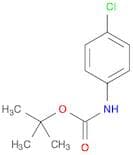
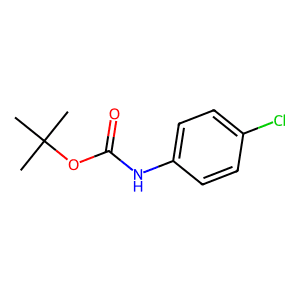
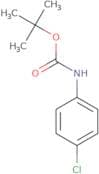
CAS 18437-66-6
:Acide carbamique, N-(4-chlorophényl)-, ester 1,1-diméthyléthyle
- (4-Chlorophenyl)carbamic acid tert-butyl ester
- 1,1-Dimethylethyl N-(4-chlorophenyl)carbamate
- Carbamic acid, (4-chlorophenyl)-, 1,1-dimethylethyl ester
- Carbamic acid, N-(4-chlorophenyl)-, 1,1-dimethylethyl ester
- Carbanilic acid, p-chloro-, tert-butyl ester
- N-BOC-4-Chloroaniline
- N-tert-Butoxycarbonyl-4-chloroaniline
- Tert-Butyl (4-Chlorophenyl)Carbamate
- p-Chloro-N-tert-butoxycarbonylaniline
- tert-Butyl 4-chlorophenylcarbamate
- tert-Butyl N-(4-chlorophenyl)carbamate
- tert-Butyl N-(p-chlorophenyl)carbamate
- 4-CHLORO-(N-BOC)ANILINE 97
- 4-Chlorophenylcarbamic acid tert-butyl ester
- 1-(tert-Butoxycarbonylamino)-4-chlorobenzene
- N-(4-Chlorophenyl)carbamic acid tert-butyl ester
- ert-butylN-(4-chlorophenyl)carbamate
- 4-Chloro-NHBoc-aniline
- N-(tert-Butyloxycarbonyl)-4-chloroaniline
- Voir plus de synonymes
N-Boc-4-chloroaniline
CAS :Formule :C11H14ClNO2Degré de pureté :98%Couleur et forme :SolidMasse moléculaire :227.6874Tert-Butyl (4-Chlorophenyl)Carbamate
CAS :Tert-Butyl (4-Chlorophenyl)CarbamateDegré de pureté :98%Masse moléculaire :227.69g/moltert-Butyl N-(4-chlorophenyl)carbamate
CAS :Formule :C11H14ClNO2Degré de pureté :97%Couleur et forme :SolidMasse moléculaire :227.694-Chloro-(N-Boc)aniline
CAS :4-Chloro-(N-Boc)aniline is an organic molecule that is used in the synthesis of quinazolinones. It is a nucleophile that reacts efficiently with amines to form substituted anilines. This reaction can be performed in one step, and the product can be used as a starting material for other reactions. The reaction time is short, and this reagent can be reused up to three times without significant loss of reactivity. 4-Chloro-(N-Boc)aniline was developed as a more efficient method for generating quinazolinones than the traditional method using 2-chloroaniline or 2,4-dichlorobenzoyl chloride. This functional group allows for the synthesis of many different types of molecules, such as immunosuppressants, antihistamines, anticonvulsants, and antibiotics.
Formule :C11H14ClNO2Degré de pureté :Min. 95%Masse moléculaire :227.69 g/mol