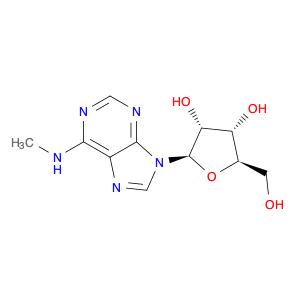
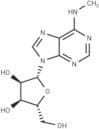
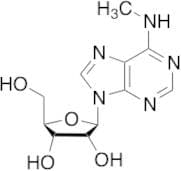
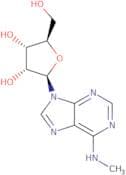
CAS 1867-73-8
:N6-Méthyladénosine
- (2R,3S,4R,5R)-2-(hydroxymethyl)-5-(6-methylaminopurin-9-yl)oxolane-3,4-diol
- 2-(Hydroxymethyl)-5-(6-methylaminopurin-9-yl)oxolane-3,4-diol
- 6-Methyladenosine
- 6-Methylamino-9-β-<span class="text-smallcaps">D</span>-ribofuranosylpurine
- 6-Methylaminopurine <span class="text-smallcaps">D</span>-riboside
- 6-Methylaminopurine ribonucleoside
- 6-Methylaminopurine riboside
- 9-β-<span class="text-smallcaps">D</span>-Ribofuranosyl-N<sup>6</sup>-methylaminopurine
- Adenosine, N-methyl-
- N-Methyladenosine
- N-methyl-9-alpha-L-ribofuranosyl-9H-purin-6-amine
- N-methyl-9-pentofuranosyl-9H-purin-6-amine
- N<sup>6</sup>-Methyladenosine
- NSC 29409
- Voir plus de synonymes
6-Methylamino-9-β-D-ribofuranosylpurine
CAS :Formule :C11H15N5O4Degré de pureté :95%Couleur et forme :SolidMasse moléculaire :281.2679(2R,3S,4R,5R)-2-(Hydroxymethyl)-5-(6-(Methylamino)-9H-Purin-9-Yl)Tetrahydrofuran-3,4-Diol
CAS :(2R,3S,4R,5R)-2-(Hydroxymethyl)-5-(6-(Methylamino)-9H-Purin-9-Yl)Tetrahydrofuran-3,4-DiolDegré de pureté :97%Masse moléculaire :281.27g/mol(2R,3S,4R,5R)-2-(Hydroxymethyl)-5-(6-(methylamino)-9H-purin-9-yl)tetrahydrofuran-3,4-diol
CAS :Degré de pureté :95.0%Couleur et forme :SolidMasse moléculaire :281.2720031738281N6-methyladenosine
CAS :N6-methyladenosine (NSC-29409), a methylated adenine residue, is an endogenous urinary nucleoside product of the degradation of transfer ribonucleic acid (tRNA)Formule :C11H15N5O4Degré de pureté :97.43% - 99.66%Couleur et forme :SolidMasse moléculaire :281.27N6-Methyladenosine
CAS :Produit contrôléApplications N6-Methyladenosine is the most common internal modification of eukaryotic mRNA. The result of this modification is specifically recognized mRNA in the cytoplasm which regulates mRNA stability.N6-Methyladenosine is made when a protein complex containin the writer enzyme METTL3 adds a methyl group to adenosine. Two different eraser enzymes ALKBH5 and FTO can remove a methyl group to turn m6A bach into adenosine.
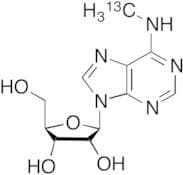
References Miura, G. et al.: Nat. Chem. Biol., 11, 903 (2015); Deng, X. et al.: Nucl. Acids Res., 43, 6557 (2015); Chem. and Eng. News, p.35, Feb. 18, 2019Formule :C11H15N5O4Couleur et forme :Off-WhiteMasse moléculaire :281.27N6-Methyladenosine-13C
CAS :Produit contrôléFormule :C1013CH15N5O4Couleur et forme :Off-WhiteMasse moléculaire :286.26N6-Methyladenosine
CAS :N6-methyladenosine (m6A) is a modified form of adenosine that contains a methyl group at the N6 position and has a high importance in epigenetics. Among other nucleoside modifications found in mRNA, N6-methyladenosine is the most common and abundant in eukaryotes, and is related to some cancers and viral infections (Huafei, 2020). Moreover, N6-methyladenoside has been reported to regulate RNA abundance in the SARS-CoV-2 infection (Zhang, 2021)
Formule :C11H15N5O4Degré de pureté :Min. 98.0 Area-%Couleur et forme :White PowderMasse moléculaire :281.27 g/mol