CAS 18684-24-7
:Prolylhydroxyproline
Description :
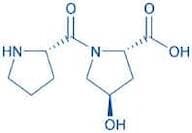
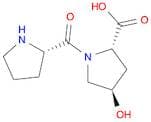
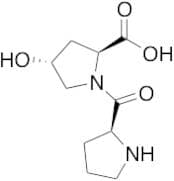
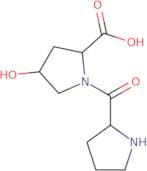
Prolylhydroxyproline, avec le numéro CAS 18684-24-7, est un dérivé d'acide aminé qui se produit naturellement et est une forme modifiée de proline. Il se caractérise par la présence d'un groupe hydroxyle attaché à la structure de la proline, ce qui améliore sa solubilité et sa réactivité. Ce composé se trouve souvent dans le collagène et est significatif dans le contexte de la synthèse et de la stabilité des protéines, en particulier dans les tissus conjonctifs. Prolylhydroxyproline joue un rôle dans la stabilisation des hélices triples de collagène, contribuant à l'intégrité structurelle de divers tissus. Il est également étudié pour ses applications thérapeutiques potentielles, y compris ses effets sur la cicatrisation des plaies et la réparation des tissus. En termes de propriétés physiques, Prolylhydroxyproline est typiquement un solide cristallin blanc, soluble dans l'eau, et présente une plage de point de fusion spécifique. Ses propriétés biochimiques en font un sujet d'intérêt tant dans la recherche nutritionnelle que pharmaceutique, en particulier dans le développement de suppléments visant à améliorer la santé de la peau et la fonction articulaire.
Formule :C10H16N2O4
InChI :InChI=1S/C10H16N2O4/c13-6-4-8(10(15)16)12(5-6)9(14)7-2-1-3-11-7/h6-8,11,13H,1-5H2,(H,15,16)/t6-,7+,8+/m1/s1
Code InChI :InChIKey=ONPXCLZMBSJLSP-CSMHCCOUSA-N
SMILES :C(=O)(N1[C@H](C(O)=O)C[C@@H](O)C1)[C@@H]2CCCN2
Synonymes :- (2E)-non-2-enal
- <span class="text-smallcaps">L</smallcap>-Proline, 4-hydroxy-1-<smallcap>L</span>-prolyl-, trans-
- <span class="text-smallcaps">L</smallcap>-Proline, <smallcap>L</span>-prolyl-4-hydroxy-, (4R)-
- <span class="text-smallcaps">L</smallcap>-Prolyl-<smallcap>L</span>-hydroxyproline
- G 3025
- H-Pro-Hyp-OH
- Proline, 4-hydroxy-1-<span class="text-smallcaps">L</smallcap>-prolyl-, <smallcap>L</span>-
- Proline, 4-hydroxy-1-<span class="text-smallcaps">L</span>-prolyl-
- Prolylhydroxyproline
- L-Proline, 4-hydroxy-1-L-prolyl-, trans-
- L-Proline, L-prolyl-4-hydroxy-, (4R)-
- Proline, 4-hydroxy-1-L-prolyl-, L-
- Voir plus de synonymes
Trier par
Degré de pureté (%)
0
100
|
0
|
50
|
90
|
95
|
100
6 produits concernés.
H-Pro-Hyp-OH
CAS :According to Shigemura et al. Pro-Hyp, a food-derived collagen peptide in human blood, stimulates the growth of fibroblasts from mouse skin. Nakatani et al. observed a chondroprotective effect of the dipeptide in mouse articular cartilage. Inoue et al. showed in a clinical study that ingestion of the dipeptides Pro-Hyp and Hyp-Gly could improve facial skin moisture and elasticity and reduce facial ageing.Formule :C10H16N2O4Degré de pureté :> 98%Couleur et forme :WhiteMasse moléculaire :228.25H-Pro-Hyp-OH
CAS :Formule :C10H16N2O4Degré de pureté :98%Couleur et forme :SolidMasse moléculaire :228.2450Pro-Hyp-OH
CAS :Pro-Hyp-OH is a model system of the human collagen prolyl hydroxylase. It is a glycoprotein that converts the inactive pro-collagen to the active collagen. Pro-Hyp-OH has been shown to have anti-inflammatory effects and may be used as a potential treatment for skin disorders. This product has also been found to increase the rate of transport of glycopeptides across 3T3-L1 preadipocytes, which may be due to its ability to bind to collagen. The structural analysis of Pro-Hyp-OH has revealed that it is composed of two domains, one with an alpha helical structure and another in beta sheet form. This product is also used in the diagnosis of collagen diseases such as osteogenesis imperfecta, Ehlers Danlos syndrome type IV, and dermatosparaxis.
Formule :C10H16N2O4Degré de pureté :(%) Min. 90%Couleur et forme :White PowderMasse moléculaire :228.25 g/mol(2S,4R)-1-(L-prolyl)-4-hydroxypyrrolidine-2-carboxylic acid
CAS :Degré de pureté :95%Masse moléculaire :228.2480011