CAS 188174-64-3
:palmitoyl coenzyme A (C16:0) lithium
Description :
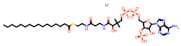
palmitoyl coenzyme A (C16:0) lithium, avec le numéro CAS 188174-64-3, est un dérivé de l'acide palmitique, un acide gras saturé. Ce composé présente une longue chaîne d'hydrocarbures (16 atomes de carbone) et est impliqué dans divers processus biochimiques, en particulier dans le métabolisme lipidique et la signalisation cellulaire. En tant que dérivé de la coenzyme A, il joue un rôle crucial dans la synthèse et la dégradation des acides gras, ainsi que dans la formation de dérivés d'acyl-CoA, qui sont essentiels pour la production d'énergie et les voies biosynthétiques. La forme de sel de lithium peut améliorer la solubilité et la stabilité dans certaines applications. Le palmitoyl CoA est également significatif dans la modification des protéines par palmitoylation, impactant la localisation et la fonction membranaire. Ses caractéristiques incluent d'être une molécule hydrophobe en raison de sa longue chaîne carbonée, et elle existe généralement dans un complexe avec d'autres biomolécules dans les systèmes biologiques. Dans l'ensemble, palmitoyl coenzyme A (C16:0) lithium est un composé important en biochimie, en particulier dans les études liées au métabolisme et aux fonctions cellulaires.
Formule :C37H65LiN7O17P3S
InChI :InChI=1/C37H66N7O17P3S.2Li/c1-4-5-6-7-8-9-10-11-12-13-14-15-16-17-28(46)65-21-20-39-27(45)18-19-40-35(49)32(48)37(2,3)23-58-64(55,56)61-63(53,54)57-22-26-31(60-62(50,51)52)30(47)36(59-26)44-25-43-29-33(38)41-24-42-34(29)44;;/h24-26,30-32,36,47-48H,4-23H2,1-3H3,(H,39,45)(H,40,49)(H,53,54)(H,55,56)(H2,38,41,42)(H2,50,51,52);;/q;2*+1/p-2/t26-,30-,31-,32+,36-;;/m1../s1
Synonymes :- Palmitoyl coenzyme A lithium salt
- adenosine, 5'-O-[hydroxy[[hydroxy[[(3R)-3-hydroxy-2,2-dimethyl-4-oxo-4-[[3-oxo-3-[[2-[(1-oxohexadecyl)thio]ethyl]amino]propyl]amino]butyl]oxy]phosphinyl]oxy]phosphinyl]-, 3'-(dihydrogen phosphate), dilithium salt
- HEXADECANOYL COENZYME A LITHIUM SALT
- palmitoyl coenzyme A (C16:0) lithium
- n-hexadecanoyl coenzyme a
- Palmitoyl coenzyme A lithium salt,n-Hexadecanoyl CoenzymeA, Hexadecanoyl coenzymeA
- PALMITOYL COENZYME A C16:0 LITHIUM SALT
- n-Hexadecanoyl CoenzymeA, Hexadecanoyl coenzyme A
- coenzyme A palmitoyl derivative (C16:0), lithium salt
- N-HEXADECANOYL COENZYME A LITHIUM SALT
- Palmitoyl coenzyme A lithium salt >=90%
- Voir plus de synonymes
Trier par
Degré de pureté (%)
0
100
|
0
|
50
|
90
|
95
|
100
6 produits concernés.
N-HEXADECANOYL COENZYME A LITHIUM SALT
CAS :Formule :C37H66LiN7O17P3SDegré de pureté :90%Masse moléculaire :1012.8839Palmitoyl Coenzyme A, Lithium salt
CAS :Palmitoyl Coenzyme A, Lithium saltDegré de pureté :≥ 95%Masse moléculaire :1005.95g/molPalmitoyl CoA lithium
CAS :Palmitoyl CoA lithium (Palmitoyl coenzyme A lithium) is a major constituent of fatty acids and is used to study metabolic disorders in the body.Formule :C37H65N7O17P3S·xLiDegré de pureté :90%Couleur et forme :SolidMasse moléculaire :1023.74Palmitoyl coenzyme A lithium
CAS :Palmitoyl coenzyme A lithium (PCAL) is a synthetic molecule that mimics the properties of palmitoyl-coenzyme A. It is synthesized by attaching a lithium ion to the carboxyl group of palmitoyl-coenzyme A. PCAL has been shown to be effective in protecting against cardiac damage in rats and neonatal mice, as well as preventing whole-body fatty acid accumulation. PCAL also has antiviral effects against certain viruses, such as cytomegalovirus and herpes simplex virus type 1. PCAL may work by binding to the fatty acid synthase enzyme and blocking its activity, which would lead to a decrease in long chain polyunsaturated fatty acids.Formule :C37H66N7O17P3S•LixDegré de pureté :90%Couleur et forme :PowderMasse moléculaire :1,011.9 g/mol