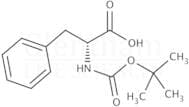
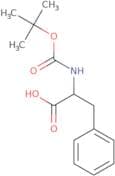
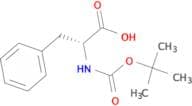
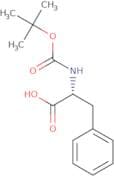
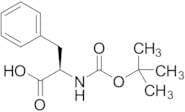
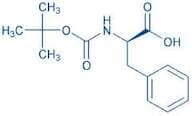
CAS 18942-49-9
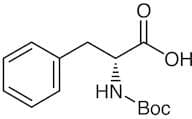
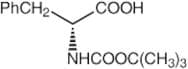
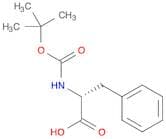
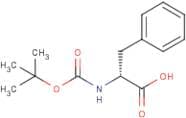
:N-tert-butoxycarbonyle-D-phénylalanine
Description :
N-tert-butoxycarbonyle-D-phénylalanine, communément appelé Boc-D-phénylalanine, est un dérivé d'acide aminé caractérisé par la présence d'un groupe protecteur tert-butyloxycarbonyle (Boc) attaché au groupe amino de D-phénylalanine. Ce composé est généralement utilisé dans la synthèse peptidique comme un groupe protecteur qui facilite la modification sélective des acides aminés sans interférer avec d'autres groupes fonctionnels. C'est un solide blanc à blanc cassé qui est soluble dans des solvants organiques tels que le dichlorométhane et le diméthylformamide, mais généralement insoluble dans l'eau. Le groupe Boc est connu pour sa stabilité dans des conditions basiques et peut être facilement éliminé dans des conditions acides, ce qui en fait un outil précieux en synthèse organique. La présence du groupe phényle contribue aux caractéristiques hydrophobes du composé, influençant ses interactions dans les systèmes biologiques. En tant que molécule chirale, elle existe sous deux formes énantiomériques, la forme D étant utilisée dans diverses applications biochimiques. Dans l'ensemble, la Boc-D-phénylalanine est significative dans le domaine de la chimie médicinale et de la recherche sur les peptides.
Formule :C14H19NO4
InChI :InChI=1S/C14H19NO4/c1-14(2,3)19-13(18)15-11(12(16)17)9-10-7-5-4-6-8-10/h4-8,11H,9H2,1-3H3,(H,15,18)(H,16,17)/t11-/m1/s1
Code InChI :InChIKey=ZYJPUMXJBDHSIF-LLVKDONJSA-N
SMILES :[C@H](CC1=CC=CC=C1)(NC(OC(C)(C)C)=O)C(O)=O
Synonymes :- (2R)-2-(tert-Butoxycarbonylamino)-3-phenylpropanoic acid
- (2R)-2-[(2-Methylpropan-2-yl)oxycarbonylamino]-3-phenylpropanoic acid
- (2R)-2-[(tert-Butoxycarbonyl)amino]-3-phenylpropionic acid
- (2R)-2-[(tert-butoxycarbonyl)amino]-3-phenylpropanoate
- (2R)-2-[[(tert-Butoxy)carbonyl]amino]-3-phenylpropanoic acid
- (R)-2-((tert-Butoxycarbonyl)amino)-3-phenylpropionic acid
- (R)-2-(tert-Butoxycarbonylamino)-3-phenylpropanoic acid
- (R)-N-(tert-Butoxycarbonyl)phenylalanine
- <span class="text-smallcaps">D</span>-Phenylalanine, N-[(1,1-dimethylethoxy)carbonyl]-
- Alanine, N-carboxy-3-phenyl-, N-tert-butyl ester, <span class="text-smallcaps">D</span>-
- BOC-<span class="text-smallcaps">D</span>-phenylalanine
- Boc-D-Phe-OH
- N-(tert-Butoxycarbonyl)-D-phenylalanine
- N-BOC-<span class="text-smallcaps">D</span>-phenylalanine
- N-Boc-D-phenylalanine
- N-[(1,1-Dimethylethoxy)carbonyl]-<span class="text-smallcaps">D</span>-phenylalanine
- N-tert-Butoxycarbonyl-<span class="text-smallcaps">D</span>-phenylalanine
- N-tert-Butyloxycarbonyl-<span class="text-smallcaps">D</span>-phenylalanine
- tert-Butoxycarbonyl-<span class="text-smallcaps">D</span>-phenylalanine
- tert-Butyloxycarbonyl-<span class="text-smallcaps">D</span>-phenylalanine
- tert-Butoxycarbonyl-D-phenylalanine
- Alanine, N-carboxy-3-phenyl-, N-tert-butyl ester, D-
- D-Phenylalanine, N-[(1,1-dimethylethoxy)carbonyl]-
- Voir plus de synonymes
Trier par
Degré de pureté (%)
0
100
|
0
|
50
|
90
|
95
|
100
13 produits concernés.
N-(tert-Butoxycarbonyl)-D-phenylalanine
CAS :Formule :C14H19NO4Degré de pureté :>98.0%(T)Couleur et forme :White to Almost white powder to crystalMasse moléculaire :265.31N-Boc-D-phenylalanine, 98%
CAS :This Thermo Scientific Chemicals brand product was originally part of the Alfa Aesar product portfolio. Some documentation and label information may refer to the legacy brand. The original Alfa Aesar product / item code or SKU reference has not changed as a part of the brand transition to Thermo SciFormule :C14H19NO4Degré de pureté :98%Couleur et forme :Crystals or powder or crystalline powder, WhiteMasse moléculaire :265.31Boc-D-Phe-OH
CAS :Formule :C14H19NO4Degré de pureté :98%Couleur et forme :SolidMasse moléculaire :265.3050Ref: IN-DA003OGR
5kgÀ demander5g19,00€1g20,00€10g24,00€25g24,00€100g61,00€250g109,00€500g184,00€1kg269,00€Boc-D-phenylalanine
CAS :Boc-D-phenylalanineFormule :C14H19NO4Degré de pureté :98%Couleur et forme : white to off-white powderMasse moléculaire :265.30g/molBoc-D-Phe-OH
CAS :Boc-D-Phe-OH is an antimicrobial peptide that is a small molecule with a molecular weight of 254.8. It has been shown to have anti-tumor activity, and can be used as an alternative to conventional chemotherapeutic drugs in the treatment of cancer. Boc-D-Phe-OH binds to the hydrophobic region on the surface of cells and disrupts the cell's membrane, causing cell death by apoptosis. This peptide also shows antibacterial activity against gramicidin S, which is a Gram-positive antibiotic that belongs to the polymyxins class. The antibacterial activity of this peptide may be due to its ability to bind to divalent cations such as calcium ions and magnesium ions. Boc-D-Phe-OH has been synthesized using a method that is both efficient and rapid (less than 12 hours). It has also been shown that this peptide does not show anyFormule :C14H19NO4Degré de pureté :Min. 95%Masse moléculaire :265.3 g/molBoc-D-Phe-OH
CAS :M03311 - Boc-D-Phe-OH
Formule :C14H19NO4Degré de pureté :98%Couleur et forme :Solid, Crystalline Powder or PowderMasse moléculaire :265.309N-Boc-D-phenylalanine
CAS :D-Phenylalanine is a molecule that is used in the synthesis of peptidomimetics. It has been shown to have a high efficiency method in the synthesis of N-Boc-D-phenylalanine, which can be used as a glycosidic bond precursor. This chemical has been shown to have anti-tumor properties and it may be useful in binding experiments with ferrocene. The compound can also form hydrogen bonds with acids, such as the acid catalyst found in the digestive system.Formule :C14H19NO4Degré de pureté :Min. 95%Couleur et forme :PowderMasse moléculaire :265.31 g/molBOC-D-Phenylalanine extrapure, 99%
CAS :Formule :C14H19NO4Degré de pureté :min. 99%Couleur et forme :White, PowderMasse moléculaire :265.30Boc-D-Phenylalanine
CAS :Produit contrôléApplications Boc-D-Phenylalanine is used in the synthesis of benzo[de][1,7]napthyridinones as PARP1 inhibitors. Also it is an important reagent in the preparation of proline-containing, β-turn mimetic cycle tetrapeptides.
References Ye, Na. et al.: J. Med. Chem., 56, 2885 (2013); Chouhan, G. et al.: Org. Lett., 15, 1206 (2013);Formule :C14H19NO4Couleur et forme :NeatMasse moléculaire :265.3Boc-D-Phe-OH
CAS :Bachem ID: 4000781.
Formule :C14H19NO4Degré de pureté :> 99%Couleur et forme :WhiteMasse moléculaire :265.31