CAS 191171-55-8
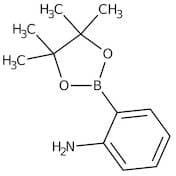
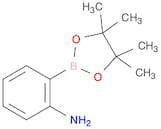
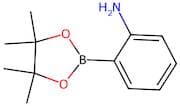
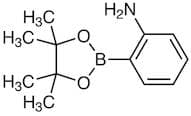
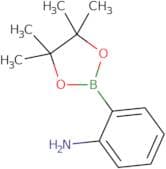
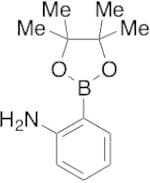
:2-(4,4,5,5-Tétraméthyl-1,3,2-dioxaborolan-2-yl)aniline
Description :
2-(4,4,5,5-Tétraméthyl-1,3,2-dioxaborolan-2-yl)aniline, avec le numéro CAS 191171-55-8, est un composé organique caractérisé par la présence d'un groupe aniline et d'une partie de dioxaborolane contenant du bore. Ce composé présente généralement une apparence solide allant du blanc au blanc cassé et est soluble dans des solvants organiques tels que le dichlorométhane et le tétrahydrofurane. La structure de dioxaborolane contribue à sa réactivité, en particulier dans les réactions de couplage croisé, ce qui le rend précieux en chimie organique synthétique, notamment dans la formation de liaisons carbone-carbone. La présence des substituants tétraméthyles améliore sa stabilité et sa solubilité, tandis que la partie aniline offre un potentiel pour une fonctionnalisation supplémentaire. De plus, ce composé peut présenter des propriétés électroniques intéressantes en raison de la conjugaison entre l'aniline et le groupe contenant du bore, ce qui peut influencer son comportement dans divers environnements chimiques. Dans l'ensemble, 2-(4,4,5,5-Tétraméthyl-1,3,2-dioxaborolan-2-yl)aniline est un élément de construction polyvalent dans la synthèse de molécules organiques complexes.
Formule :C12H18BNO2
InChI :InChI=1S/C12H18BNO2/c1-11(2)12(3,4)16-13(15-11)9-7-5-6-8-10(9)14/h5-8H,14H2,1-4H3
Code InChI :InChIKey=ZCJRWQDZPIIYLM-UHFFFAOYSA-N
SMILES :NC1=C(B2OC(C)(C)C(C)(C)O2)C=CC=C1
Synonymes :- 2-(2-Aminophenyl)-4,4,5,5-tetramethyl-1,3,2-dioxaborolane
- 2-(4,4,5,5-Tetramethyl-1,3,2-dioxaborolan-2-yl)aniline
- 2-(4,4,5,5-Tetramethyl-1,3,2-dioxaborolan-2-yl)benzenamine
- 2-(4,4,5,5-Tetramethyl-1,3,2-dioxaborolan-2-yl)phenylamine
- 2-(Tetramethyl-1,3,2-dioxaborolan-2-yl)aniline
- 2-Aminobenzeneboronic acid pinacol cyclic ester
- 2-Aminophenylboronic acid pinacol cyclic ester
- 2-Aminophenylboronic acid pinacol ester
- Benzenamine, 2-(4,4,5,5-tetramethyl-1,3,2-dioxaborolan-2-yl)-
- 2-Aminophenyl boronic acid pinacol ester
Trier par
Degré de pureté (%)
0
100
|
0
|
50
|
90
|
95
|
100
9 produits concernés.
2-Aminobenzeneboronic acid pinacol ester, 97%
CAS :This Thermo Scientific Chemicals brand product was originally part of the Alfa Aesar product portfolio. Some documentation and label information may refer to the legacy brand. The original Alfa Aesar product / item code or SKU reference has not changed as a part of the brand transition to Thermo SciFormule :C12H18BNO2Degré de pureté :97%Couleur et forme :White to cream to brown, Crystalline powderMasse moléculaire :219.09Benzenamine, 2-(4,4,5,5-tetramethyl-1,3,2-dioxaborolan-2-yl)-
CAS :Formule :C12H18BNO2Degré de pureté :97%Couleur et forme :SolidMasse moléculaire :219.08782-(Aminophenyl)boronic acid, pinacol ester
CAS :2-(Aminophenyl)boronic acid, pinacol esterFormule :C12H18BNO2Degré de pureté :98%Couleur et forme : off white solidMasse moléculaire :219.09g/mol2-(4,4,5,5-Tetramethyl-1,3,2-dioxaborolan-2-yl)aniline
CAS :Formule :C12H18BNO2Degré de pureté :>98.0%(GC)Couleur et forme :White to Yellow to Orange powder to crystalMasse moléculaire :219.092-Aminophenylboronic acid pinacol cyclic ester
CAS :This compound is a drug target that is an organic molecule found in many pharmaceuticals. It is an acidic, ammonium persulfate-sensitive biomolecule, which can be introduced into cells and tissues to study their function. This compound has been shown to have cancer-fighting abilities, and has potent inhibitory activity against microbial infections. The compound also has suzuki coupling properties, which are used to introduce hemicyanine groups onto other molecules.Formule :C12H18BNO2Degré de pureté :Min. 95%Couleur et forme :White PowderMasse moléculaire :219.09 g/mol2-(4,4,5,5-Tetramethyl-1,3,2-dioxaborolan-2-yl)aniline
CAS :Formule :C12H18BNO2Degré de pureté :97%Couleur et forme :SolidMasse moléculaire :219.092-Aminobenzeneboronic acid pinacol ester
CAS :Produit contrôléApplications 2-Aminobenzeneboronic acid pinacol ester is a reagent used to synthesize regiospecific quinolines. It can also be used to synthesize (±)-Epimeloscine and (±)-Meloscine.
References Zhang, H., et al.: J. Am. Chem. Soc. 133, 10376 (2011); Horn, J., et al.: Org. Lett 10, 4117 (2008)Formule :C12H20BNO3Couleur et forme :NeatMasse moléculaire :237.103